Liu Guihua, Rong Hua, Zhang Ping, Xue Yu, Du Bei, Wang Biying, Hu Jiamei, Chen Zhi, Wei Ruihua
Tianjin Key Laboratory of Retinal Functions and Diseases, Tianjin Branch of National Clinical Research Center for Ocular Disease, Eye Institute and School of Optometry, Tianjin Medical University Eye Hospital, Tianjin, China.
NHC Key Laboratory of Myopia, Eye Institute and Department of Ophthalmology, Eye and ENT Hospital, Fudan University, Shanghai, China.
Front Bioeng Biotechnol. 2021 Dec 2;9:777239. doi: 10.3389/fbioe.2021.777239. eCollection 2021.
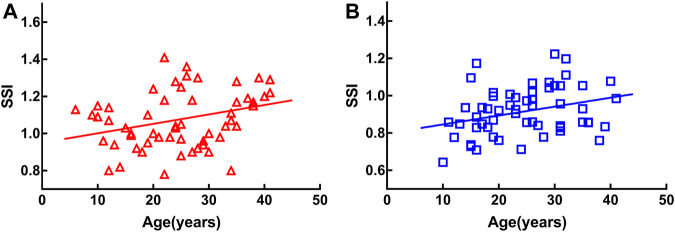
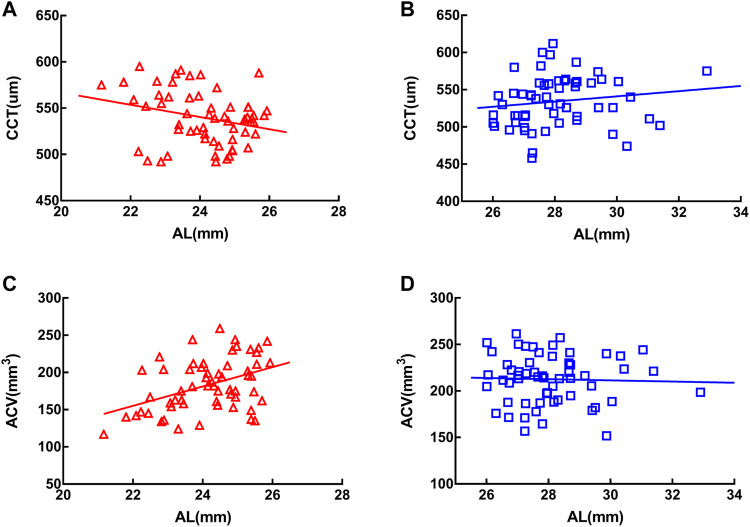
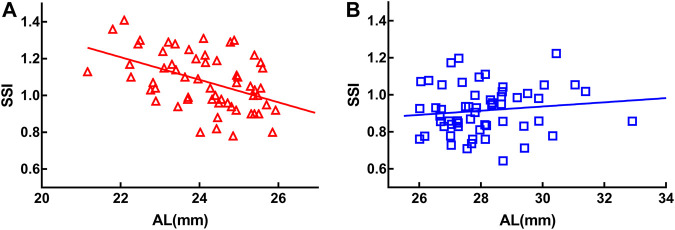
To investigate the correlation between the corneal biomechanical parameter stress-strain index (SSI) and axial length (AL) in moderately elongated eye (MEE) and severely elongated eye (SEE). This study included 117 eyes from 117 participants. Among them, 59 (50.4%) had MEE (AL<26 mm) and 58 (49.6%) had SEE (AL≥26 mm). AL was measured using Lenstar LS-900, and central corneal thickness (CCT) and anterior chamber volume (ACV) were measured using Pentacam. SSI was measured corneal visualisation Scheimpflug technology (Corvis ST). Kolmogorov-Smirnov test, Student's -test, and Pearson and partial correlation analyses were used for statistical analyses. The mean (±SD) SSI was 1.08 ± 0.15 in the MEE group and 0.92 ± 0.13 in the SEE group ( < 0.01). SSI was positively correlated with age (MEE: = 0.326, < 0.05; SEE: = 0.298, < 0.05) in both groups; it was negatively correlated with AL ( = -0.476, < 0.001) in the MEE group but not in the SEE group ( > 0.05). CCT was negatively correlated with AL ( = -0.289, < 0.05) and ACV positively correlated with AL ( = 0.444, < 0.001) in the MEE group. Neither CCT nor ACV was correlated with AL ( > 0.05) in the SEE group. Corneal biomechanical parameter SSI, which represents the stiffness of corneal tissue, was lower in the SEE group than in the MEE group. When analyzed separately, SSI was negatively correlated with AL in the MEE group, but not in the SEE group, which may provide insight into different ocular growth patterns between lower myopia and higher myopia.
探讨中度眼轴延长眼(MEE)和重度眼轴延长眼(SEE)中角膜生物力学参数应力应变指数(SSI)与眼轴长度(AL)之间的相关性。本研究纳入了117名参与者的117只眼睛。其中,59只(50.4%)为MEE(眼轴长度<26mm),58只(49.6%)为SEE(眼轴长度≥26mm)。使用Lenstar LS-900测量眼轴长度,使用Pentacam测量中央角膜厚度(CCT)和前房容积(ACV)。使用角膜可视化Scheimpflug技术(Corvis ST)测量SSI。采用Kolmogorov-Smirnov检验、Student's检验以及Pearson和偏相关分析进行统计学分析。MEE组的平均(±标准差)SSI为1.08±0.15,SEE组为0.92±0.13(P<0.01)。两组中SSI均与年龄呈正相关(MEE组:r = 0.326,P<0.05;SEE组:r = 0.298,P<0.05);MEE组中SSI与眼轴长度呈负相关(r = -0.476,P<0.001),而SEE组中无相关性(P>0.05)。MEE组中CCT与眼轴长度呈负相关(r = -0.289,P<0.05),ACV与眼轴长度呈正相关(r = 0.444,P<0.001)。SEE组中CCT和ACV与眼轴长度均无相关性(P>0.05)。代表角膜组织硬度的角膜生物力学参数SSI在SEE组低于MEE组。单独分析时,MEE组中SSI与眼轴长度呈负相关,而SEE组中无此相关性,这可能有助于深入了解低度近视和高度近视之间不同的眼部生长模式。