Lian Chunfeng, Wang Fan, Deng Hannah H, Wang Li, Xiao Deqiang, Kuang Tianshu, Lin Hung-Ying, Gateno Jaime, Shen Steve G F, Yap Pew-Thian, Xia James J, Shen Dinggang
Department of Radiology and BRIC, University of North Carolina at Chapel Hill, Chapel Hill, NC, USA.
Department of Oral and Maxillofacial Surgery, Houston Methodist Hospital, Houston, TX, USA.
Med Image Comput Comput Assist Interv. 2020 Oct;12264:807-816. doi: 10.1007/978-3-030-59719-1_78. Epub 2020 Sep 29.
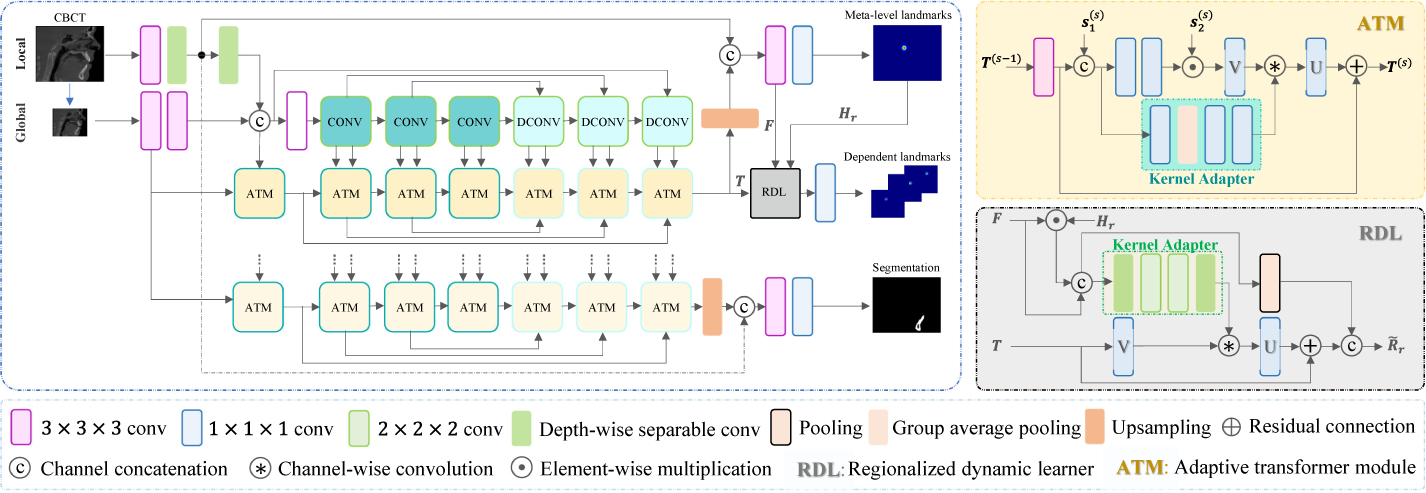
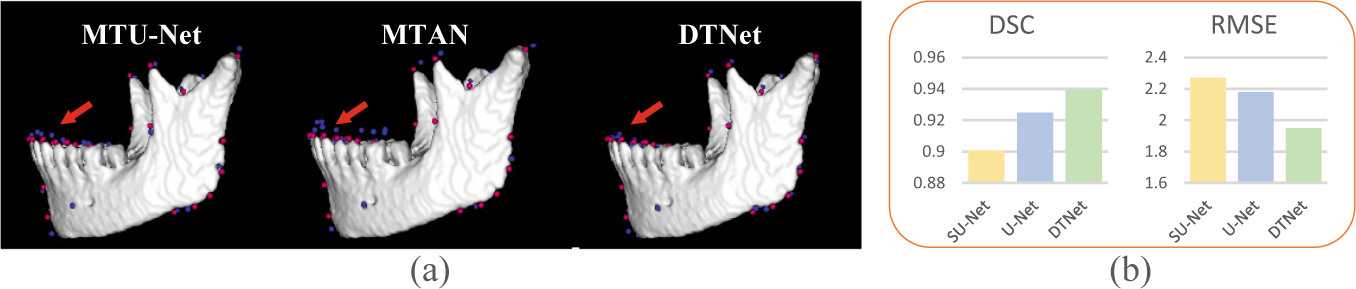
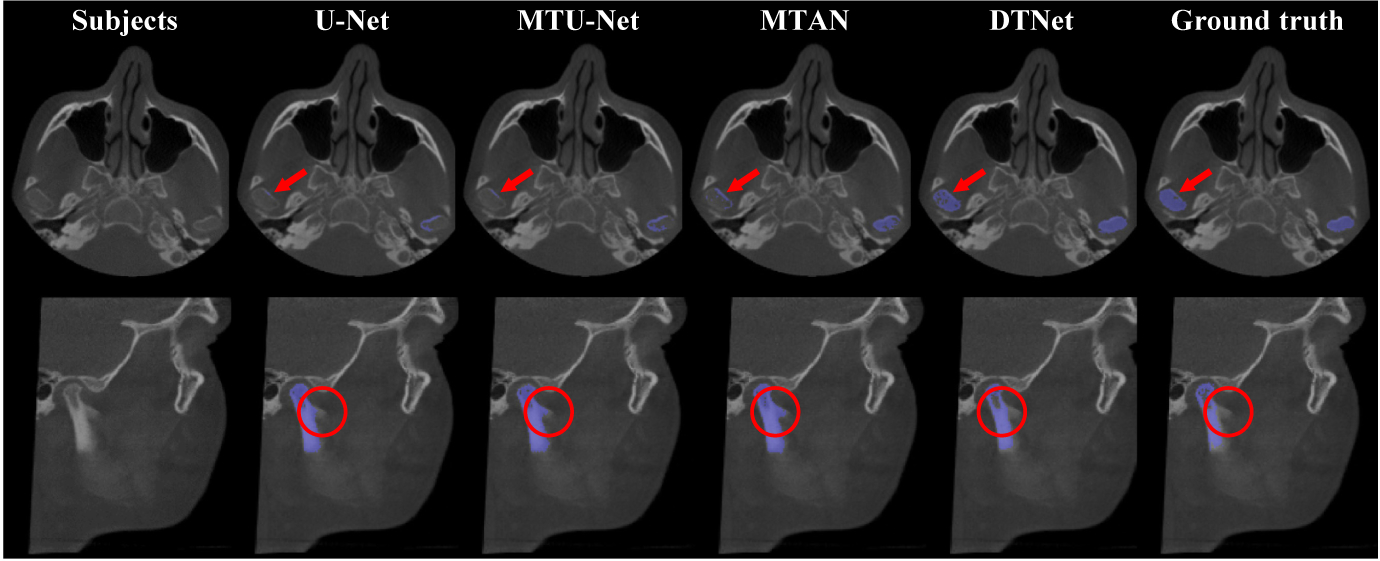
Accurate bone segmentation and anatomical landmark localization are essential tasks in computer-aided surgical simulation for patients with craniomaxillofacial (CMF) deformities. To leverage the complementarity between the two tasks, we propose an efficient end-to-end deep network, i.e., multi-task dynamic transformer network (DTNet), to concurrently segment CMF bones and localize large-scale landmarks in one-pass from large volumes of cone-beam computed tomography (CBCT) data. Our DTNet was evaluated quantitatively using CBCTs of patients with CMF deformities. The results demonstrated that our method outperforms the other state-of-the-art methods in both tasks of the bony segmentation and the landmark digitization. Our DTNet features three main technical contributions. , a collaborative two-branch architecture is designed to efficiently capture both fine-grained image details and complete global context for high-resolution volume-to-volume prediction. , leveraging anatomical dependencies between landmarks, regionalized dynamic learners (RDLs) are designed in the concept of "learns to learn" to jointly regress large-scale 3D heatmaps of all landmarks under limited computational costs. , adaptive transformer modules (ATMs) are designed for the flexible learning of task-specific feature embedding from common feature bases.
准确的骨分割和解剖标志点定位是颅颌面(CMF)畸形患者计算机辅助手术模拟中的关键任务。为了利用这两项任务之间的互补性,我们提出了一种高效的端到端深度网络,即多任务动态Transformer网络(DTNet),以便从大量锥束计算机断层扫描(CBCT)数据中一次性同时分割CMF骨骼并定位大规模标志点。我们的DTNet使用CMF畸形患者的CBCT进行了定量评估。结果表明,我们的方法在骨分割和标志点数字化这两项任务上均优于其他现有先进方法。我们的DTNet具有三项主要技术贡献。其一,设计了一种协作式双分支架构,以有效地捕捉细粒度图像细节并为高分辨率体到体预测获取完整的全局上下文。其二,利用标志点之间的解剖依赖性,在“学会学习”的概念下设计了区域化动态学习器(RDL),以在有限的计算成本下联合回归所有标志点的大规模三维热图。其三,设计了自适应Transformer模块(ATM),用于从通用特征库中灵活学习特定任务的特征嵌入。