Department of NanoEngineering, University of California San Diego, 9500 Gilman Drive, La Jolla, CA 92093, USA.
Department of Bioengineering, University of California San Diego, 9500 Gilman Drive, La Jolla, California 92093, USA.
Angew Chem Int Ed Engl. 2022 Feb 21;61(9):e202112995. doi: 10.1002/anie.202112995. Epub 2022 Jan 14.
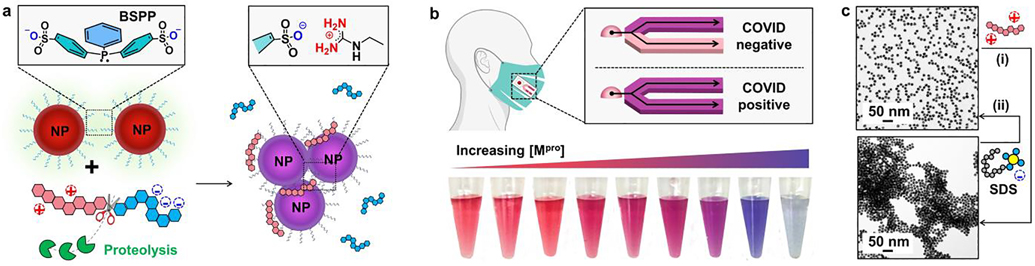
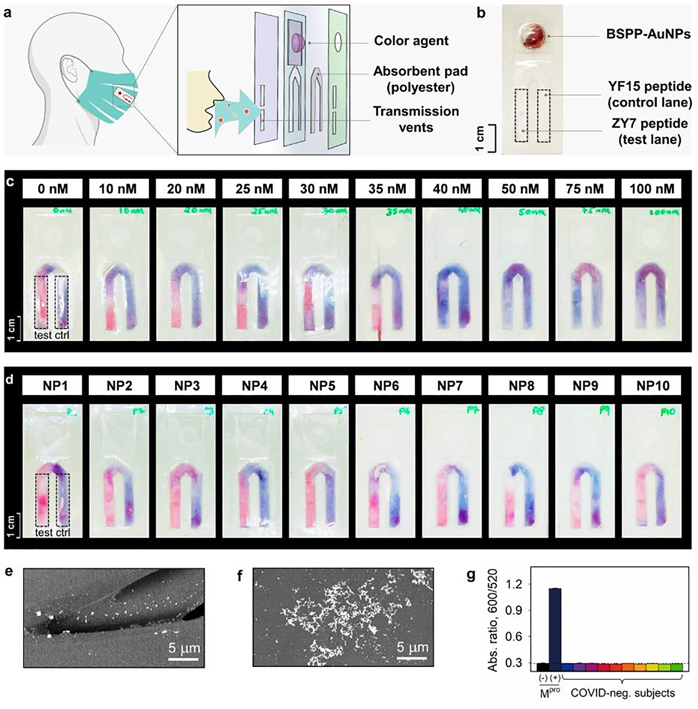
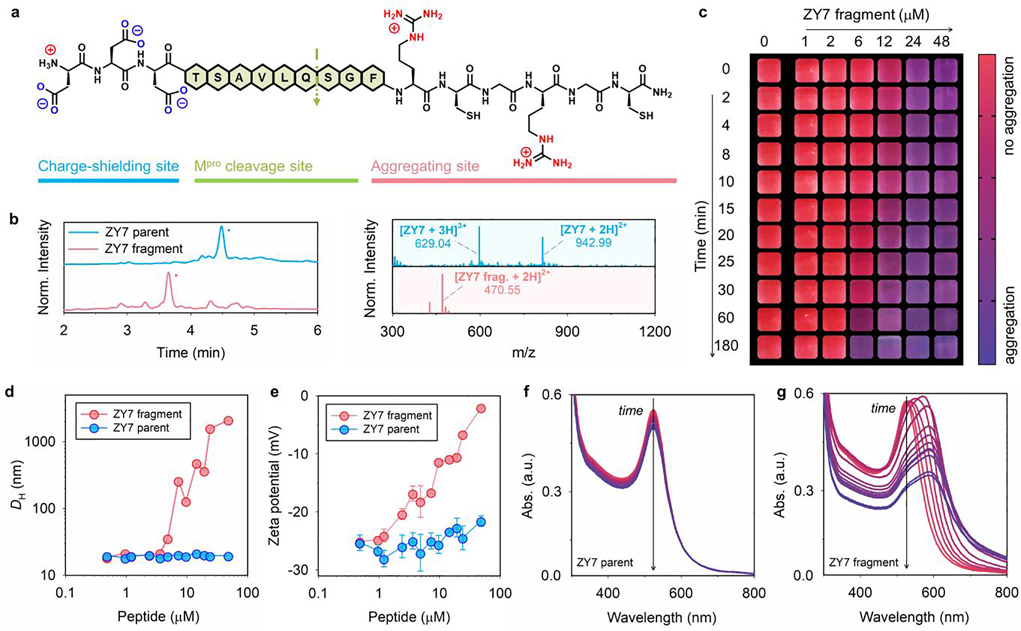
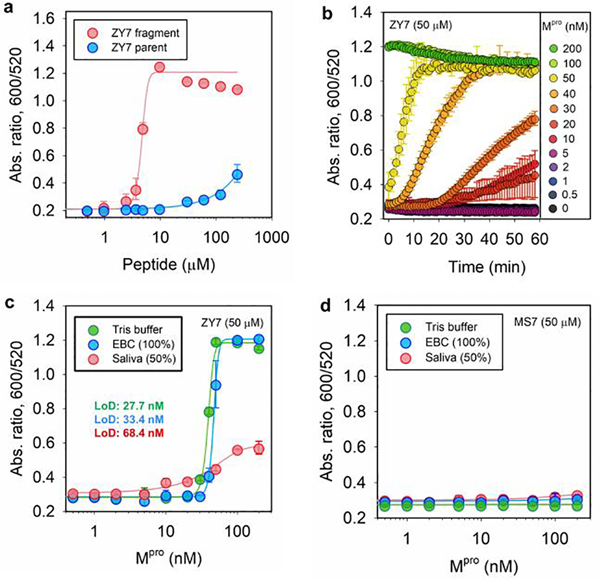
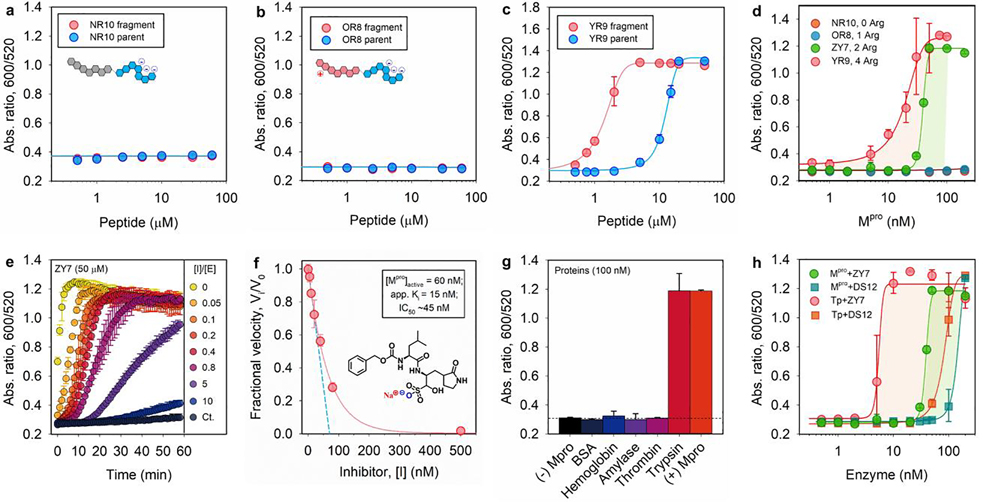
The transmission of SARS-CoV-2 coronavirus has led to the COVID-19 pandemic. Nucleic acid testing while specific has limitations for mass surveillance. One alternative is the main protease (M ) due to its functional importance in mediating the viral life cycle. Here, we describe a combination of modular substrate and gold colloids to detect M via visual readout. The strategy involves zwitterionic peptide that carries opposite charges at the C-/N-terminus to exploit the specific recognition by M . Autolytic cleavage releases a positively charged moiety that assembles the nanoparticles with rapid color changes (t<10 min). We determine a limit of detection for M in breath condensate matrices <10 nM. We further assayed ten COVID-negative subjects and found no false-positive result. In the light of simplicity, our test for viral protease is not limited to an equipped laboratory, but also is amenable to integrating as portable point-of-care devices including those on face-coverings.
严重急性呼吸综合征冠状病毒 2 型(SARS-CoV-2)的传播导致了 COVID-19 大流行。核酸检测虽然具有特异性,但在大规模监测方面存在局限性。另一种选择是主蛋白酶(M),因为它在介导病毒生命周期方面具有重要功能。在这里,我们描述了一种通过视觉读出检测 M 的模块化底物和金纳米粒子的组合。该策略涉及带有相反电荷的两性离子肽在 C-/N-末端,以利用 M 的特异性识别。自裂解释放出带正电荷的部分,与纳米粒子组装并快速改变颜色(<10 min)。我们确定呼吸冷凝物基质中 M 的检测限<10 nM。我们进一步检测了十个 COVID-阴性的个体,没有发现假阳性结果。鉴于其简单性,我们的病毒蛋白酶检测不仅限于配备实验室的情况,而且易于集成便携式即时检测设备,包括口罩上的设备。