Department of Exercise Physiology, Faculty of Sport Sciences, University of Isfahan, Isfahan 81746-7344, Iran.
Department of Exercise Physiology, Faculty of Educational Sciences and Psychology, University of Mohaghegh Ardabili, Ardabil 56199-11367, Iran.
Int J Environ Res Public Health. 2021 Dec 11;18(24):13093. doi: 10.3390/ijerph182413093.
This study aims to assess the effects of 8 weeks of plyometric jump training (PJT) conducted on sand or a rigid court surface on jump-related biomechanical variables and physical fitness in female indoor volleyball players.
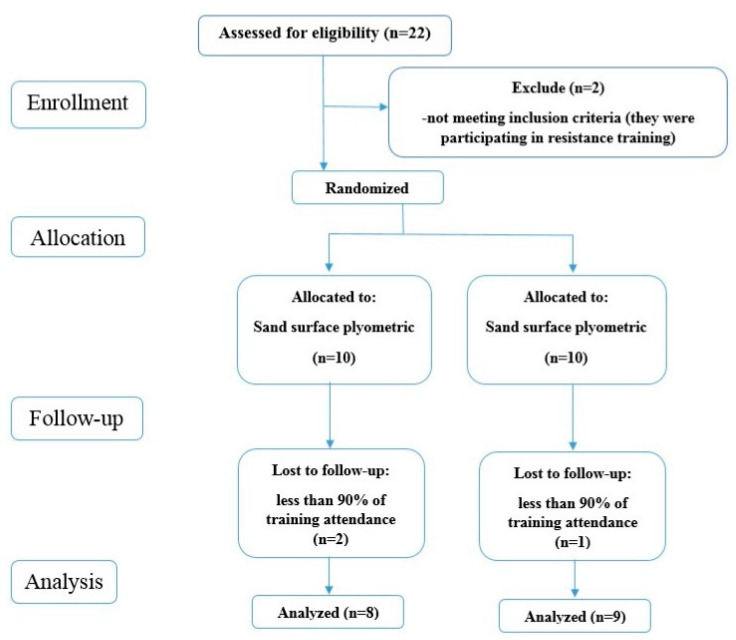
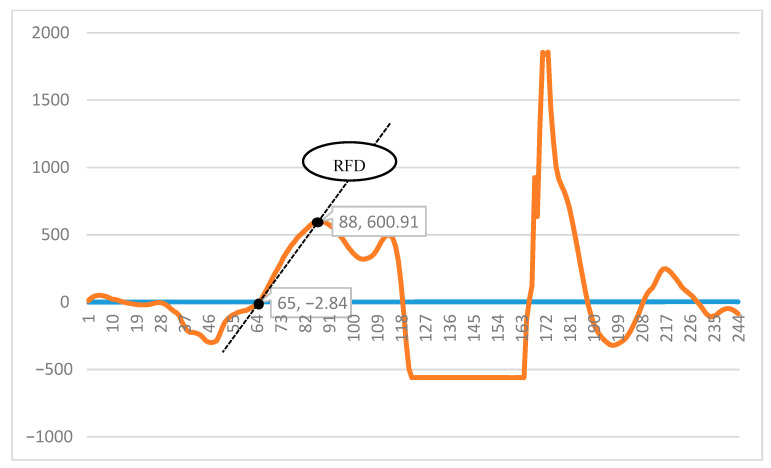
Seventeen participants were randomly divided into a sand surface group (SsG, = 8) and rigid surface group (RsG, = 9). Both groups completed equal indoor volleyball training routines. Participants were assessed pre and post the 8-week PJT for jump-related biomechanical variables (countermovement jump (CMJ) RSI; drop jump (DJ) reactive strength index (RSI); spike jump (SJ) height; CMJ height; CMJ rate of force development (RFD); CMJ velocity at take-off; DJ height and CMJ peak force), 20 m linear sprint time, test for change-of-direction sprint (CODs) time, Wingate test peak power (PP), cardiorespiratory endurance, and leg-press one-repetition maximum (1RM).
A two-way mixed analysis of variance (group × time) revealed that there was a significant group × time interaction between DJ height ( = 0.035) and CMJ peak force ( = 0.032) in favour of RsG and SsG, respectively. A significant interaction was also observed for cardiorespiratory endurance ( = 0.01) and 1RM ( = 0.002), both favouring the SsG. No other group × time interaction was observed.
The type of surface used during PJT induced specific adaptations in terms of jump-related biomechanical variables and physical fitness in female indoor volleyball players. Based on the individual needs of the athletes, practitioners may prescribe one type of surface preferentially over another to maximize the benefits derived from PJT.
本研究旨在评估在沙质或刚性表面上进行 8 周的增强式跳跃训练(PJT)对女性室内排球运动员跳跃相关生物力学变量和身体素质的影响。
17 名参与者被随机分为沙质表面组(SsG,n=8)和刚性表面组(RsG,n=9)。两组均完成同等的室内排球训练计划。参与者在 8 周 PJT 前后接受评估,评估指标包括跳跃相关生物力学变量(纵跳相对力量指数(CMJ RSI);落地跳(DJ)反应强度指数(RSI);扣球跳(SJ)高度;CMJ 高度;CMJ 力量发展速率(RFD);CMJ 起跳速度;DJ 高度和 CMJ 峰值力量)、20 米直线冲刺时间、变向冲刺测试(CODs)时间、Wingate 测试峰值功率(PP)、心肺耐力和腿举 1 次最大重复次数(1RM)。
组间×时间的双因素混合方差分析显示,DJ 高度( = 0.035)和 CMJ 峰值力量( = 0.032)存在显著的组间×时间交互作用,分别有利于 RsG 和 SsG。心肺耐力( = 0.01)和 1RM( = 0.002)也观察到显著的交互作用,均有利于 SsG。未观察到其他组间×时间的交互作用。
PJT 中使用的表面类型会导致女性室内排球运动员在跳跃相关生物力学变量和身体素质方面产生特定的适应性。根据运动员的个体需求,从业者可以优先选择一种表面类型,以最大限度地从 PJT 中获益。