Department of Orthopedics, Xianyang Central Hospital, Xianyang, China.
Clinical Medical Research Center, Xianyang Central Hospital, Xianyang, China.
Front Public Health. 2021 Dec 10;9:812023. doi: 10.3389/fpubh.2021.812023. eCollection 2021.
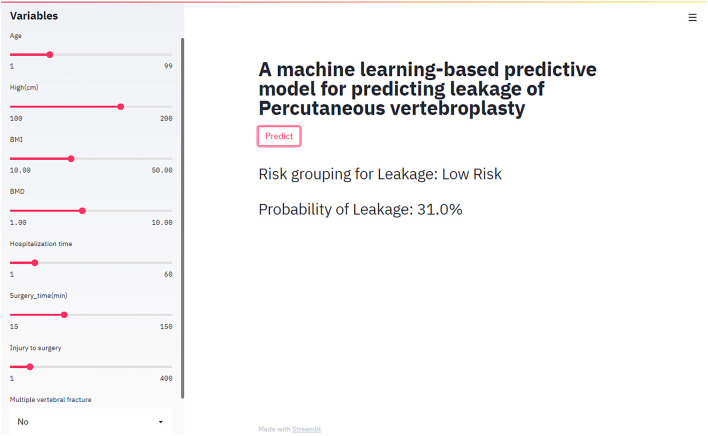
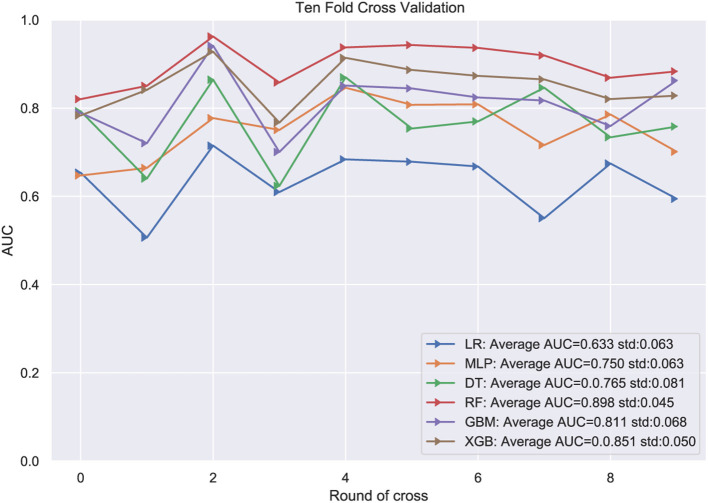
Bone cement leakage is a common complication of percutaneous vertebroplasty and it could be life-threatening to some extent. The aim of this study was to develop a machine learning model for predicting the risk of cement leakage in patients with osteoporotic vertebral compression fractures undergoing percutaneous vertebroplasty. Furthermore, we developed an online calculator for clinical application. This was a retrospective study including 385 patients, who had osteoporotic vertebral compression fracture disease and underwent surgery at the Department of Spine Surgery, Liuzhou People's Hospital from June 2016 to June 2018. Combing the patient's clinical characteristics variables, we applied six machine learning (ML) algorithms to develop the predictive models, including logistic regression (LR), Gradient boosting machine (GBM), Extreme gradient boosting (XGB), Random Forest (RF), Decision Tree (DT) and Multilayer perceptron (MLP), which could predict the risk of bone cement leakage. We tested the results with ten-fold cross-validation, which calculated the Area Under Curve (AUC) of the six models and selected the model with the highest AUC as the excellent performing model to build the web calculator. The results showed that Injection volume of bone cement, Surgery time and Multiple vertebral fracture were all independent predictors of bone cement leakage by using multivariate logistic regression analysis in the 385 observation subjects. Furthermore, Heatmap revealed the relative proportions of the 15 clinical variables. In bone cement leakage prediction, the AUC of the six ML algorithms ranged from 0.633 to 0.898, while the RF model had an AUC of 0.898 and was used as the best performing ML Web calculator (https://share.streamlit.io/liuwencai0/pvp_leakage/main/pvp_leakage) was developed to estimate the risk of bone cement leakage that each patient undergoing vertebroplasty. It achieved a good prediction for the occurrence of bone cement leakage with our ML model. The Web calculator concluded based on RF model can help orthopedist to make more individual and rational clinical strategies.
骨水泥渗漏是经皮椎体成形术的常见并发症,在某种程度上危及生命。本研究旨在开发一种机器学习模型,以预测接受经皮椎体成形术治疗的骨质疏松性椎体压缩性骨折患者的骨水泥渗漏风险。此外,我们还开发了一个在线计算器用于临床应用。
这是一项回顾性研究,纳入了 2016 年 6 月至 2018 年 6 月在柳州市人民医院脊柱外科接受手术治疗的 385 例骨质疏松性椎体压缩性骨折患者。结合患者的临床特征变量,我们应用 6 种机器学习(ML)算法(逻辑回归(LR)、梯度提升机(GBM)、极端梯度提升(XGB)、随机森林(RF)、决策树(DT)和多层感知机(MLP))来开发预测模型,以预测骨水泥渗漏的风险。我们采用 10 折交叉验证来测试结果,计算了 6 种模型的曲线下面积(AUC),并选择 AUC 最高的模型作为性能最优的模型来构建网络计算器。
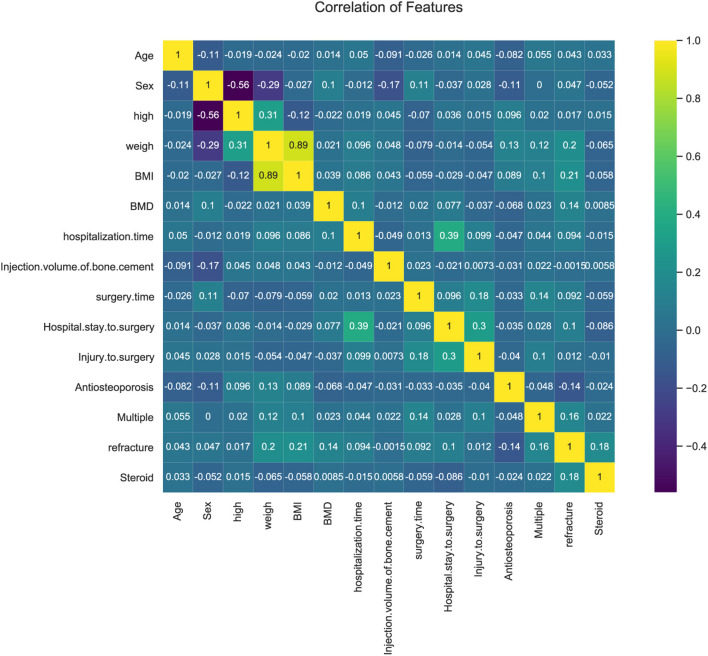
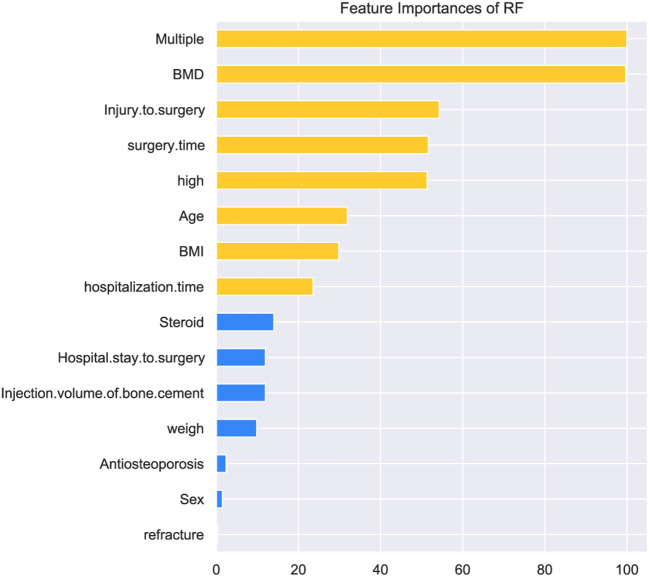
结果显示,在 385 例观察对象中,使用多变量逻辑回归分析发现,骨水泥注射量、手术时间和多发椎体骨折是骨水泥渗漏的独立预测因素。此外,热图揭示了 15 个临床变量的相对比例。在骨水泥渗漏预测中,6 种 ML 算法的 AUC 范围为 0.633 至 0.898,其中 RF 模型的 AUC 为 0.898,被用作性能最优的 ML 网络计算器(https://share.streamlit.io/liuwencai0/pvp_leakage/main/pvp_leakage),用于估计每位接受椎体成形术患者的骨水泥渗漏风险。该模型通过 ML 实现了对骨水泥渗漏发生的良好预测。基于 RF 模型的网络计算器可以帮助骨科医生制定更个体化和更合理的临床策略。