University of Wollongong, School of Health and Society, Australia.
University of Wollongong, School of Health and Society, Australia.
Int J Drug Policy. 2022 Mar;101:103561. doi: 10.1016/j.drugpo.2021.103561. Epub 2021 Dec 9.
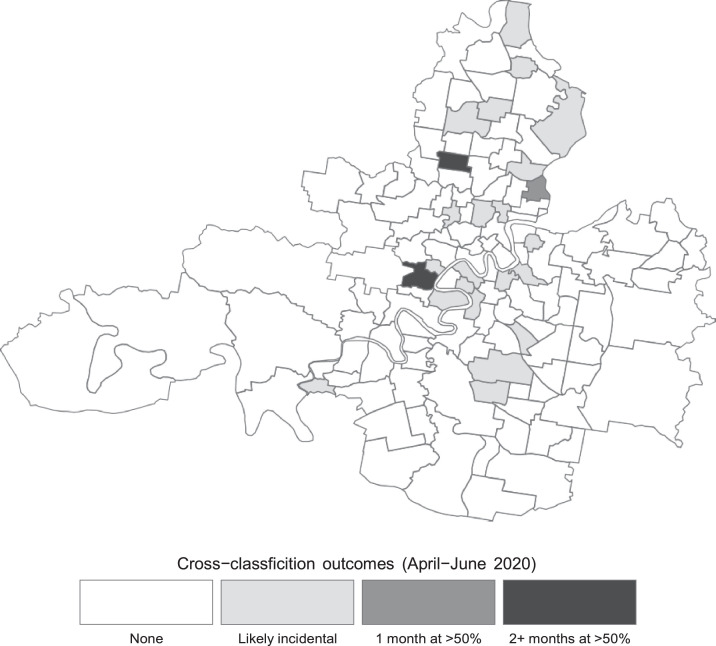
In many parts of the world, the social mobility restrictions and stay-at-home orders introduced during the early months of the COVID-19 pandemic have been associated with significant reductions in crime. However, contrary to this general finding, illicit drug offence detections increased significantly. In this study, we explore the geographical distribution of the increase in Queensland, Australia, using spatiotemporal generalised additive model (GAM) to identify locations in the Local Government Area (LGA) of Brisbane where drug offence detection rates were unusually high during the three months of the COVID-19 lockdown (April-June 2020). Contrary to expectation, we find that the increase in drug offence detection rates appears to have been modest in most places, but widespread and diffuse throughout the city. We conclude that drug offence detections are most likely to have increased incidentally, probably as a consequence of general street policing initiatives which saw an increase in the visibility and vulnerability of drug user communities. We do, however, identify several locations in Brisbane where the drug offence detection rate exceeded the prediction by a considerable margin (in one case, more than double the upper limit of the prediction). We argue that in these locations the increase was likely the result of some spatial displacement of inner-city drug markets coupled with a series of targeted policing activities. Further research is needed to clarify the true mechanism of change in these locations.
在世界上许多地区,COVID-19 大流行早期实施的社会流动性限制和居家令与犯罪显著减少有关。然而,与这一普遍发现相反,非法毒品犯罪的检测显著增加。在这项研究中,我们使用时空广义加性模型(GAM)来探索澳大利亚昆士兰州的疫情封锁期间(2020 年 4 月至 6 月)毒品犯罪检测率异常高的地点的地理分布情况,以探索澳大利亚昆士兰州的情况。出乎意料的是,我们发现大多数地方的毒品犯罪检测率的增加似乎是适度的,但在整个城市广泛而分散。我们得出结论,毒品犯罪的检测率很可能是偶然增加的,可能是由于一般的街头治安措施增加了毒贩社区的可见度和脆弱性。然而,我们确实确定了布里斯班的几个地点,毒品犯罪检测率远远超过了预测值(在一个案例中,超过预测值上限的两倍)。我们认为,在这些地点,增加可能是由于市中心毒品市场的一些空间转移,以及一系列有针对性的治安活动。需要进一步研究来澄清这些地点变化的真正机制。