Chen Chen, Qin Yuhui, Cheng Junying, Gao Fabao, Zhou Xiaoyue
Department of Radiology, West China Hospital, Sichuan University, Chengdu, China.
Department of MRI, The First Affiliated Hospital of Zhengzhou University, Zhengzhou, China.
Front Oncol. 2021 Dec 13;11:701289. doi: 10.3389/fonc.2021.701289. eCollection 2021.
We used texture analysis and machine learning (ML) to classify small round cell malignant tumors (SRCMTs) and Non-SRCMTs of nasal and paranasal sinus on fat-suppressed T2 weighted imaging (Fs-T2WI).
Preoperative MRI scans of 164 patients from 1 January 2018 to 1 January 2021 diagnosed with SRCMTs and Non-SRCMTs were included in this study. A total of 271 features were extracted from each regions of interest. Datasets were randomly divided into two sets, including a training set (∼70%) and a test set (∼30%). The Pearson correlation coefficient (PCC) and principal component analysis (PCA) methods were performed to reduce dimensions, and the Analysis of Variance (ANOVA), Kruskal-Wallis (KW), and Recursive Feature Elimination (RFE) and Relief were performed for feature selections. Classifications were performed using 10 ML classifiers. Results were evaluated using a leave one out cross-validation analysis.
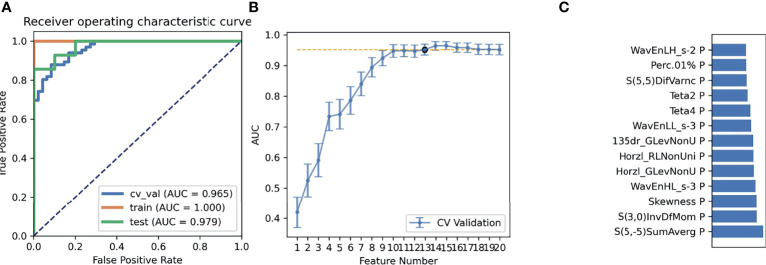
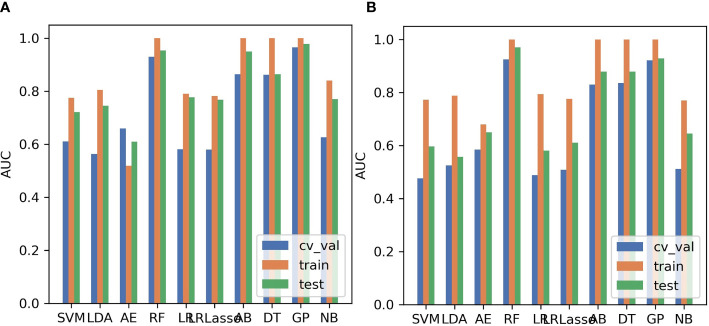
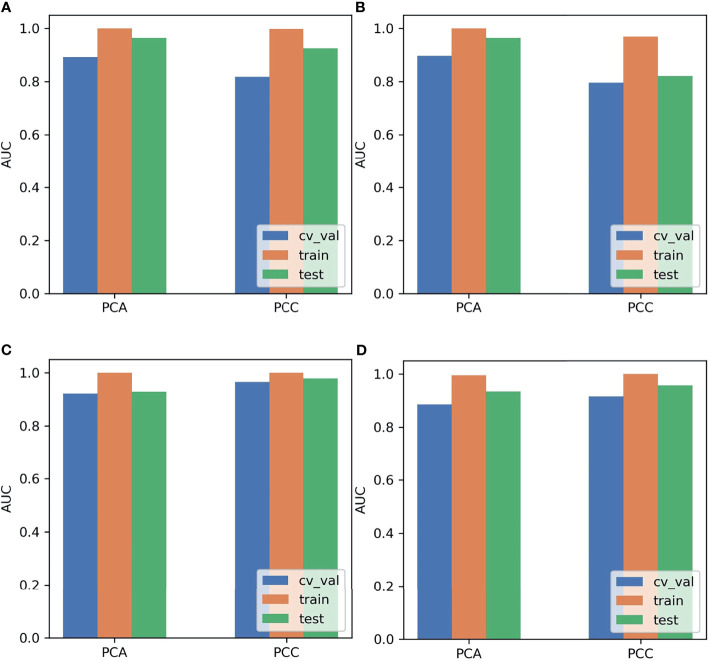
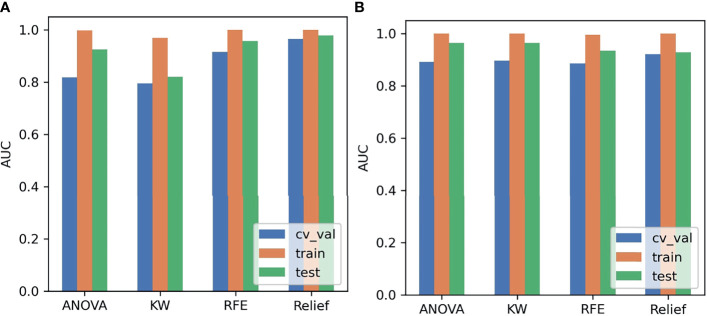
We compared the AUC of all pipelines on the validation dataset with FeAture Explorer (FAE) software. The pipeline using a PCC dimension reduction, relief feature selection, and gaussian process (GP) classifier yielded the highest area under the curve (AUC) using 15 features. When the "one-standard error" rule was used, FAE also produced a simpler model with 13 features, including S(5,-5)SumAverg, S(3,0)InvDfMom, Skewness, WavEnHL_s-3, Horzl_GlevNonU, Horzl_RLNonUni, 135dr_GlevNonU, WavEnLL_s-3, Teta4, Teta2, S(5,5)DifVarnc, Perc.01%, and WavEnLH_s-2. The AUCs of the training/validation/test datasets were 1.000/0.965/0.979, and the accuracies, sensitivities, and specificities were 0.890, 0.880, and 0.920, respectively. The best algorithm was GP whose AUCs of the training/validation/test datasets by the two-dimensional reduction methods and four feature selection methods were greater than approximately 0.800. Especially, the AUCs of different datasets were greater than approximately 0.900 using the PCC, RFE/Relief, and GP algorithms.
We demonstrated the feasibility of combining artificial intelligence and the radiomics from Fs-T2WI to differentially diagnose SRCMTs and Non-SRCMTs. This non-invasive approach could be very promising in clinical oncology.
我们运用纹理分析和机器学习(ML)对鼻腔及鼻窦的小圆形细胞恶性肿瘤(SRCMT)和非SRCMT在脂肪抑制T2加权成像(Fs-T2WI)上进行分类。
本研究纳入了2018年1月1日至2021年1月1日期间164例被诊断为SRCMT和非SRCMT患者的术前MRI扫描图像。从每个感兴趣区域提取了总共271个特征。数据集被随机分为两组,包括训练集(约70%)和测试集(约30%)。采用Pearson相关系数(PCC)和主成分分析(PCA)方法进行降维,并进行方差分析(ANOVA)、Kruskal-Wallis(KW)、递归特征消除(RFE)和Relief进行特征选择。使用10种ML分类器进行分类。结果采用留一法交叉验证分析进行评估。
我们使用FeAture Explorer(FAE)软件在验证数据集上比较了所有流程的曲线下面积(AUC)。使用PCC降维、Relief特征选择和高斯过程(GP)分类器的流程在使用15个特征时产生了最高的曲线下面积(AUC)。当使用“一个标准误差”规则时,FAE还生成了一个更简单的包含13个特征的模型,包括S(5,-5)SumAverg、S(3,0)InvDfMom、偏度、WavEnHL_s-3、Horzl_GlevNonU、Horzl_RLNonUni、135dr_GlevNonU、WavEnLL_s-3、Teta4、Teta2、S(5,5)DifVarnc、Perc.01%和WavEnLH_s-2。训练/验证/测试数据集的AUC分别为1.000/0.965/0.979,准确率、敏感性和特异性分别为0.890、0.880和0.920。最佳算法是GP,其通过二维降维方法和四种特征选择方法在训练/验证/测试数据集上的AUC大于约0.800。特别是,使用PCC、RFE/Relief和GP算法时不同数据集的AUC大于约0.900。
我们证明了结合人工智能和Fs-T2WI的放射组学对SRCMT和非SRCMT进行鉴别诊断的可行性。这种非侵入性方法在临床肿瘤学中可能非常有前景。