Duke Clinical Research Institute, Duke University, Durham, North Carolina, USA.
Center for Human Health and the Environment, North Carolina State University, Raleigh, North Carolina, USA.
Occup Environ Med. 2022 Jul;79(7):469-476. doi: 10.1136/oemed-2021-107611. Epub 2021 Dec 30.
This research evaluates whether environmental exposures (pesticides and smoke) influence respiratory and allergic outcomes in women living in a tropical, agricultural environment.
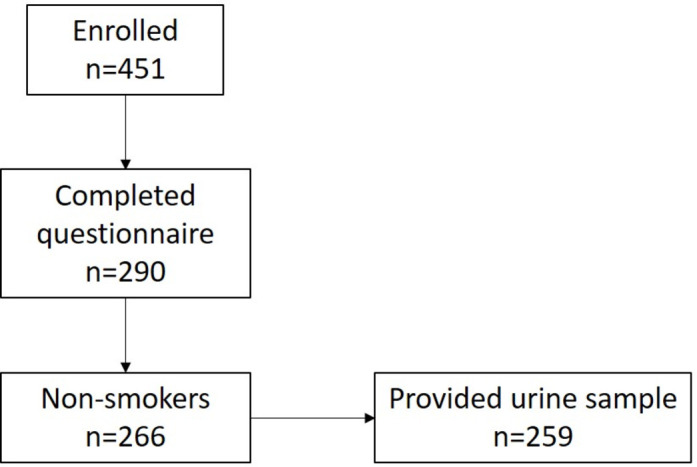
We used data from 266 mothers from the Infants' Environmental Health cohort study in Costa Rica. We evaluated environmental exposures in women by measuring seven pesticide and two polycyclic aromatic hydrocarbons metabolites in urine samples. We defined 'high exposure' as having a metabolite value in the top 75th percentile. We collected survey data on respiratory and allergic outcomes in mothers as well as on pesticides and other environmental exposures. Using logistic regression models adjusted for obesity, we assessed the associations of pesticide exposure with multiple outcomes (wheeze, doctor-diagnosed asthma, high (≥2) asthma score based on symptoms, rhinitis, eczema and itchy rash).
Current pesticide use in the home was positively associated with diagnosed asthma (OR=1.99 (95% CI=1.05 to 3.87)). High urinary levels of 5-hydroxythiabendazole (thiabendazole metabolite) and living in a neighbourhood with frequent smoke from waste burning were associated with a high asthma score (OR=1.84 (95%CI=1.05 to 3.25) and OR=2.31 (95%CI=1.11 to 5.16), respectively). Women who worked in agriculture had a significantly lower prevalence of rhinitis (0.19 (0.01 to 0.93)), but were more likely to report eczema (OR=2.54 (95%CI=1.33 to 4.89)) and an itchy rash (OR=3.17 (95%CI=1.24 to 7.73)).
While limited by sample size, these findings suggest that environmental exposure to both pesticides and smoke may impact respiratory and skin-related allergic outcomes in women.
本研究旨在评估生活在热带农业环境中的女性的环境暴露(农药和烟雾)是否会影响呼吸和过敏结果。
我们使用了来自哥斯达黎加婴儿环境健康队列研究的 266 位母亲的数据。我们通过测量尿液样本中的七种农药和两种多环芳烃代谢物来评估女性的环境暴露情况。我们将“高暴露”定义为代谢物值处于前 75%分位值。我们收集了母亲的呼吸和过敏结果以及农药和其他环境暴露的调查数据。我们使用调整了肥胖因素的逻辑回归模型,评估了农药暴露与多种结果(喘息、医生诊断的哮喘、基于症状的高(≥2)哮喘评分、鼻炎、湿疹和瘙痒皮疹)之间的关联。
当前在家中使用农药与确诊哮喘呈正相关(OR=1.99(95%CI=1.05 至 3.87))。高水平的 5-羟基噻苯达唑(噻苯达唑代谢物)和生活在经常有废物燃烧烟雾的社区与高哮喘评分相关(OR=1.84(95%CI=1.05 至 3.25)和 OR=2.31(95%CI=1.11 至 5.16))。从事农业工作的女性患鼻炎的比例显著较低(0.19(0.01 至 0.93)),但更有可能报告湿疹(OR=2.54(95%CI=1.33 至 4.89))和瘙痒皮疹(OR=3.17(95%CI=1.24 至 7.73))。
尽管受到样本量的限制,但这些发现表明,环境中接触农药和烟雾可能会影响女性的呼吸和与皮肤相关的过敏结果。