
基于临床数据与模型驱动数据相结合的机器学习对心脏再同步治疗反应的预测
Machine Learning Prediction of Cardiac Resynchronisation Therapy Response From Combination of Clinical and Model-Driven Data.
作者信息
Khamzin Svyatoslav, Dokuchaev Arsenii, Bazhutina Anastasia, Chumarnaya Tatiana, Zubarev Stepan, Lyubimtseva Tamara, Lebedeva Viktoria, Lebedev Dmitry, Gurev Viatcheslav, Solovyova Olga
机构信息
Institute of Immunology and Physiology Ural Branch of the Russian Academy of Sciences, Yekaterinburg, Russia.
Ural Federal University, Yekaterinburg, Russia.
出版信息
Front Physiol. 2021 Dec 14;12:753282. doi: 10.3389/fphys.2021.753282. eCollection 2021.
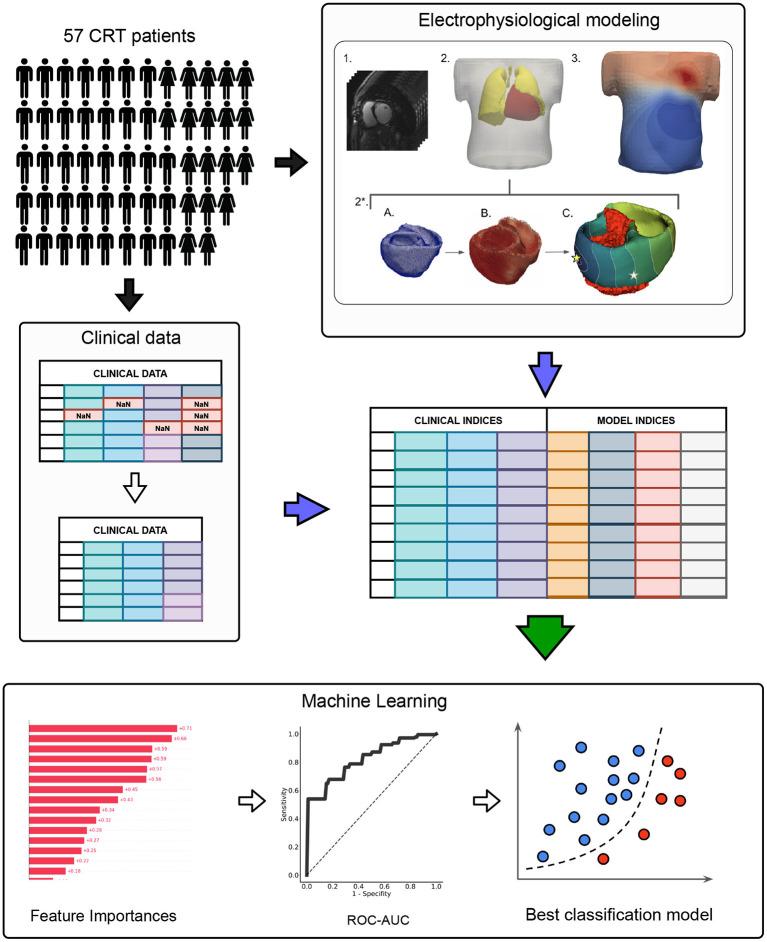
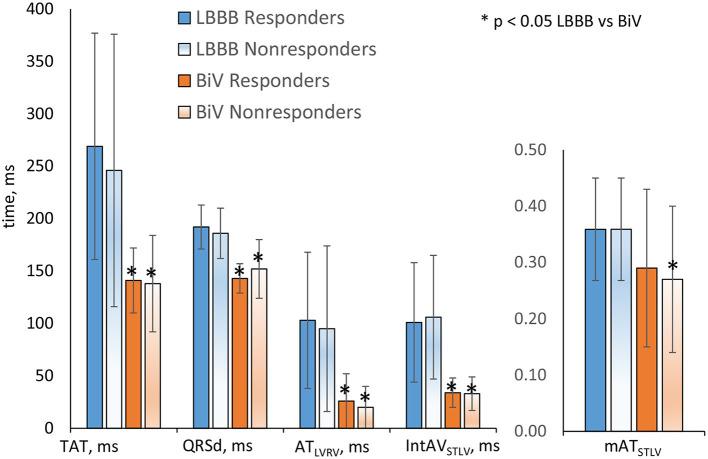
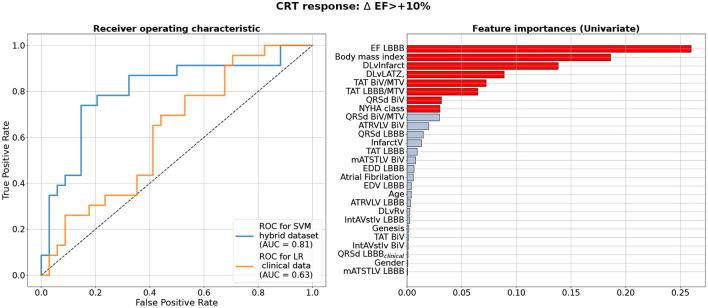
Up to 30-50% of chronic heart failure patients who underwent cardiac resynchronization therapy (CRT) do not respond to the treatment. Therefore, patient stratification for CRT and optimization of CRT device settings remain a challenge. The main goal of our study is to develop a predictive model of CRT outcome using a combination of clinical data recorded in patients before CRT and simulations of the response to biventricular (BiV) pacing in personalized computational models of the cardiac electrophysiology. Retrospective data from 57 patients who underwent CRT device implantation was utilized. Positive response to CRT was defined by a 10% increase in the left ventricular ejection fraction in a year after implantation. For each patient, an anatomical model of the heart and torso was reconstructed from MRI and CT images and tailored to ECG recorded in the participant. The models were used to compute ventricular activation time, ECG duration and electrical dyssynchrony indices during intrinsic rhythm and BiV pacing from the sites of implanted leads. For building a predictive model of CRT response, we used clinical data recorded before CRT device implantation together with model-derived biomarkers of ventricular excitation in the left bundle branch block mode of activation and under BiV stimulation. Several Machine Learning (ML) classifiers and feature selection algorithms were tested on the hybrid dataset, and the quality of predictors was assessed using the area under receiver operating curve (ROC AUC). The classifiers on the hybrid data were compared with ML models built on clinical data only. The best ML classifier utilizing a hybrid set of clinical and model-driven data demonstrated ROC AUC of 0.82, an accuracy of 0.82, sensitivity of 0.85, and specificity of 0.78, improving quality over that of ML predictors built on clinical data from much larger datasets by more than 0.1. Distance from the LV pacing site to the post-infarction zone and ventricular activation characteristics under BiV pacing were shown as the most relevant model-driven features for CRT response classification. Our results suggest that combination of clinical and model-driven data increases the accuracy of classification models for CRT outcomes.
高达30%-50%接受心脏再同步治疗(CRT)的慢性心力衰竭患者对该治疗无反应。因此,CRT患者分层及CRT设备设置的优化仍是一项挑战。我们研究的主要目标是利用CRT前记录的临床数据以及心脏电生理个性化计算模型中双心室(BiV)起搏反应的模拟结果,开发一种CRT结果预测模型。利用了57例接受CRT设备植入患者的回顾性数据。CRT阳性反应定义为植入后一年内左心室射血分数增加10%。对于每位患者,根据MRI和CT图像重建心脏和躯干的解剖模型,并根据参与者记录的心电图进行定制。这些模型用于计算固有节律和BiV起搏期间从植入导线部位开始的心室激活时间、心电图持续时间和电不同步指数。为构建CRT反应预测模型,我们使用了CRT设备植入前记录的临床数据以及在左束支传导阻滞激活模式和BiV刺激下模型衍生的心室兴奋生物标志物。在混合数据集上测试了几种机器学习(ML)分类器和特征选择算法,并使用受试者工作特征曲线下面积(ROC AUC)评估预测指标的质量。将混合数据上的分类器与仅基于临床数据构建的ML模型进行比较。利用临床和模型驱动数据的最佳ML分类器显示ROC AUC为0.82,准确率为0.82,灵敏度为0.85,特异性为0.78,比基于更大数据集临床数据构建的ML预测指标质量提高了0.1以上。左心室起搏部位到梗死区的距离以及BiV起搏下的心室激活特征被证明是CRT反应分类中最相关的模型驱动特征。我们的结果表明,临床和模型驱动数据的结合提高了CRT结果分类模型的准确性。



 Zotero 插件