Gao Panyue, Li Xinrong, Du Xinzhe, Liu Sha, Xu Yong
Department of Psychiatry, First Hospital/First Clinical Medical College of Shanxi Medical University, Taiyuan, China.
Shanxi Key Laboratory of Artificial Intelligence Assisted Diagnosis and Treatment for Mental Disorder, First Hospital of Shanxi Medical University, Taiyuan, China.
Front Aging Neurosci. 2021 Dec 16;13:790863. doi: 10.3389/fnagi.2021.790863. eCollection 2021.
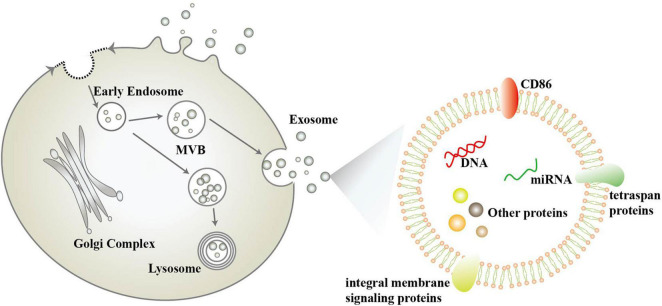
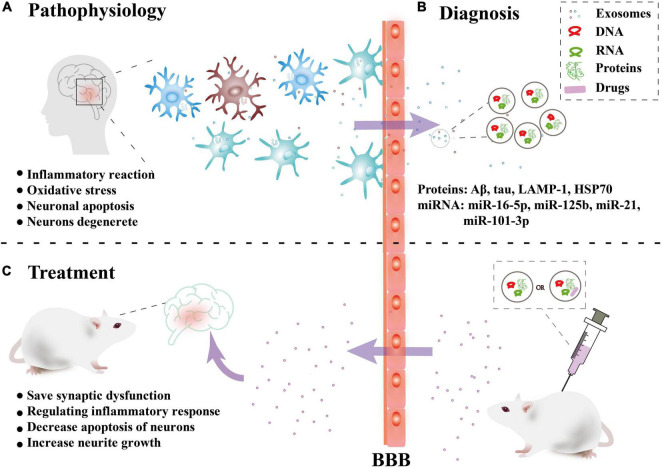
Neurodegenerative diseases are closely related to brain function and the progression of the diseases are irreversible. Due to brain tissue being not easy to acquire, the study of the pathophysiology of neurodegenerative disorders has many limitations-lack of reliable early biomarkers and personalized treatment. At the same time, the blood-brain barrier (BBB) limits most of the drug molecules into the damaged areas of the brain, which makes a big drop in the effect of drug treatment. Exosomes, a kind of endogenous nanoscale vesicles, play a key role in cell signaling through the transmission of genetic information and proteins between cells. Because of the ability to cross the BBB, exosomes are expected to link peripheral changes to central nervous system (CNS) events as potential biomarkers, and can even be used as a therapeutic carrier to deliver molecules specifically to CNS. Here we summarize the role of exosomes in pathophysiology, diagnosis, prognosis, and treatment of some neurodegenerative diseases (Alzheimer's Disease, Parkinson's Disease, Huntington's Disease, Amyotrophic Lateral Sclerosis).
神经退行性疾病与脑功能密切相关,且疾病进展不可逆。由于脑组织不易获取,神经退行性疾病病理生理学的研究存在诸多局限性——缺乏可靠的早期生物标志物和个性化治疗方法。同时,血脑屏障(BBB)限制了大多数药物分子进入脑损伤区域,这使得药物治疗效果大幅下降。外泌体是一种内源性纳米级囊泡,通过在细胞间传递遗传信息和蛋白质,在细胞信号传导中发挥关键作用。由于能够穿过血脑屏障,外泌体有望作为潜在的生物标志物,将外周变化与中枢神经系统(CNS)事件联系起来,甚至可作为治疗载体,将分子特异性递送至中枢神经系统。在此,我们总结外泌体在一些神经退行性疾病(阿尔茨海默病、帕金森病、亨廷顿病、肌萎缩侧索硬化症)的病理生理学、诊断、预后及治疗中的作用。