Sabouni Rami, Tarrab Rand, Kalaji Dania, Abbassi Haitham
Faculty of Medicine, Damascus University, Damascus, Syria.
Department of Radiology, Faculty of Medicine, Damascus University, Damascus, Syria.
Ann Med Surg (Lond). 2021 Dec 11;73:103149. doi: 10.1016/j.amsu.2021.103149. eCollection 2022 Jan.
The prevalence of Primary ovarian insufficiency (POI) is estimated to be 1-2%, resulting from many causes, including, iatrogenic causes which are becoming more common.There is no precise treatment to restore fertility in POI patients. However, new treatments -such as ovarian rejuvenation using platelet-rich autologous plasma (PRP)- are being tested and have shown promising results. We report using a new PRP injection protocol to manage a Syrian patient with ovarian insufficiency.
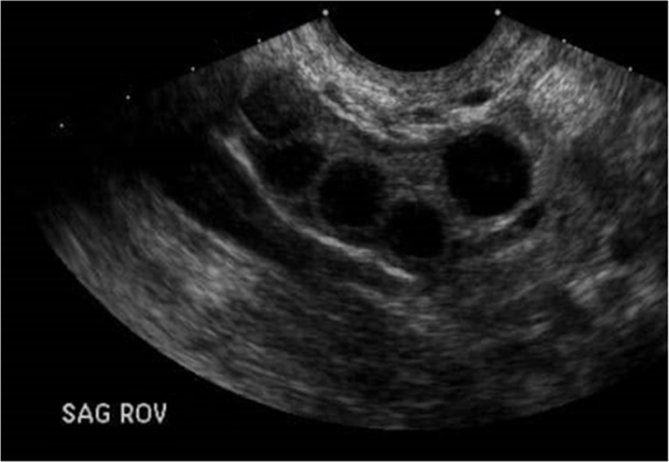
A 35-year-old woman with five years of primary infertility presented with decreased anti-mullerian hormone (AMH) after she underwent a laparoscopy one year ago. Where the AMH dropped from 1.07 to 0.39 ng/mL after it. She underwent an ovarian rejuvenation using PRP. Half mL of PRP was injected into every ovary, 2 mL were injected into the cervix, 7 mL intra-uterus, and 7 mL were injected intramuscularly to the patient's legs. Fifteen days following the operation, the patient's new AMH level was 0.94 ng/mL. The patient was placed on ovarian stimulation, and five days later the ultrasonography showed the development of six follicles in each ovary.
Managing POI using ovarian rejuvenation is the best alternative treatment; When the donor eggs programs are not acceptable. The use of PRP in ovarian rejuvenation has been reported to be effective.
The use of PRP was beneficial in restoring fertility in a Syrian patient with ovarian insufficiency. Furthermore, the new PRP injection protocol was successful. However, more studies are needed to confirm this result.
原发性卵巢功能不全(POI)的患病率估计为1%-2%,其病因众多,包括日益常见的医源性病因。目前尚无恢复POI患者生育能力的精确治疗方法。然而,诸如使用富含血小板的自体血浆(PRP)进行卵巢复壮等新疗法正在进行试验,并已显示出有希望的结果。我们报告了使用一种新的PRP注射方案来治疗一名患有卵巢功能不全的叙利亚患者。
一名35岁、原发性不孕五年的女性,在一年前接受腹腔镜检查后抗苗勒管激素(AMH)水平下降。此后,AMH从1.07降至0.39 ng/mL。她接受了PRP卵巢复壮治疗。向每个卵巢注射0.5 mL PRP,向宫颈注射2 mL,向子宫内注射7 mL,并向患者腿部肌肉注射7 mL。术后15天,患者新的AMH水平为0.94 ng/mL。患者接受了卵巢刺激,五天后超声检查显示每个卵巢有六个卵泡发育。
当供卵方案不可接受时,使用卵巢复壮治疗POI是最佳的替代治疗方法。据报道,PRP在卵巢复壮中的应用是有效的。
PRP的使用有助于恢复一名患有卵巢功能不全的叙利亚患者的生育能力。此外,新的PRP注射方案是成功的。然而,需要更多研究来证实这一结果。