Movement Disorders Institute and Department of Neurology, Chaim Sheba Medical Center, Tel Hashomer, Ramat-Gan, Israel.
Sackler Faculty of Medicine, Tel-Aviv University, Tel-Aviv, Israel.
PLoS One. 2022 Jan 7;17(1):e0261947. doi: 10.1371/journal.pone.0261947. eCollection 2022.
The purpose of this study is to explore the possibility of developing a biomarker that can discriminate early-stage Parkinson's disease from healthy brain function using electroencephalography (EEG) event-related potentials (ERPs) in combination with Brain Network Analytics (BNA) technology and machine learning (ML) algorithms.
Currently, diagnosis of PD depends mainly on motor signs and symptoms. However, there is need for biomarkers that detect PD at an earlier stage to allow intervention and monitoring of potential disease-modifying therapies. Cognitive impairment may appear before motor symptoms, and it tends to worsen with disease progression. While ERPs obtained during cognitive tasks performance represent processing stages of cognitive brain functions, they have not yet been established as sensitive or specific markers for early-stage PD.
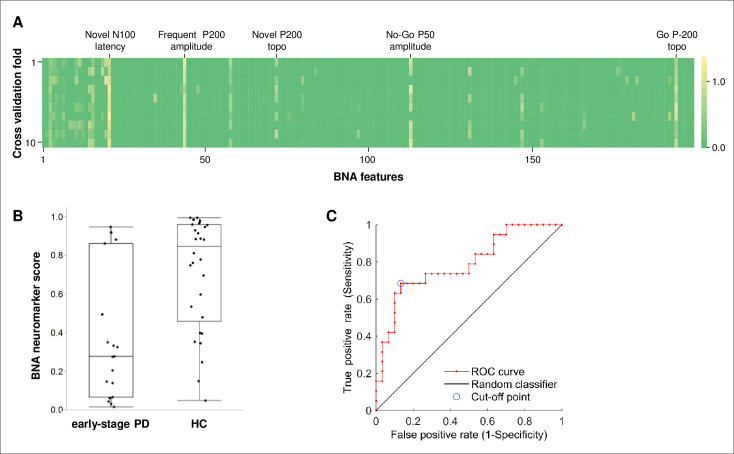
Nineteen PD patients (disease duration of ≤2 years) and 30 healthy controls (HC) underwent EEG recording while performing visual Go/No-Go and auditory Oddball cognitive tasks. ERPs were analyzed by the BNA technology, and a ML algorithm identified a combination of features that distinguish early PD from HC. We used a logistic regression classifier with a 10-fold cross-validation.
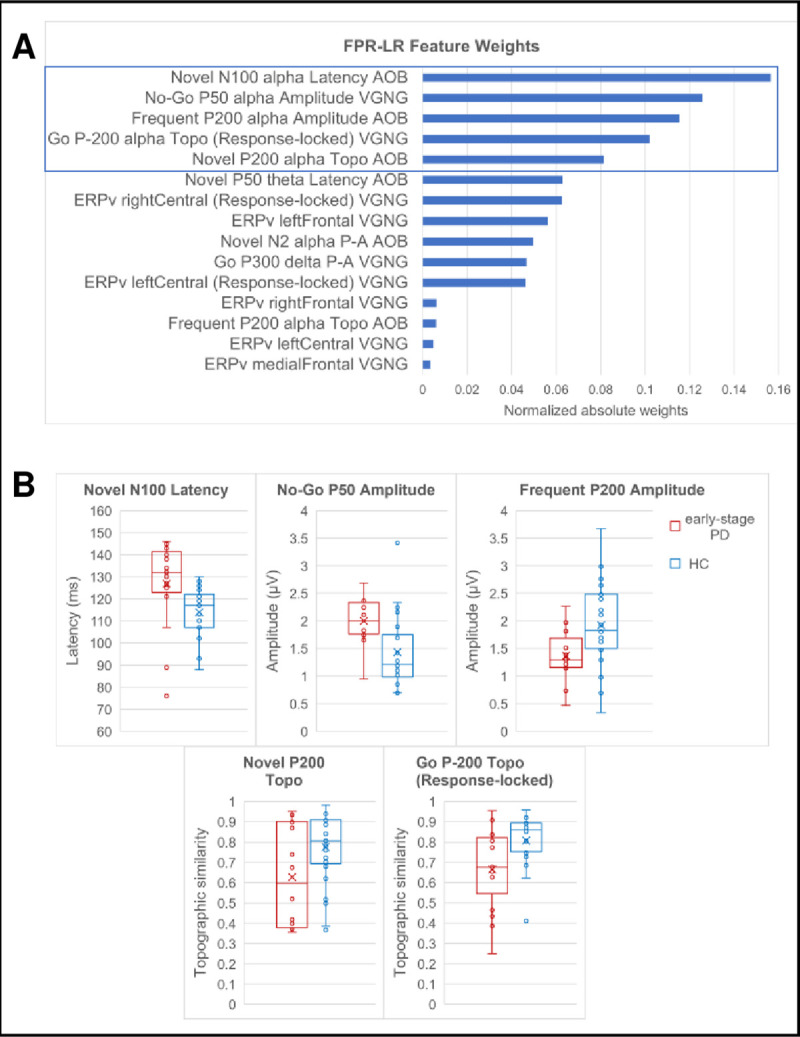
The ML algorithm identified a neuromarker comprising 15 BNA features that discriminated early PD patients from HC. The area-under-the-curve of the receiver-operating characteristic curve was 0.79. Sensitivity and specificity were 0.74 and 0.73, respectively. The five most important features could be classified into three cognitive functions: early sensory processing (P50 amplitude, N100 latency), filtering of information (P200 amplitude and topographic similarity), and response-locked activity (P-200 topographic similarity preceding the motor response in the visual Go/No-Go task).
This pilot study found that BNA can identify patients with early PD using an advanced analysis of ERPs. These results need to be validated in a larger PD patient sample and assessed for people with premotor phase of PD.
本研究旨在探索使用脑电图(EEG)事件相关电位(ERP)结合脑网络分析(BNA)技术和机器学习(ML)算法,从健康的大脑功能中区分早期帕金森病的生物标志物的可能性。
目前,PD 的诊断主要依赖于运动症状和体征。然而,需要有生物标志物来更早地发现 PD,以便进行干预和监测潜在的疾病修饰治疗。认知障碍可能在运动症状出现之前出现,并且随着疾病的进展往往会恶化。虽然在认知任务表现期间获得的 ERP 代表认知大脑功能的处理阶段,但它们尚未被确立为早期 PD 的敏感或特异性标志物。
19 名 PD 患者(疾病持续时间≤2 年)和 30 名健康对照者(HC)在执行视觉 Go/No-Go 和听觉 Oddball 认知任务时接受 EEG 记录。通过 BNA 技术分析 ERP,ML 算法确定了区分早期 PD 与 HC 的特征组合。我们使用 10 倍交叉验证的逻辑回归分类器。
ML 算法确定了一个由 15 个 BNA 特征组成的神经标志物,可区分早期 PD 患者和 HC。接收者操作特征曲线下的面积为 0.79。敏感性和特异性分别为 0.74 和 0.73。五个最重要的特征可以分为三种认知功能:早期感觉处理(P50 振幅、N100 潜伏期)、信息过滤(P200 振幅和拓扑相似性)和反应锁定活动(视觉 Go/No-Go 任务中运动反应前的 P-200 拓扑相似性)。
这项初步研究发现,BNA 可以使用 ERP 的高级分析来识别早期 PD 患者。这些结果需要在更大的 PD 患者样本中进行验证,并评估处于 PD 前期阶段的人群。