Wang Chengdi, Xu Xiuyuan, Shao Jun, Zhou Kai, Zhao Kefu, He Yanqi, Li Jingwei, Guo Jixiang, Yi Zhang, Li Weimin
Department of Respiratory and Critical Care Medicine, West China Hospital, West China Medical School, Sichuan University, Chengdu, China.
Machine Intelligence Laboratory, College of Computer Science, Sichuan University, Chengdu, China.
J Oncol. 2021 Dec 31;2021:5499385. doi: 10.1155/2021/5499385. eCollection 2021.
The detection of epidermal growth factor receptor (EGFR) mutation and programmed death ligand-1 (PD-L1) expression status is crucial to determine the treatment strategies for patients with non-small-cell lung cancer (NSCLC). Recently, the rapid development of radiomics including but not limited to deep learning techniques has indicated the potential role of medical images in the diagnosis and treatment of diseases.
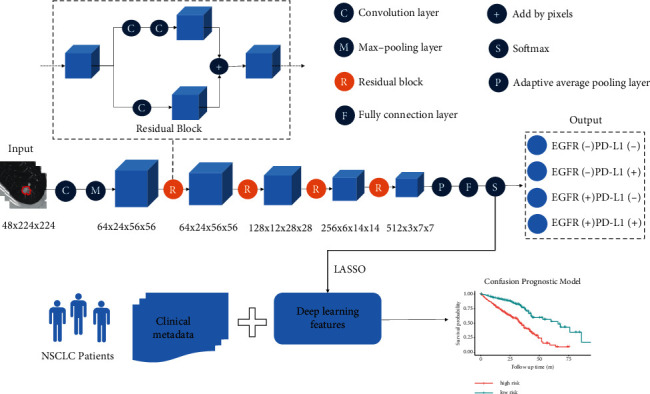
Eligible patients diagnosed/treated at the West China Hospital of Sichuan University from January 2013 to April 2019 were identified retrospectively. The preoperative CT images were obtained, as well as the gene status regarding EGFR mutation and PD-L1 expression. Tumor region of interest (ROI) was delineated manually by experienced respiratory specialists. We used 3D convolutional neural network (CNN) with ROI information as input to construct a classification model and established a prognostic model combining deep learning features and clinical features to stratify survival risk of lung cancer patients.
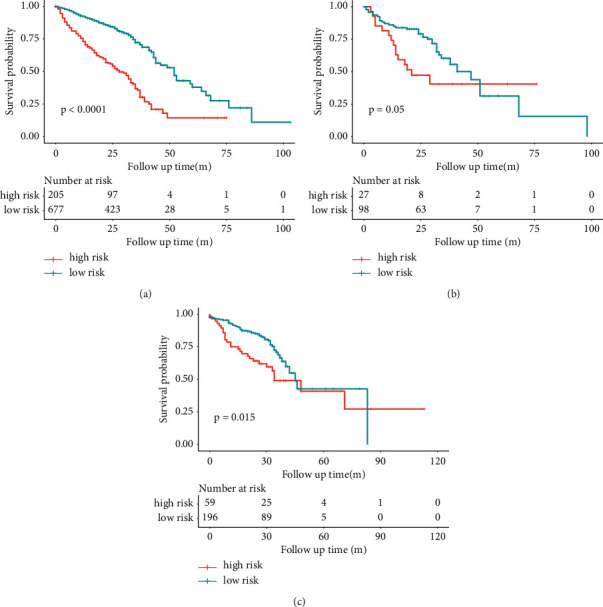
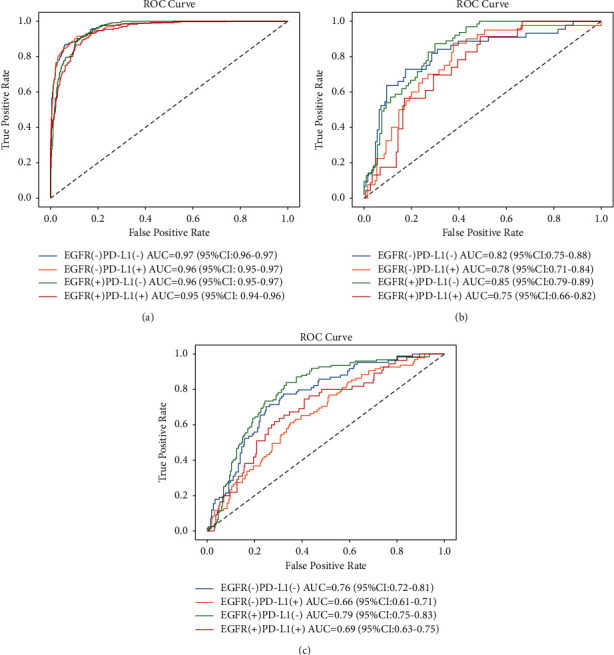
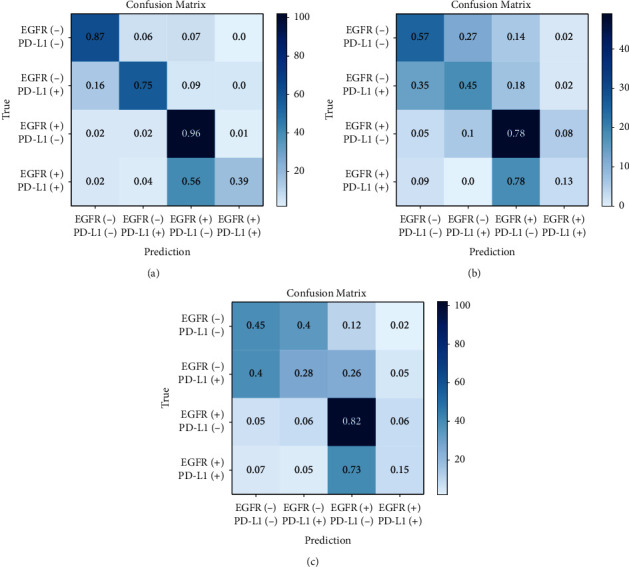
The whole cohort ( = 1262) was divided into a training set ( = 882, 70%), validation set ( = 125, 10%), and test set ( = 255, 20%). We used a 3D convolutional neural network (CNN) to construct a prediction model, with AUCs of 0.96 (95% CI: 0.94-0.98), 0.80 (95% CI: 0.72-0.88), and 0.73 (95% CI: 0.63-0.83) in the training, validation, and test cohorts, respectively. The combined prognostic model showed a good performance on survival prediction in NSCLC patients (C-index: 0.71).
In this study, a noninvasive and effective model was proposed to predict EGFR mutation and PD-L1 expression status as a clinical decision support tool. Additionally, the combination of deep learning features with clinical features demonstrated great stratification capabilities in the prognostic model. Our team would continue to explore the application of imaging markers for treatment selection of lung cancer patients.
检测表皮生长因子受体(EGFR)突变和程序性死亡配体1(PD-L1)表达状态对于确定非小细胞肺癌(NSCLC)患者的治疗策略至关重要。近年来,包括但不限于深度学习技术在内的放射组学迅速发展,显示出医学图像在疾病诊断和治疗中的潜在作用。
回顾性纳入2013年1月至2019年4月在四川大学华西医院诊断/治疗的符合条件的患者。获取术前CT图像以及关于EGFR突变和PD-L1表达的基因状态。由经验丰富的呼吸专科医生手动勾勒肿瘤感兴趣区域(ROI)。我们使用以ROI信息为输入的3D卷积神经网络(CNN)构建分类模型,并建立结合深度学习特征和临床特征的预后模型,以对肺癌患者的生存风险进行分层。
整个队列(n = 1262)分为训练集(n = 882,70%)、验证集(n = 125,10%)和测试集(n = 255,20%)。我们使用3D卷积神经网络(CNN)构建预测模型,在训练、验证和测试队列中的AUC分别为0.96(95%CI:0.94 - 0.98)、0.80(95%CI:0.72 - 0.88)和0.73(95%CI:0.63 - 0.83)。联合预后模型在NSCLC患者生存预测方面表现良好(C指数:0.71)。
在本研究中,提出了一种无创且有效的模型来预测EGFR突变和PD-L1表达状态,作为临床决策支持工具。此外,深度学习特征与临床特征的结合在预后模型中显示出强大的分层能力。我们团队将继续探索影像标志物在肺癌患者治疗选择中的应用。