Department of Mechatronics, Robotics and Digital Manufacturing, Vilnius Gediminas Technical University, 03224 Vilnius, Lithuania.
Department of Chemistry and Bioengineering, Faculty of Fundamental Sciences, Vilnius Gediminas Technical University, 10223 Vilnius, Lithuania.
Sensors (Basel). 2022 Jan 2;22(1):327. doi: 10.3390/s22010327.
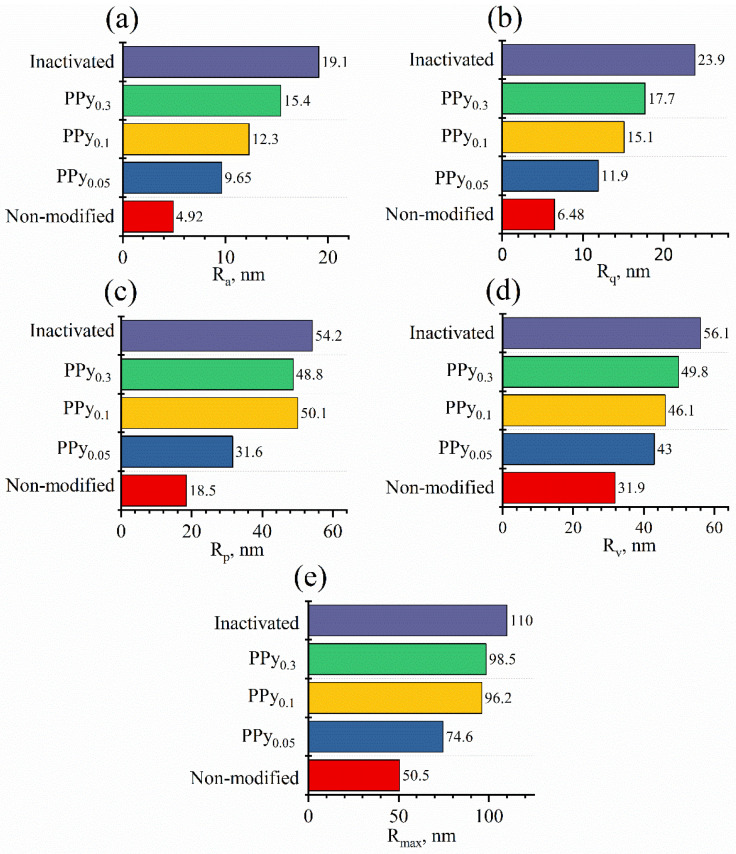
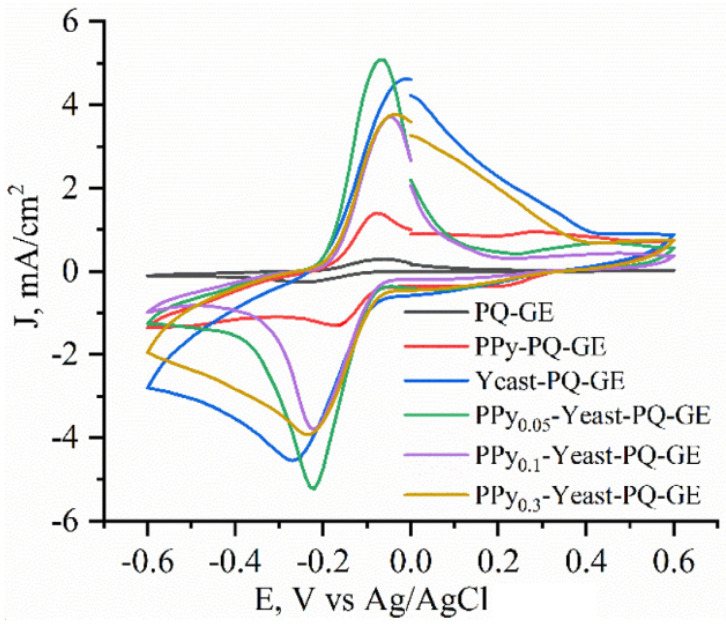
Electrically conductive polymers are promising materials for charge transfer from living cells to the anodes of electrochemical biosensors and biofuel cells. The modification of living cells by polypyrrole (PPy) causes shortened cell lifespan, burdens the replication process, and diminishes renewability in the long term. In this paper, the viability and morphology non-modified, inactivated, and PPy-modified yeasts were evaluated. The results displayed a reduction in cell size, an incremental increase in roughness parameters, and the formation of small structural clusters of polymers on the yeast cells with the increase in the pyrrole concentration used for modification. Yeast modified with the lowest pyrrole concentration showed minimal change; thus, a microbial fuel cell (MFC) was designed using yeast modified by a solution containing 0.05 M pyrrole and compared with the characteristics of an MFC based on non-modified yeast. The maximal generated power of the modified system was 47.12 mW/m, which is 8.32 mW/m higher than that of the system based on non-modified yeast. The open-circuit potentials of the non-modified and PPy-modified yeast-based cells were 335 mV and 390 mV, respectively. Even though applying a PPy layer to yeast increases the charge-transfer efficiency towards the electrode, the damage done to the cells due to modification with a higher concentration of PPy diminishes the amount of charge transferred, as the current density drops by 846 μA/cm. This decrease suggests that modification by PPy may have a cytotoxic effect that greatly hinders the metabolic activity of yeast.
导电聚合物是将活细胞中的电荷转移到电化学生物传感器和生物燃料电池的阳极的有前途的材料。聚吡咯(PPy)对活细胞的修饰会缩短细胞寿命、增加复制过程的负担,并在长期内降低可再生性。在本文中,评估了非修饰、失活和 PPy 修饰的酵母的生存能力和形态。结果显示,随着用于修饰的吡咯浓度的增加,细胞尺寸减小,粗糙度参数递增增加,并且聚合物的小结构簇在酵母细胞上形成。用最低浓度吡咯修饰的酵母显示出最小的变化;因此,使用含有 0.05 M 吡咯的溶液修饰的酵母设计了微生物燃料电池(MFC),并与基于非修饰酵母的 MFC 的特性进行了比较。修饰系统产生的最大功率为 47.12 mW/m,比基于非修饰酵母的系统高 8.32 mW/m。非修饰和 PPy 修饰的酵母细胞的开路电位分别为 335 mV 和 390 mV。尽管在酵母上施加 PPy 层会提高向电极的电荷转移效率,但由于更高浓度的 PPy 修饰而对细胞造成的损害会降低传递的电荷量,因为电流密度下降了 846 μA/cm。这种下降表明,PPy 的修饰可能具有细胞毒性作用,极大地阻碍了酵母的代谢活性。