School of Sciences, Engineering and Environment, University of Salford Manchester, Salford, UK.
Programa de Pós-Graduação em Ecologia de Biomas Tropicais, Departamento de Evolução, Biodiversidade e Meio Ambiente, Universidade Federal de Ouro Preto, Ouro Preto, Minas Gerais, Brasil.
Sci Rep. 2022 Jan 10;12(1):478. doi: 10.1038/s41598-021-04502-2.
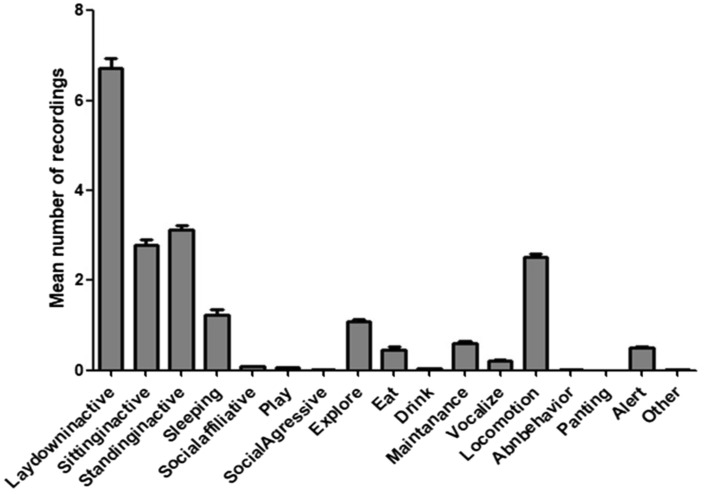
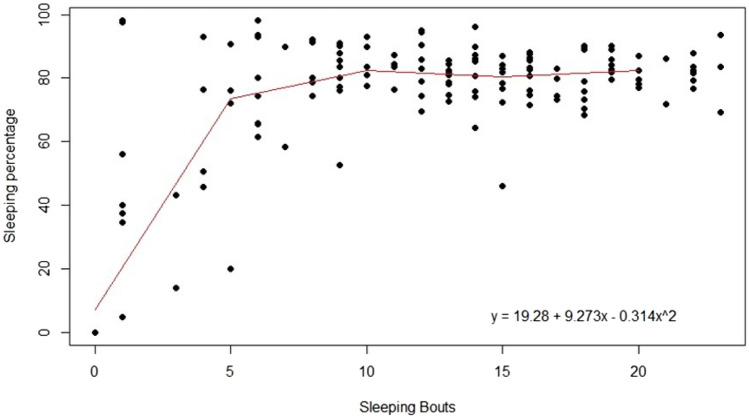
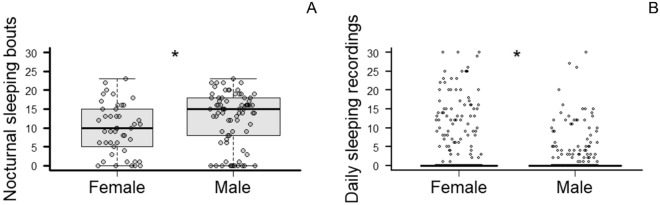
Sleep deprivation has been found to negatively affect an individual´s physical and psychological health. Sleep loss affects activity patterns, increases anxiety-like behaviors, decreases cognitive performance and is associated with depressive states. The activity/rest cycle of dogs has been investigated before, but little is known about the effects of sleep loss on the behavior of the species. Dogs are polyphasic sleepers, meaning the behavior is most observed at night, but bouts are also present during the day. However, sleep can vary with ecological and biological factors, such as age, sex, fitness, and even human presence. In this study, kennelled laboratory adult dogs' sleep and diurnal behavior were recorded during 24-h, five-day assessment periods to investigate sleep quality and its effect on daily behavior. In total, 1560 h of data were analyzed, and sleep metrics and diurnal behavior were quantified. The relationship between sleeping patterns and behavior and the effect of age and sex were evaluated using non-parametric statistical tests and GLMM modelling. Dogs in our study slept substantially less than previously reported and presented a modified sleep architecture with fewer awakenings during the night and almost no sleep during the day. Sleep loss increased inactivity, decreased play and alert behaviors, while increased time spent eating during the day. Males appeared to be more affected by sleep fragmentation than females. Different age groups also experienced different effects of sleep loss. Overall, dogs appear to compensate for the lack of sleep during the night by remaining inactive during the day. With further investigations, the relationship between sleep loss and behavior has the potential to be used as a measure of animal welfare.
睡眠剥夺已被发现会对个人的身心健康产生负面影响。睡眠不足会影响活动模式,增加类似焦虑的行为,降低认知表现,并与抑郁状态有关。以前已经研究过狗的活动/休息周期,但对于睡眠不足对该物种行为的影响知之甚少。狗是多相睡眠者,这意味着行为最常见于夜间,但白天也有发作。然而,睡眠会因生态和生物因素而变化,例如年龄、性别、健康状况,甚至人类的存在。在这项研究中,在 24 小时、五天的评估期间记录了犬舍中成年犬的睡眠和日间行为,以研究睡眠质量及其对日常行为的影响。总共分析了 1560 小时的数据,并量化了睡眠指标和日间行为。使用非参数统计检验和 GLMM 模型评估了睡眠模式和行为之间的关系以及年龄和性别的影响。我们研究中的狗睡眠明显少于之前的报告,并呈现出经过修改的睡眠结构,夜间觉醒次数减少,白天几乎没有睡眠。睡眠不足会增加不活动、减少玩耍和警觉行为,同时增加白天的进食时间。雄性似乎比雌性更容易受到睡眠碎片化的影响。不同年龄组也经历了不同的睡眠不足影响。总的来说,狗似乎通过白天保持不活动来弥补夜间的睡眠不足。随着进一步的研究,睡眠不足与行为之间的关系有可能被用作衡量动物福利的指标。