• 文献检索
  • 文档翻译
  • 深度研究
  • 学术资讯
  • Suppr Zotero 插件Zotero 插件
  • 邀请有礼
  • 套餐&价格
  • 历史记录
应用&插件
Suppr Zotero 插件Zotero 插件浏览器插件Mac 客户端Windows 客户端微信小程序
定价
高级版会员购买积分包购买API积分包
服务
文献检索文档翻译深度研究API 文档MCP 服务
关于我们
关于 Suppr公司介绍联系我们用户协议隐私条款
关注我们

Suppr 超能文献

核心技术专利:CN118964589B侵权必究
粤ICP备2023148730 号-1Suppr @ 2026

文献检索

告别复杂PubMed语法,用中文像聊天一样搜索,搜遍4000万医学文献。AI智能推荐,让科研检索更轻松。

立即免费搜索

文件翻译

保留排版,准确专业,支持PDF/Word/PPT等文件格式,支持 12+语言互译。

免费翻译文档

深度研究

AI帮你快速写综述,25分钟生成高质量综述,智能提取关键信息,辅助科研写作。

立即免费体验

医疗保健中基于人工智能的预测模型的指南和质量标准:一项范围综述

Guidelines and quality criteria for artificial intelligence-based prediction models in healthcare: a scoping review.

作者信息

de Hond Anne A H, Leeuwenberg Artuur M, Hooft Lotty, Kant Ilse M J, Nijman Steven W J, van Os Hendrikus J A, Aardoom Jiska J, Debray Thomas P A, Schuit Ewoud, van Smeden Maarten, Reitsma Johannes B, Steyerberg Ewout W, Chavannes Niels H, Moons Karel G M

机构信息

Department of Information Technology and Digital Innovation, Leiden University Medical Center, Leiden, The Netherlands.

Clinical AI Implementation and Research Lab, Leiden University Medical Center, Leiden, The Netherlands.

出版信息

NPJ Digit Med. 2022 Jan 10;5(1):2. doi: 10.1038/s41746-021-00549-7.

DOI:10.1038/s41746-021-00549-7
PMID:35013569
原文链接:https://pmc.ncbi.nlm.nih.gov/articles/PMC8748878/
Abstract

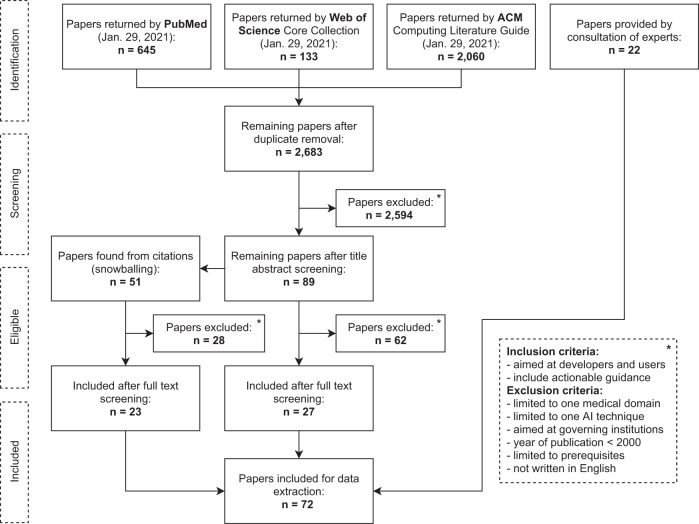
While the opportunities of ML and AI in healthcare are promising, the growth of complex data-driven prediction models requires careful quality and applicability assessment before they are applied and disseminated in daily practice. This scoping review aimed to identify actionable guidance for those closely involved in AI-based prediction model (AIPM) development, evaluation and implementation including software engineers, data scientists, and healthcare professionals and to identify potential gaps in this guidance. We performed a scoping review of the relevant literature providing guidance or quality criteria regarding the development, evaluation, and implementation of AIPMs using a comprehensive multi-stage screening strategy. PubMed, Web of Science, and the ACM Digital Library were searched, and AI experts were consulted. Topics were extracted from the identified literature and summarized across the six phases at the core of this review: (1) data preparation, (2) AIPM development, (3) AIPM validation, (4) software development, (5) AIPM impact assessment, and (6) AIPM implementation into daily healthcare practice. From 2683 unique hits, 72 relevant guidance documents were identified. Substantial guidance was found for data preparation, AIPM development and AIPM validation (phases 1-3), while later phases clearly have received less attention (software development, impact assessment and implementation) in the scientific literature. The six phases of the AIPM development, evaluation and implementation cycle provide a framework for responsible introduction of AI-based prediction models in healthcare. Additional domain and technology specific research may be necessary and more practical experience with implementing AIPMs is needed to support further guidance.

摘要

虽然机器学习和人工智能在医疗保健领域的机会前景广阔,但复杂的数据驱动预测模型的发展在应用于日常实践并推广之前,需要仔细进行质量和适用性评估。本范围综述旨在为那些密切参与基于人工智能的预测模型(AIPM)开发、评估和实施的人员(包括软件工程师、数据科学家和医疗保健专业人员)确定可操作的指导意见,并找出该指导意见中潜在的差距。我们使用全面的多阶段筛选策略,对有关AIPM开发、评估和实施的指导意见或质量标准的相关文献进行了范围综述。检索了PubMed、科学网和美国计算机协会数字图书馆,并咨询了人工智能专家。从已识别的文献中提取主题,并在本综述核心的六个阶段进行总结:(1)数据准备,(2)AIPM开发,(3)AIPM验证,(4)软件开发,(5)AIPM影响评估,以及(6)AIPM在日常医疗实践中的实施。从2683个独特的搜索结果中,识别出72份相关指导文件。在数据准备、AIPM开发和AIPM验证(第1 - 3阶段)方面发现了大量指导意见,而在科学文献中,后期阶段(软件开发、影响评估和实施)显然受到的关注较少。AIPM开发、评估和实施周期的六个阶段为在医疗保健中负责任地引入基于人工智能的预测模型提供了一个框架。可能需要更多特定领域和技术的研究,并且需要更多实施AIPM的实践经验来支持进一步的指导。
https://cdn.ncbi.nlm.nih.gov/pmc/blobs/04ff/8748878/705dd363af26/41746_2021_549_Fig1_HTML.jpg

相似文献

1
Guidelines and quality criteria for artificial intelligence-based prediction models in healthcare: a scoping review.医疗保健中基于人工智能的预测模型的指南和质量标准:一项范围综述
NPJ Digit Med. 2022 Jan 10;5(1):2. doi: 10.1038/s41746-021-00549-7.
2
Artificial intelligence technologies and compassion in healthcare: A systematic scoping review.医疗保健中的人工智能技术与人文关怀:一项系统综述。
Front Psychol. 2023 Jan 17;13:971044. doi: 10.3389/fpsyg.2022.971044. eCollection 2022.
3
Challenges and Facilitation Approaches for the Participatory Design of AI-Based Clinical Decision Support Systems: Protocol for a Scoping Review.基于人工智能的临床决策支持系统参与式设计的挑战和促进方法:系统评价方案。
JMIR Res Protoc. 2024 Sep 5;13:e58185. doi: 10.2196/58185.
4
Impact of Responsible AI on the Occurrence and Resolution of Ethical Issues: Protocol for a Scoping Review.负责任的人工智能对伦理问题的发生和解决的影响:范围综述方案。
JMIR Res Protoc. 2024 Jun 5;13:e52349. doi: 10.2196/52349.
5
ARTIFICIAL INTELLIGENCE IN MEDICAL PRACTICE: REGULATIVE ISSUES AND PERSPECTIVES.人工智能在医学实践中的应用:监管问题与展望。
Wiad Lek. 2020;73(12 cz 2):2722-2727.
6
Barriers to and facilitators of clinician acceptance and use of artificial intelligence in healthcare settings: a scoping review.医疗环境中临床医生接受和使用人工智能的障碍与促进因素:一项范围综述
BMJ Open. 2025 Apr 15;15(4):e092624. doi: 10.1136/bmjopen-2024-092624.
7
Beyond the black stump: rapid reviews of health research issues affecting regional, rural and remote Australia.超越黑木树:影响澳大利亚地区、农村和偏远地区的健康研究问题的快速综述。
Med J Aust. 2020 Dec;213 Suppl 11:S3-S32.e1. doi: 10.5694/mja2.50881.
8
Understanding the factors influencing acceptability of AI in medical imaging domains among healthcare professionals: A scoping review.理解医疗保健专业人员对医学影像领域中 AI 可接受性的影响因素:范围综述。
Artif Intell Med. 2024 Jan;147:102698. doi: 10.1016/j.artmed.2023.102698. Epub 2023 Nov 9.
9
Ventilator-Associated Pneumonia Prediction Models Based on AI: Scoping Review.基于人工智能的呼吸机相关性肺炎预测模型:范围综述
JMIR Med Inform. 2024 May 14;12:e57026. doi: 10.2196/57026.
10
Suitability of the Current Health Technology Assessment of Innovative Artificial Intelligence-Based Medical Devices: Scoping Literature Review.现行创新型基于人工智能的医疗器械卫生技术评估的适宜性:范围文献综述。
J Med Internet Res. 2024 May 13;26:e51514. doi: 10.2196/51514.

引用本文的文献

1
Deep Learning Model for Osteoporosis Screening From Chest Radiographs: A Multicenter Analysis of External Robustness and Model Calibration.基于胸部X光片的骨质疏松症筛查深度学习模型:外部稳健性和模型校准的多中心分析
Cureus. 2025 Aug 5;17(8):e89446. doi: 10.7759/cureus.89446. eCollection 2025 Aug.
2
Machine learning approaches in the therapeutic outcome prediction in major depressive disorder: a systematic review.机器学习方法在重度抑郁症治疗结果预测中的应用:一项系统综述
Front Psychiatry. 2025 Aug 13;16:1588963. doi: 10.3389/fpsyt.2025.1588963. eCollection 2025.
3
A Bayesian network-based predictive model for postoperative delirium following coronary artery bypass grafting.

本文引用的文献

1
Minimum sample size for external validation of a clinical prediction model with a binary outcome.具有二元结局的临床预测模型外部验证的最小样本量
Stat Med. 2021 Aug 30;40(19):4230-4251. doi: 10.1002/sim.9025. Epub 2021 May 24.
2
Checklist for Artificial Intelligence in Medical Imaging (CLAIM): A Guide for Authors and Reviewers.医学影像人工智能清单(CLAIM):作者和审稿人指南
Radiol Artif Intell. 2020 Mar 25;2(2):e200029. doi: 10.1148/ryai.2020200029. eCollection 2020 Mar.
3
Clinical prediction models: diagnosis versus prognosis.
一种基于贝叶斯网络的冠状动脉搭桥术后谵妄预测模型。
BMC Psychiatry. 2025 Aug 26;25(1):822. doi: 10.1186/s12888-025-07299-w.
4
Label Accuracy in Electronic Health Records and Its Impact on Machine Learning Models for Early Prediction of Gestational Diabetes: 3-Step Retrospective Validation Study.电子健康记录中的标签准确性及其对妊娠期糖尿病早期预测机器学习模型的影响:三步回顾性验证研究
JMIR Med Inform. 2025 Aug 21;13:e72938. doi: 10.2196/72938.
5
Establishing organizational AI governance in healthcare: a case study in Canada.在医疗保健领域建立组织人工智能治理:加拿大的一个案例研究。
NPJ Digit Med. 2025 Aug 15;8(1):522. doi: 10.1038/s41746-025-01909-3.
6
Prognostic models for large cell neuroendocrine lung carcinoma: a machine learning and regression approach.大细胞神经内分泌肺癌的预后模型:一种机器学习与回归方法
Transl Lung Cancer Res. 2025 Jul 31;14(7):2470-2482. doi: 10.21037/tlcr-2025-130. Epub 2025 Jul 28.
7
A practical framework for appropriate implementation and review of artificial intelligence (FAIR-AI) in healthcare.医疗保健领域人工智能合理实施与审查实用框架(FAIR-AI)
NPJ Digit Med. 2025 Aug 11;8(1):514. doi: 10.1038/s41746-025-01900-y.
8
TRIPOD+AI statement: updated guidance for reporting clinical prediction models that use regression or machine learning methods: a Korean translation.TRIPOD+AI声明:使用回归或机器学习方法的临床预测模型报告的更新指南:韩文翻译
Ewha Med J. 2025 Jul;48(3):e48. doi: 10.12771/emj.2025.00668. Epub 2025 Jul 31.
9
Clinical Performance and Communication Skills of ChatGPT Versus Physicians in Emergency Medicine: Simulated Patient Study.ChatGPT与急诊医学医生的临床表现及沟通技巧:模拟患者研究
JMIR Med Inform. 2025 Jul 17;13:e68409. doi: 10.2196/68409.
10
From data to medical context: the power of categorization in healthcare.从数据到医学背景:医疗保健中分类的力量。
Front Med (Lausanne). 2025 Jun 11;12:1575195. doi: 10.3389/fmed.2025.1575195. eCollection 2025.
临床预测模型:诊断与预后。
J Clin Epidemiol. 2021 Apr;132:142-145. doi: 10.1016/j.jclinepi.2021.01.009.
4
Adaptive sample size determination for the development of clinical prediction models.临床预测模型开发中的自适应样本量确定
Diagn Progn Res. 2021 Mar 22;5(1):6. doi: 10.1186/s41512-021-00096-5.
5
From Code to Bedside: Implementing Artificial Intelligence Using Quality Improvement Methods.从代码到床边:使用质量改进方法实施人工智能。
J Gen Intern Med. 2021 Apr;36(4):1061-1066. doi: 10.1007/s11606-020-06394-w. Epub 2021 Jan 19.
6
Continual updating and monitoring of clinical prediction models: time for dynamic prediction systems?临床预测模型的持续更新与监测:动态预测系统的时代来临了吗?
Diagn Progn Res. 2021 Jan 11;5(1):1. doi: 10.1186/s41512-020-00090-3.
7
Penalization and shrinkage methods produced unreliable clinical prediction models especially when sample size was small.惩罚和收缩方法会产生不可靠的临床预测模型,尤其是在样本量较小时。
J Clin Epidemiol. 2021 Apr;132:88-96. doi: 10.1016/j.jclinepi.2020.12.005. Epub 2020 Dec 8.
8
Machine learning in cardiovascular radiology: ESCR position statement on design requirements, quality assessment, current applications, opportunities, and challenges.心血管放射学中的机器学习:欧洲心血管放射学会关于设计要求、质量评估、当前应用、机遇和挑战的立场声明。
Eur Radiol. 2021 Jun;31(6):3909-3922. doi: 10.1007/s00330-020-07417-0. Epub 2020 Nov 19.
9
Minimum sample size for external validation of a clinical prediction model with a continuous outcome.用于连续结局临床预测模型外部验证的最小样本量。
Stat Med. 2021 Jan 15;40(1):133-146. doi: 10.1002/sim.8766. Epub 2020 Nov 4.
10
Regulatory Frameworks for Development and Evaluation of Artificial Intelligence-Based Diagnostic Imaging Algorithms: Summary and Recommendations.基于人工智能的诊断成像算法的开发和评估的监管框架:总结和建议。
J Am Coll Radiol. 2021 Mar;18(3 Pt A):413-424. doi: 10.1016/j.jacr.2020.09.060. Epub 2020 Oct 20.