The Brain and Mind Institute, Western University, London, Canada.
Department of Computer Science, Western University, London, Canada.
Elife. 2022 Jan 12;11:e69517. doi: 10.7554/eLife.69517.
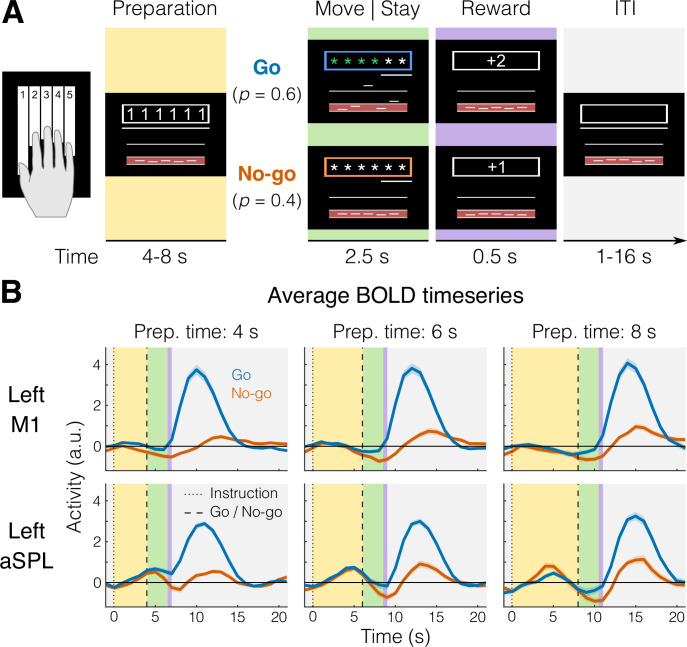
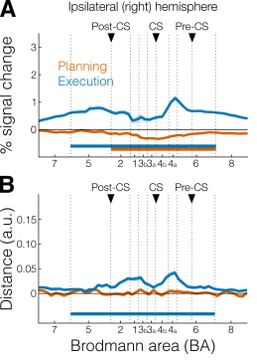
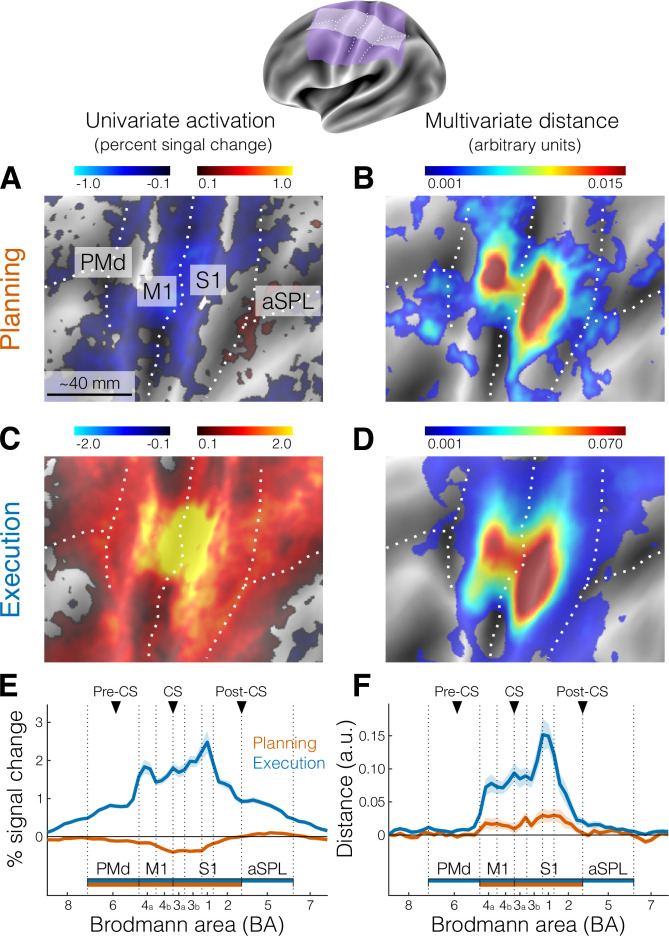
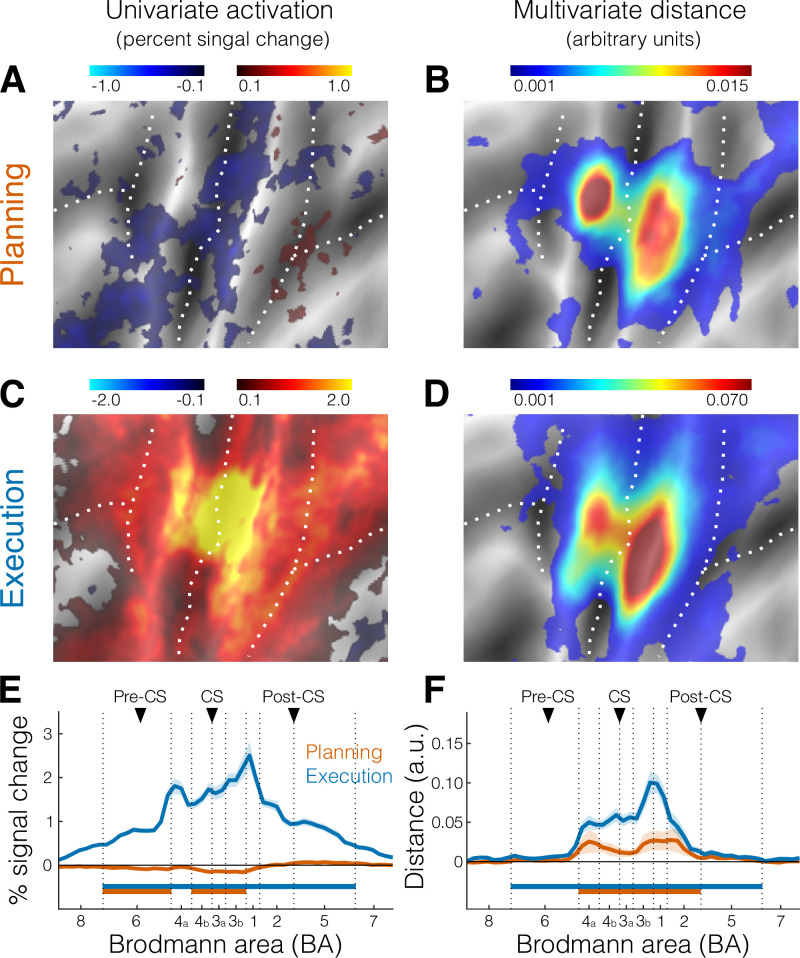
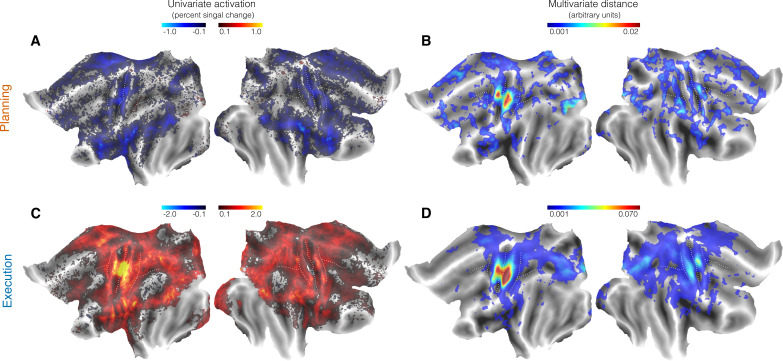
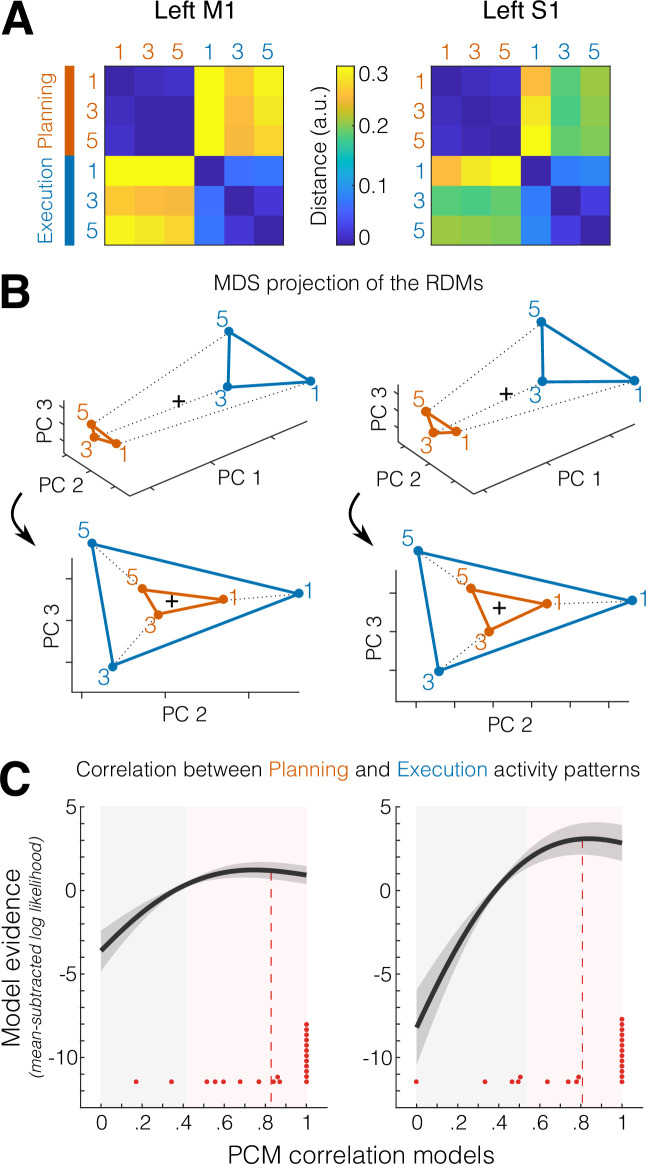
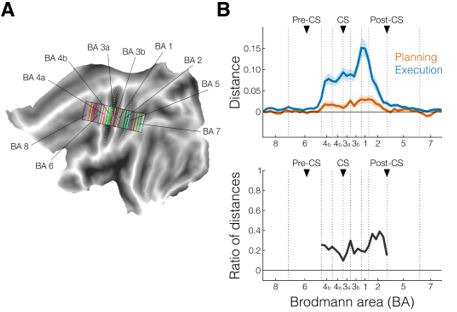
Motor planning plays a critical role in producing fast and accurate movement. Yet, the neural processes that occur in human primary motor and somatosensory cortex during planning, and how they relate to those during movement execution, remain poorly understood. Here, we used 7T functional magnetic resonance imaging and a delayed movement paradigm to study single finger movement planning and execution. The inclusion of no-go trials and variable delays allowed us to separate what are typically overlapping planning and execution brain responses. Although our univariate results show widespread deactivation during finger planning, multivariate pattern analysis revealed finger-specific activity patterns in contralateral primary somatosensory cortex (S1), which predicted the planned finger action. Surprisingly, these activity patterns were as informative as those found in contralateral primary motor cortex (M1). Control analyses ruled out the possibility that the detected information was an artifact of subthreshold movements during the preparatory delay. Furthermore, we observed that finger-specific activity patterns during planning were highly correlated to those during execution. These findings reveal that motor planning activates the specific S1 and M1 circuits that are engaged during the execution of a finger press, while activity in both regions is overall suppressed. We propose that preparatory states in S1 may improve movement control through changes in sensory processing or via direct influence of spinal motor neurons.
运动规划在产生快速准确的运动中起着至关重要的作用。然而,人类初级运动和体感皮层在规划过程中发生的神经过程,以及它们与运动执行过程中的神经过程有何关联,仍知之甚少。在这里,我们使用 7T 功能磁共振成像和延迟运动范式来研究单个手指的运动规划和执行。包含非运动试验和可变延迟,使我们能够分离通常重叠的规划和执行脑反应。虽然我们的单变量结果显示手指规划期间广泛的去激活,但多元模式分析显示对侧初级体感皮层(S1)中存在手指特异性活动模式,这些模式预测了规划的手指动作。令人惊讶的是,这些活动模式与在对侧初级运动皮层(M1)中发现的模式一样具有信息量。控制分析排除了在预备延迟期间检测到的信息是亚阈值运动的伪影的可能性。此外,我们观察到规划期间的手指特异性活动模式与执行期间的高度相关。这些发现表明,运动规划激活了在执行手指按压时所涉及的特定 S1 和 M1 回路,而两个区域的活动总体上受到抑制。我们提出,S1 中的预备状态可能通过改变感觉处理或通过对脊髓运动神经元的直接影响来改善运动控制。