Neural Control of Movement Laboratory, Department of Health Sciences and Technology, ETH Zürich, Zürich, Switzerland.
Spinal Cord Injury Center, Balgrist University Hospital, University of Zürich, Zürich, Switzerland.
Elife. 2021 Oct 19;10:e67713. doi: 10.7554/eLife.67713.
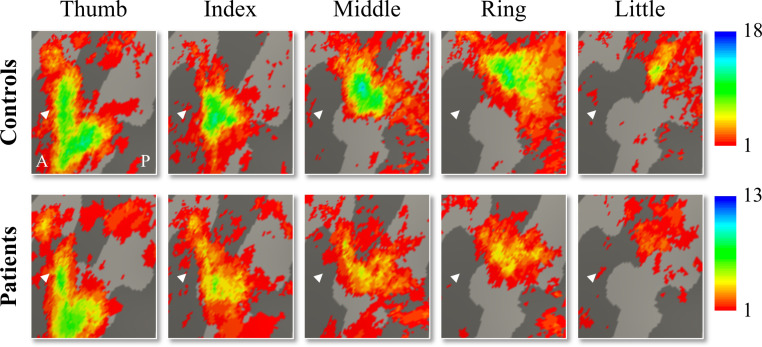
Previous studies showed reorganised and/or altered activity in the primary sensorimotor cortex after a spinal cord injury (SCI), suggested to reflect abnormal processing. However, little is known about whether somatotopically specific representations can be activated despite reduced or absent afferent hand inputs. In this observational study, we used functional MRI and a (attempted) finger movement task in tetraplegic patients to characterise the somatotopic hand layout in primary somatosensory cortex. We further used structural MRI to assess spared spinal tissue bridges. We found that somatotopic hand representations can be activated through attempted finger movements in the absence of sensory and motor hand functioning, and no spared spinal tissue bridges. Such preserved hand somatotopy could be exploited by rehabilitation approaches that aim to establish new hand-brain functional connections after SCI (e.g. neuroprosthetics). However, over years since SCI the hand representation somatotopy deteriorated, suggesting that somatotopic hand representations are more easily targeted within the first years after SCI.
先前的研究表明,脊髓损伤(SCI)后初级感觉运动皮层的活动发生了重组和/或改变,这被认为反映了异常的处理过程。然而,对于尽管传入手部输入减少或缺失,是否仍可以激活躯体定位特异性的手部代表,我们知之甚少。在这项观察性研究中,我们使用功能磁共振成像和四肢瘫痪患者的(尝试)手指运动任务来描述初级体感皮层中的手部躯体定位图。我们进一步使用结构磁共振成像来评估保留的脊髓组织桥。我们发现,即使在没有感觉和运动手部功能的情况下,通过尝试手指运动也可以激活躯体定位的手部代表,并且不需要保留的脊髓组织桥。这种保留的手部躯体定位图可以被康复方法利用,这些方法旨在在 SCI 后建立新的手脑功能连接(例如神经假体)。然而,在 SCI 发生后的多年中,手部代表的躯体定位图恶化了,这表明在 SCI 后最初几年中更容易针对躯体定位的手部代表进行治疗。