Northern Medical Program, 6727University of Northern British Columbia (UNBC), Prince George, British Columbia, Canada.
School of Population and Public Health, University of British Columbia (UBC), Vancouver, British Columbia, Canada.
Can J Psychiatry. 2022 Aug;67(8):616-625. doi: 10.1177/07067437211070650. Epub 2022 Jan 12.
Cannabis legalization in many jurisdictions worldwide has raised concerns that such legislation might increase the burden of transient and persistent psychotic illnesses in society. Our study aimed to address this issue.
Drawing upon emergency department (ED) presentations aggregated across Alberta and Ontario, Canada records (April 1, 2015-December 31, 2019), we employed Seasonal Autoregressive Integrated Moving Average (SARIMA) models to assess associations between Canada's cannabis legalization (via the implemented on October 17, 2018) and weekly ED presentation counts of the following ICD-10-CA-defined target series of cannabis-induced psychosis (F12.5; = 5832) and schizophrenia and related conditions ("schizophrenia"; F20-F29; = 211,661), as well as two comparison series of amphetamine-induced psychosis (F15.5; = 10,829) and alcohol-induced psychosis (F10.5; = 1,884).
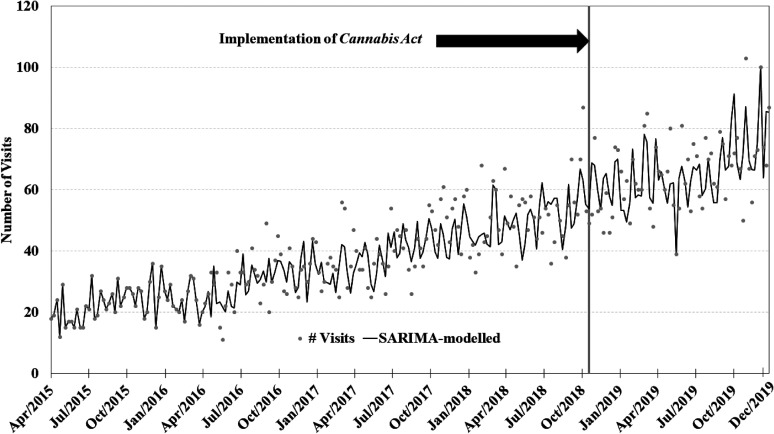
ED presentations for cannabis-induced psychosis doubled between April 2015 and December 2019. However, across all four SARIMA models, there was no evidence of significant step-function effects associated with cannabis legalization on post-legalization weekly ED counts of: (1) cannabis-induced psychosis [0.34 (95% CI -4.1; 4.8; = 0.88)]; (2) schizophrenia [24.34 (95% CI -18.3; 67.0; = 0.26)]; (3) alcohol-induced psychosis [0.61 (95% CI -0.6; 1.8; = 0.31); or (4) amphetamine-induced psychosis [1.93 (95% CI -2.8; 6.7; = 0.43)].
Implementation of Canada's cannabis legalization framework was not associated with evidence of significant changes in cannabis-induced psychosis or schizophrenia ED presentations. Given the potentially idiosyncratic rollout of Canada's cannabis legalization, further research will be required to establish whether study results generalize to other settings.
在世界上许多司法管辖区,大麻合法化引起了人们的担忧,即此类立法可能会增加社会中短暂和持续精神病的负担。我们的研究旨在解决这个问题。
利用加拿大艾伯塔省和安大略省的急诊部(ED)就诊记录(2015 年 4 月 1 日至 2019 年 12 月 31 日),我们采用季节性自回归综合移动平均(SARIMA)模型来评估加拿大大麻合法化(通过 2018 年 10 月 17 日实施)与以下 ICD-10-CA 定义的大麻诱发精神病(F12.5;=5832)和精神分裂症及相关病症(“精神分裂症”;F20-F29;=211661)每周 ED 就诊计数之间的关联,以及两个比较系列的安非他命诱发精神病(F15.5;=10829)和酒精诱发精神病(F10.5;=1884)。
2015 年 4 月至 2019 年 12 月期间,大麻诱发精神病的 ED 就诊人数增加了一倍。然而,在所有四个 SARIMA 模型中,都没有证据表明大麻合法化与以下方面存在显著的阶跃效应:(1)大麻诱发精神病[0.34(95%CI-4.1;4.8;=0.88)];(2)精神分裂症[24.34(95%CI-18.3;67.0;=0.26)];(3)酒精诱发精神病[0.61(95%CI-0.6;1.8;=0.31)];或(4)安非他命诱发精神病[1.93(95%CI-2.8;6.7;=0.43)]。
加拿大大麻合法化框架的实施与大麻诱发精神病或精神分裂症 ED 就诊人数的显著变化无关。鉴于加拿大大麻合法化的实施可能具有特殊性,需要进一步的研究来确定研究结果是否适用于其他环境。