Research and Development, Dascena, Houston, Texas, USA.
Research and Development, Dascena, Houston, Texas, USA
BMJ Open Diabetes Res Care. 2022 Jan;10(1). doi: 10.1136/bmjdrc-2021-002560.
Diabetic kidney disease (DKD) accounts for the majority of increased risk of mortality for patients with diabetes, and eventually manifests in approximately half of those patients diagnosed with type 2 diabetes mellitus (T2DM). Although increased screening frequency can avoid delayed diagnoses, this is not uniformly implemented. The purpose of this study was to develop and retrospectively validate a machine learning algorithm (MLA) that predicts stages of DKD within 5 years upon diagnosis of T2DM.
Two MLAs were trained to predict stages of DKD severity, and compared with the Centers for Disease Control and Prevention (CDC) risk score to evaluate performance. The models were validated on a hold-out test set as well as an external dataset sourced from separate facilities.
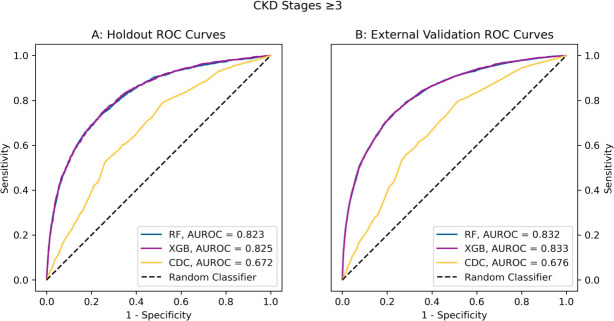
The MLAs outperformed the CDC risk score in both the hold-out test and external datasets. Our algorithms achieved an area under the receiver operating characteristic curve (AUROC) of 0.75 on the hold-out set for prediction of any-stage DKD and an AUROC of over 0.82 for more severe endpoints, compared with the CDC risk score with an AUROC <0.70 on all test sets and endpoints.
This retrospective study shows that an MLA can provide timely predictions of DKD among patients with recently diagnosed T2DM.
糖尿病肾病(DKD)是导致糖尿病患者死亡率增加的主要原因,最终约有一半的 2 型糖尿病(T2DM)患者会出现这种情况。尽管增加筛查频率可以避免诊断延迟,但这种做法并未得到普遍实施。本研究旨在开发并回顾性验证一种机器学习算法(MLA),以预测 T2DM 确诊后 5 年内 DKD 的分期。
我们训练了两种 MLA 来预测 DKD 严重程度分期,并与疾病预防控制中心(CDC)风险评分进行比较,以评估性能。我们还在保留测试集和来自不同机构的外部数据集上对模型进行了验证。
在保留测试集和外部数据集上,MLA 的表现均优于 CDC 风险评分。我们的算法在保留测试集中预测任何分期 DKD 的受试者工作特征曲线下面积(AUROC)为 0.75,对于更严重的终点,AUROC 超过 0.82,而 CDC 风险评分在所有测试集和终点的 AUROC 均低于 0.70。
这项回顾性研究表明,MLA 可以为近期诊断为 T2DM 的患者及时预测 DKD。