Noel Teia, Wang Qingbo S, Greka Anna, Marshall Jamie L
Kidney Disease Initiative, Broad Institute of MIT and Harvard, Cambridge, MA, United States.
Program in Medical and Population Genetics, Broad Institute of MIT and Harvard, Cambridge, MA, United States.
Front Physiol. 2022 Jan 6;12:809346. doi: 10.3389/fphys.2021.809346. eCollection 2021.
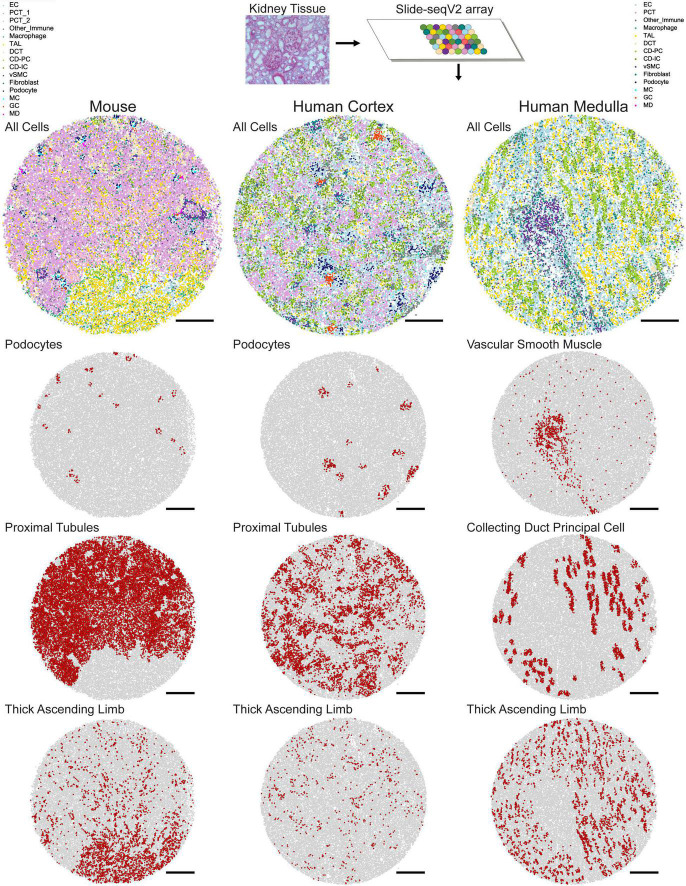
Spatial transcriptomic technologies capture genome-wide readouts across biological tissue space. Moreover, recent advances in this technology, including Slide-seqV2, have achieved spatial transcriptomic data collection at a near-single cell resolution. To-date, a repertoire of computational tools has been developed to discern cell type classes given the transcriptomic profiles of tissue coordinates. Upon applying these tools, we can explore the spatial patterns of distinct cell types and characterize how genes are spatially expressed within different cell type contexts. The kidney is one organ whose function relies upon spatially defined structures consisting of distinct cellular makeup. Thus, the application of Slide-seqV2 to kidney tissue has enabled us to elucidate spatially characteristic cellular and genetic profiles at a scale that remains largely unexplored. Here, we review spatial transcriptomic technologies, as well as computational approaches for cell type mapping and spatial cell type and transcriptomic characterizations. We take kidney tissue as an example to demonstrate how the technologies are applied, while considering the nuances of this architecturally complex tissue.
空间转录组技术可在生物组织空间内获取全基因组读数。此外,包括Slide-seqV2在内的该技术的最新进展已实现了近单细胞分辨率的空间转录组数据收集。迄今为止,已经开发了一系列计算工具,用于根据组织坐标的转录组概况识别细胞类型类别。应用这些工具后,我们可以探索不同细胞类型的空间模式,并描述基因在不同细胞类型背景下的空间表达情况。肾脏是一个器官,其功能依赖于由不同细胞组成构成的空间定义结构。因此,将Slide-seqV2应用于肾脏组织使我们能够在很大程度上尚未探索的尺度上阐明空间特征性的细胞和遗传概况。在这里,我们回顾空间转录组技术,以及用于细胞类型映射和空间细胞类型及转录组特征描述的计算方法。我们以肾脏组织为例,展示这些技术的应用方式,同时考虑这种结构复杂组织的细微差别。