Gosmann Dario, Russelli Lisa, Weber Wolfgang A, Schwaiger Markus, Krackhardt Angela M, D'Alessandria Calogero
Klinik und Poliklinik für Innere Medizin III, Klinikum rechts der Isar, Technische Universität München, Munich, Germany.
Klinik und Poliklinik für Nuklearmedizin, Klinikum rechts der Isar, Technische Universität München, Munich, Germany.
EJNMMI Res. 2022 Jan 31;12(1):5. doi: 10.1186/s13550-022-00877-z.
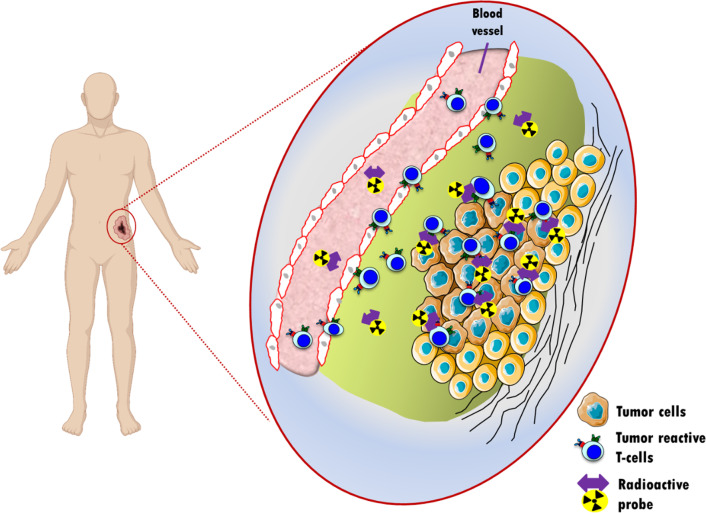
In the last decades, our understanding of the role of the immune system in cancer has significantly improved and led to the discovery of new immunotherapeutic targets and tools, which boosted the advances in cancer immunotherapy to fight a growing number of malignancies. Approved immunotherapeutic approaches are currently mainly based on immune checkpoint inhibitors, antibody-derived targeted therapies, or cell-based immunotherapies. In essence, these therapies induce or enhance the infiltration and function of tumor-reactive T cells within the tumors, ideally resulting in complete tumor eradication. While the clinical application of immunotherapies has shown great promise, these therapies are often accompanied either by a variety of side effects as well as partial or complete unresponsiveness of a number of patients. Since different stages of disease progression elicit different local and systemic immune responses, the ability to longitudinally interrogate the migration and expansion of immune cells, especially T cells, throughout the whole body might greatly facilitate disease characterization and understanding. Furthermore, it can serve as a tool to guide development as well as selection of appropriate treatment regiments. This review provides an overview about a variety of immune-imaging tools available to characterize and study T-cell responses induced by anti-cancer immunotherapy. Moreover, challenges are discussed that must be taken into account and overcome to use immune-imaging tools as predictive and surrogate markers to enhance assessment and successful application of immunotherapies.
在过去几十年中,我们对免疫系统在癌症中作用的理解有了显著提高,并促成了新的免疫治疗靶点和工具的发现,推动了癌症免疫治疗在对抗越来越多恶性肿瘤方面的进展。目前获批的免疫治疗方法主要基于免疫检查点抑制剂、抗体衍生的靶向疗法或基于细胞的免疫疗法。从本质上讲,这些疗法诱导或增强肿瘤内肿瘤反应性T细胞的浸润和功能,理想情况下可实现肿瘤的完全根除。虽然免疫疗法的临床应用已显示出巨大潜力,但这些疗法往往伴随着各种副作用以及许多患者出现部分或完全无反应的情况。由于疾病进展的不同阶段会引发不同的局部和全身免疫反应,因此能够纵向研究免疫细胞,尤其是T细胞在全身的迁移和扩增,可能会极大地促进疾病特征的描述和理解。此外,它还可以作为指导治疗方案制定和选择的工具。本综述概述了多种可用于表征和研究抗癌免疫治疗诱导的T细胞反应的免疫成像工具。此外,还讨论了在将免疫成像工具用作预测性和替代标志物以加强免疫疗法的评估和成功应用时必须考虑和克服的挑战。