• 文献检索
  • 文档翻译
  • 深度研究
  • 学术资讯
  • Suppr Zotero 插件Zotero 插件
  • 邀请有礼
  • 套餐&价格
  • 历史记录
应用&插件
Suppr Zotero 插件Zotero 插件浏览器插件Mac 客户端Windows 客户端微信小程序
定价
高级版会员购买积分包购买API积分包
服务
文献检索文档翻译深度研究API 文档MCP 服务
关于我们
关于 Suppr公司介绍联系我们用户协议隐私条款
关注我们

Suppr 超能文献

核心技术专利:CN118964589B侵权必究
粤ICP备2023148730 号-1Suppr @ 2026

文献检索

告别复杂PubMed语法,用中文像聊天一样搜索,搜遍4000万医学文献。AI智能推荐,让科研检索更轻松。

立即免费搜索

文件翻译

保留排版,准确专业,支持PDF/Word/PPT等文件格式,支持 12+语言互译。

免费翻译文档

深度研究

AI帮你快速写综述,25分钟生成高质量综述,智能提取关键信息,辅助科研写作。

立即免费体验

1990-2019 年巴西饮食相关的非传染性疾病负担:2019 年全球疾病负担研究分析。

Burden of non-communicable diseases attributable to dietary risks in Brazil, 1990-2019: an analysis of the Global Burden of Disease Study 2019.

机构信息

Universidade Federal de Ouro Preto, Departamento de Medicina de Família, Saúde Mental e Coletiva, Ouro Preto, MG, Brasil.

Universidade Federal de Ouro Preto, Programa de Pós-Graduação em Saúde e Nutrição, Ouro Preto, MG, Brasil.

出版信息

Rev Soc Bras Med Trop. 2022 Jan 28;55(suppl 1):e0282. doi: 10.1590/0037-8682-0282-2021. eCollection 2022.

DOI:10.1590/0037-8682-0282-2021
PMID:35107532
原文链接:https://pmc.ncbi.nlm.nih.gov/articles/PMC9009426/
Abstract

INTRODUCTION

An unhealthy diet is a modifiable risk factor for non-communicable diseases (NCDs), one of the most important public health problems in Brazil. This study aimed to analyze the burden of NCDs attributable to dietary risks in Brazil between 1990-2019.

METHODS

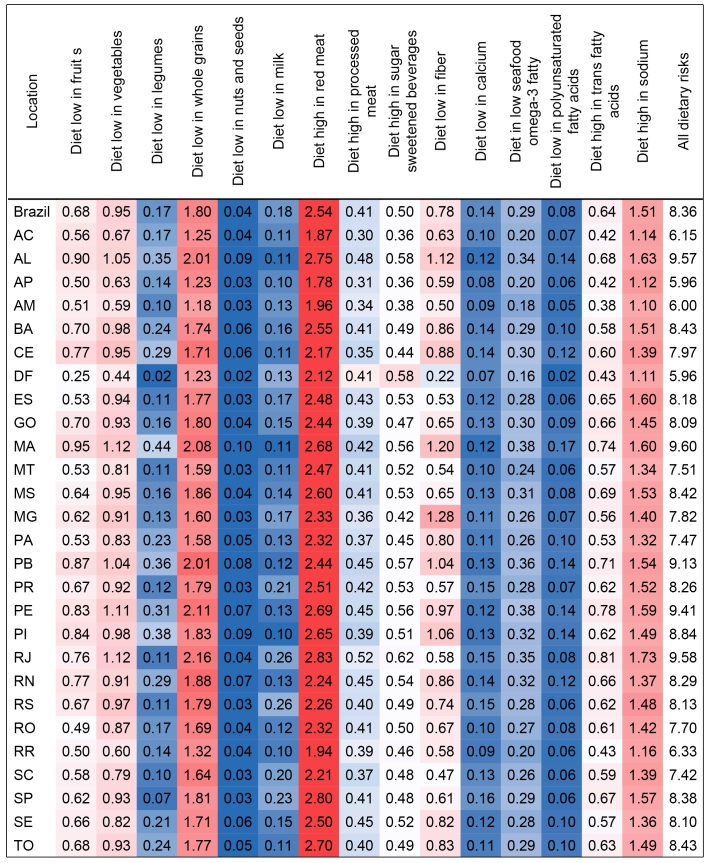
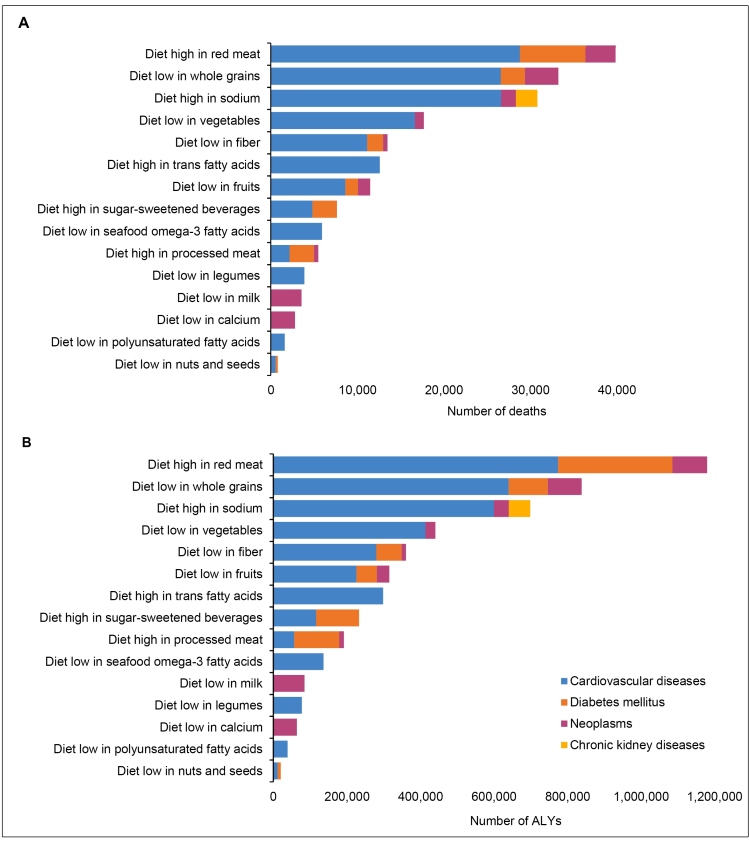
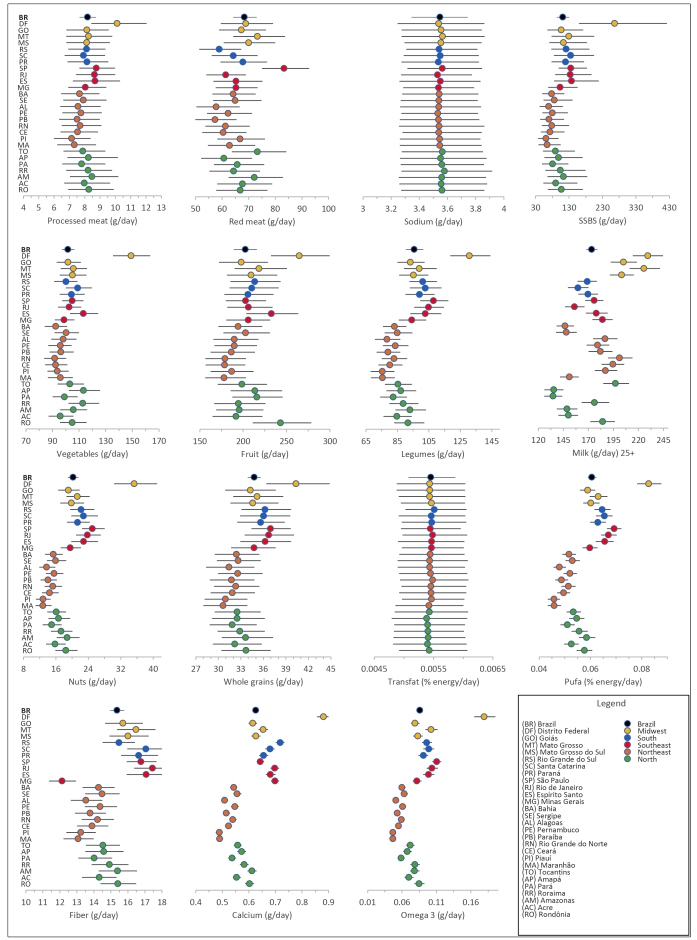
Secondary data from the Global Burden of Disease Study were used to estimate the burden attributable to fifteen dietary risks in Brazil. The main sources of data for Brazil were national surveys and international databases. A comparative risk assessment was used to obtain the population attributable fraction. We described the intake of each dietary risk and the distribution of number and rates of deaths and Disability-adjusted life years (DALYs) attributable to diet by sex, age, state, and year from 1990-2019.

RESULTS

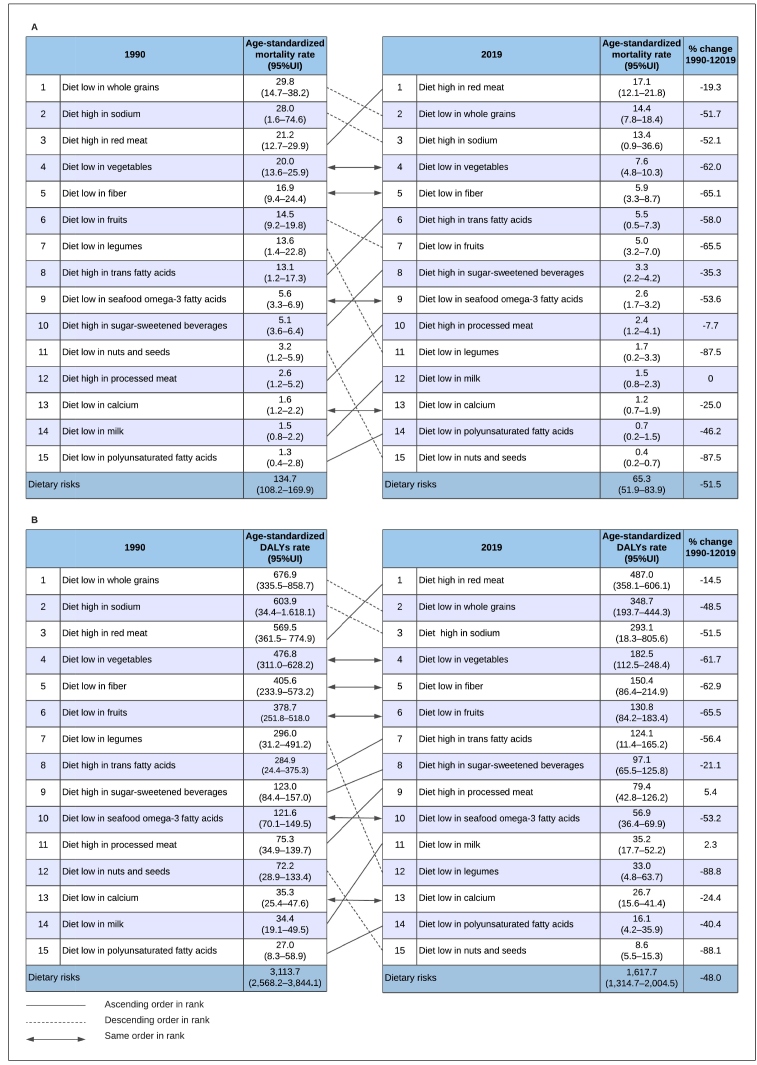
Cardiovascular diseases, diabetes mellitus, and neoplasms were the main NCDs attributable to an unhealthy diet. Age-standardized mortality and DALYs rates attributable to unhealthy diet decreased between 1990-2019 (-51.5% and -48.8, respectively). Diet high in red meat and sodium, and low in whole grains were the three main risk factors contributing to the burden of NCDs both in 1990 and 2019. The burden of NCDs was higher among males in the middle-aged population (around 50 years), as well as in the states of Maranhão, Rio de Janeiro, and Alagoas.

CONCLUSIONS

The present study found a suboptimum diet among the Brazilian population. The major contributors to this burden were diet high in red meat and sodium and low in whole grains. This study supports priorities in public policies on food and nutrition to reduce the burden of NCDs.

摘要

简介

不健康的饮食是导致非传染性疾病(NCDs)的可改变风险因素之一,也是巴西最重要的公共卫生问题之一。本研究旨在分析 1990 年至 2019 年巴西饮食相关风险因素对 NCD 负担的影响。

方法

本研究使用全球疾病负担研究的二次数据来估计巴西十五种饮食风险因素的负担。巴西的主要数据来源是国家调查和国际数据库。采用比较风险评估方法获得人群归因分数。我们描述了每种饮食风险的摄入量,并按性别、年龄、州和年份描述了 1990 年至 2019 年因饮食导致的死亡人数和伤残调整生命年(DALYs)的分布情况。

结果

心血管疾病、糖尿病和肿瘤是主要的由不健康饮食导致的 NCDs。1990 年至 2019 年,年龄标准化死亡率和因饮食导致的伤残调整生命年率分别下降了 51.5%和 48.8%。高红肉和钠、低全谷物的饮食是导致 NCD 负担的三个主要危险因素,无论是在 1990 年还是 2019 年都是如此。NCD 负担在中年人群(约 50 岁)以及马拉尼昂、里约热内卢和阿拉戈斯州的男性中更高。

结论

本研究发现巴西人口中存在饮食不当的情况。造成这种负担的主要原因是饮食中红肉和钠含量高,而全谷物含量低。本研究支持在食品和营养方面的公共政策优先考虑,以减轻 NCD 负担。
https://cdn.ncbi.nlm.nih.gov/pmc/blobs/7686/9009426/04c2504ae110/1678-9849-rsbmt-55-s01-e0282-2021-gf5.jpg
https://cdn.ncbi.nlm.nih.gov/pmc/blobs/7686/9009426/128ca9e02ba6/1678-9849-rsbmt-55-s01-e0282-2021-gf1.jpg
https://cdn.ncbi.nlm.nih.gov/pmc/blobs/7686/9009426/bfaf53f4a78a/1678-9849-rsbmt-55-s01-e0282-2021-gf2.jpg
https://cdn.ncbi.nlm.nih.gov/pmc/blobs/7686/9009426/70310c2d216d/1678-9849-rsbmt-55-s01-e0282-2021-gf3.jpg
https://cdn.ncbi.nlm.nih.gov/pmc/blobs/7686/9009426/2d54ca80817e/1678-9849-rsbmt-55-s01-e0282-2021-gf4.jpg
https://cdn.ncbi.nlm.nih.gov/pmc/blobs/7686/9009426/04c2504ae110/1678-9849-rsbmt-55-s01-e0282-2021-gf5.jpg
https://cdn.ncbi.nlm.nih.gov/pmc/blobs/7686/9009426/128ca9e02ba6/1678-9849-rsbmt-55-s01-e0282-2021-gf1.jpg
https://cdn.ncbi.nlm.nih.gov/pmc/blobs/7686/9009426/bfaf53f4a78a/1678-9849-rsbmt-55-s01-e0282-2021-gf2.jpg
https://cdn.ncbi.nlm.nih.gov/pmc/blobs/7686/9009426/70310c2d216d/1678-9849-rsbmt-55-s01-e0282-2021-gf3.jpg
https://cdn.ncbi.nlm.nih.gov/pmc/blobs/7686/9009426/2d54ca80817e/1678-9849-rsbmt-55-s01-e0282-2021-gf4.jpg
https://cdn.ncbi.nlm.nih.gov/pmc/blobs/7686/9009426/04c2504ae110/1678-9849-rsbmt-55-s01-e0282-2021-gf5.jpg

相似文献

1
Burden of non-communicable diseases attributable to dietary risks in Brazil, 1990-2019: an analysis of the Global Burden of Disease Study 2019.1990-2019 年巴西饮食相关的非传染性疾病负担:2019 年全球疾病负担研究分析。
Rev Soc Bras Med Trop. 2022 Jan 28;55(suppl 1):e0282. doi: 10.1590/0037-8682-0282-2021. eCollection 2022.
2
Trends in mortality due to non-communicable diseases in the Brazilian adult population: national and subnational estimates and projections for 2030.非传染性疾病导致的巴西成年人口死亡率趋势:2030 年的国家和国家以下各级的估计和预测。
Popul Health Metr. 2020 Sep 30;18(Suppl 1):16. doi: 10.1186/s12963-020-00216-1.
3
Burden and trend of diet-related non-communicable diseases in Australia and comparison with 34 OECD countries, 1990-2015: findings from the Global Burden of Disease Study 2015.澳大利亚与 34 个经合组织国家 1990-2015 年与饮食相关的非传染性疾病负担和趋势:2015 年全球疾病负担研究结果。
Eur J Nutr. 2019 Apr;58(3):1299-1313. doi: 10.1007/s00394-018-1656-7. Epub 2018 Mar 7.
4
Global burden of non-communicable diseases attributable to dietary risks in 1990-2019.1990-2019 年归因于饮食风险的非传染性疾病全球负担。
J Hum Nutr Diet. 2022 Feb;35(1):202-213. doi: 10.1111/jhn.12904. Epub 2021 Jun 23.
5
Burden of non-communicable diseases from infectious causes in 2017: a modelling study.2017 年由传染性病因导致的非传染性疾病负担:一项建模研究。
Lancet Glob Health. 2020 Dec;8(12):e1489-e1498. doi: 10.1016/S2214-109X(20)30358-2. Epub 2020 Oct 21.
6
The burden of non-communicable diseases attributable to high BMI in Brazil, 1990-2017: findings from the Global Burden of Disease Study.巴西高 BMI 导致的非传染性疾病负担:来自全球疾病负担研究的发现。
Popul Health Metr. 2020 Sep 30;18(Suppl 1):18. doi: 10.1186/s12963-020-00219-y.
7
Health impacts caused by excessive sodium consumption in Brazil: results of the GBD 2019 study.巴西因过量摄入钠而导致的健康影响:GBD 2019 研究结果。
Rev Soc Bras Med Trop. 2022 Feb 7;55(suppl 1):e0266. doi: 10.1590/0037-8682-0266-2021. eCollection 2022.
8
Health effects of dietary risks in 195 countries, 1990-2017: a systematic analysis for the Global Burden of Disease Study 2017.195 个国家 1990 年至 2017 年饮食风险对健康的影响:2017 年全球疾病负担研究的系统分析。
Lancet. 2019 May 11;393(10184):1958-1972. doi: 10.1016/S0140-6736(19)30041-8. Epub 2019 Apr 4.
9
Burden of disease attributable to suboptimal diet, metabolic risks and low physical activity in Ethiopia and comparison with Eastern sub-Saharan African countries, 1990-2015: findings from the Global Burden of Disease Study 2015.1990-2015 年埃塞俄比亚与东撒哈拉以南非洲国家因饮食不佳、代谢风险和缺乏身体活动导致的疾病负担:来自 2015 年全球疾病负担研究的结果。
BMC Public Health. 2018 Apr 25;18(1):552. doi: 10.1186/s12889-018-5438-1.
10
Exposure to and Burden of Major Non-Communicable Disease Risk Factors in Brazil and its States, 1990-2019: The Global Burden of Disease Study.巴西及其各州 1990-2019 年主要非传染性疾病风险因素的暴露和负担:全球疾病负担研究。
Rev Soc Bras Med Trop. 2022 Feb 7;55(suppl 1):e0275. doi: 10.1590/0037-8682-0275-2021. eCollection 2022.

引用本文的文献

1
Flavor and Well-Being: A Comprehensive Review of Food Choices, Nutrition, and Health Interactions.风味与幸福感:食物选择、营养与健康相互作用的综合综述
Food Sci Nutr. 2025 May 16;13(5):e70276. doi: 10.1002/fsn3.70276. eCollection 2025 May.
2
The food environment in favelas is associated with the presence of arterial hypertension and diabetes in socially vulnerable women.贫民窟的食物环境与社会弱势女性患动脉高血压和糖尿病有关。
Public Health Nutr. 2025 Feb 3;28(1):e44. doi: 10.1017/S1368980025000175.
3
Plant-based diets-impacts of consumption of little or no animal-source foods on human health.

本文引用的文献

1
Factors associated with salt intake in the Brazilian adult population: National Health Survey.与巴西成年人口盐摄入量相关的因素:国家健康调查。
Cien Saude Colet. 2021 Feb;26(2):555-567. doi: 10.1590/1413-81232021262.37492020. Epub 2020 Oct 25.
2
Health, lifestyle and sociodemographic characteristics are associated with Brazilian dietary patterns: Brazilian National Health Survey.健康、生活方式和社会人口学特征与巴西饮食模式相关:巴西国家健康调查。
PLoS One. 2021 Feb 16;16(2):e0247078. doi: 10.1371/journal.pone.0247078. eCollection 2021.
3
Approaches to Defining Healthy Diets: A Background Paper for the International Expert Consultation on Sustainable Healthy Diets.
植物性饮食——极少或不食用动物源食物对人类健康的影响。
Front Nutr. 2024 Sep 18;11:1423925. doi: 10.3389/fnut.2024.1423925. eCollection 2024.
4
Knowledge, Attitudes, and Practices Associated with the Selection of Sweetened Ultra-Processed Foods and Their Importance in Oral Health.与甜味超加工食品选择相关的知识、态度和行为及其在口腔健康中的重要性。
Dent J (Basel). 2024 Aug 20;12(8):268. doi: 10.3390/dj12080268.
5
Disability and costs of IHD attributable to the consumption of trans-fatty acids in Brazil.巴西反式脂肪酸消费导致的缺血性心脏病残疾和成本。
Public Health Nutr. 2024 May 10;27(1):e132. doi: 10.1017/S1368980024001101.
6
A multicomponent family intervention, combined with salt reduction for children with obesity: a factorial randomized study protocol.一种多成分家庭干预,结合儿童肥胖的减盐措施:一项析因随机研究方案。
BMC Public Health. 2023 Jul 29;23(1):1453. doi: 10.1186/s12889-023-16356-6.
7
Avoidable diet-related deaths and cost-of-illness with culturally optimized modifications in diet: The case of Brazil.避免与饮食相关的可预防死亡和疾病负担:以文化优化的饮食调整为例:巴西。
PLoS One. 2023 Jul 11;18(7):e0288471. doi: 10.1371/journal.pone.0288471. eCollection 2023.
8
Unhealthy lifestyles and clusters status among 3637 adolescents aged 11-23 years: a school-based cross-sectional study in China.中国一项基于学校的横断面研究显示,3637 名 11-23 岁青少年存在不健康生活方式和聚类状态。
BMC Public Health. 2023 Jul 3;23(1):1279. doi: 10.1186/s12889-023-16197-3.
9
Chronic diseases attributable to a diet rich in processed meat in Brazil: Burden and financial impact on the healthcare system.巴西因食用富含加工肉类的饮食导致的慢性病:对医疗系统的负担和经济影响。
Front Nutr. 2023 Mar 15;10:1114766. doi: 10.3389/fnut.2023.1114766. eCollection 2023.
10
Behavioral and Metabolic Risk Factors for Noncommunicable Diseases among Population in the Republic of Srpska (Bosnia and Herzegovina).斯普斯卡共和国(波斯尼亚和黑塞哥维那)人群中非传染性疾病的行为和代谢风险因素
Healthcare (Basel). 2023 Feb 7;11(4):483. doi: 10.3390/healthcare11040483.
定义健康饮食的方法:可持续健康饮食国际专家协商会背景文件。
Food Nutr Bull. 2020 Dec;41(2_suppl):7S-30S. doi: 10.1177/0379572120973111.
4
Global burden of 87 risk factors in 204 countries and territories, 1990-2019: a systematic analysis for the Global Burden of Disease Study 2019.204 个国家和地区 1990-2019 年 87 种风险因素的全球负担:2019 年全球疾病负担研究的系统分析。
Lancet. 2020 Oct 17;396(10258):1223-1249. doi: 10.1016/S0140-6736(20)30752-2.
5
Trends in mortality due to non-communicable diseases in the Brazilian adult population: national and subnational estimates and projections for 2030.非传染性疾病导致的巴西成年人口死亡率趋势:2030 年的国家和国家以下各级的估计和预测。
Popul Health Metr. 2020 Sep 30;18(Suppl 1):16. doi: 10.1186/s12963-020-00216-1.
6
Dynamics of the double burden of malnutrition and the changing nutrition reality.营养不良双重负担的动态变化与不断改变的营养现实。
Lancet. 2020 Jan 4;395(10217):65-74. doi: 10.1016/S0140-6736(19)32497-3. Epub 2019 Dec 15.
7
Prevalence and co-occurrence of modifiable risk factors in adults and older people.成年人和老年人可改变风险因素的流行率和共病情况。
Rev Saude Publica. 2019 Oct 21;53:86. doi: 10.11606/s1518-8787.2019053001142. eCollection 2019.
8
Social inequalities in the food consumption profile of the Brazilian population: National Health Survey, 2013.巴西人口食物消费状况中的社会不平等:2013年全国健康调查
Rev Bras Epidemiol. 2019 Oct 7;22Suppl 02(Suppl 02):E190011.SUPL.2. doi: 10.1590/1980-549720190011.supl.2. eCollection 2019.
9
[Chronic noncommunicable diseases and associated factors among adults in an impoverished urban area of the Brazilian northeast].[巴西东北部贫困城区成年人中的慢性非传染性疾病及其相关因素]
Cien Saude Colet. 2019 Aug 5;24(8):3159-3168. doi: 10.1590/1413-81232018248.30742017.
10
Clusters of risk behaviors for noncommunicable diseases in the Brazilian adult population.巴西成年人中与非传染性疾病相关的风险行为群。
Int J Public Health. 2019 Jul;64(6):821-830. doi: 10.1007/s00038-019-01242-z. Epub 2019 May 6.