Department of Cardiology, Zhejiang Hospital, Hangzhou, 310013, Zhejiang Province, China.
Department of Ultrasonic, Taizhou Hospital Affiliated to Wenzhou Medical University, Linhai, 317000, Zhejiang Province, China.
BMC Cardiovasc Disord. 2022 Feb 5;22(1):32. doi: 10.1186/s12872-022-02479-y.
Aortic diameter is a critical parameter for the diagnosis of aortic dilated diseases. Aortic dilation has some common risk factors with cardiovascular diseases. This study aimed to investigate potential influence of traditional cardiovascular risk factors and the measures of subclinical atherosclerosis on aortic diameter of specific segments among adults.
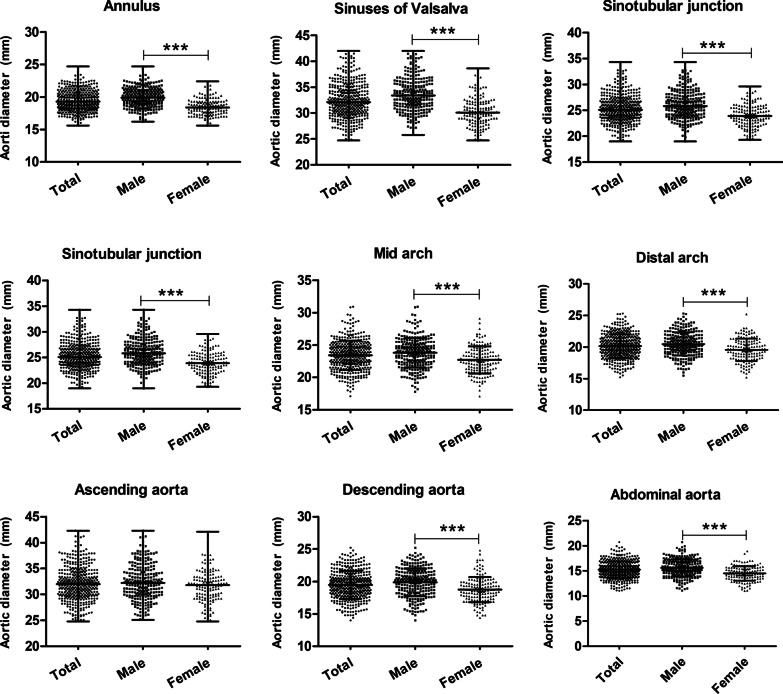
Four hundred and eight patients with cardiovascular risk factors were prospectively recruited in the observational study. Comprehensive transthoracic M-mode, 2-dimensional Doppler echocardiographic studies were performed using commercial and clinical diagnostic ultrasonography techniques. The aortic dimensions were assessed at different levels: (1) the annulus, (2) the mid-point of the sinuses of Valsalva, (3) the sinotubular junction, (4) the ascending aorta at the level of its largest diameter, (5) the transverse arch (including proximal arch, mid arch, distal arch), (6) the descending aorta posterior to the left atrium, and (7) the abdominal aorta just distal to the origin of the renal arteries. Multivariable linear regression analysis was used for evaluating aortic diameter-related risk factors, including common cardiovascular risk factors, co-morbidities, subclinical atherosclerosis, lipid profile, and hematological parameters.
Significant univariate relations were found between aortic diameter of different levels and most traditional cardiovascular risk factors. Carotid intima-media thickness was significantly correlated with diameter of descending and abdominal aorta. Multivariate linear regression showed potential effects of age, sex, body surface area and some other cardiovascular risk factors on aortic diameter enlargement. Among them, high-density lipoprotein cholesterol had a significantly positive effect on the diameter of ascending and abdominal aorta. Diastolic blood pressure was observed for the positive associations with diameters of five thoracic aortic segments, while systolic blood pressure was only independently related to mid arch diameter.
Aortic segmental diameters were associated with diastolic blood pressure, high-density lipoprotein cholesterol, atherosclerosis diseases and other traditional cardiovascular risk factors, and some determinants still need to be clarified for a better understanding of aortic dilation diseases.
主动脉直径是诊断主动脉扩张性疾病的一个关键参数。主动脉扩张与心血管疾病有一些共同的危险因素。本研究旨在探讨传统心血管危险因素和亚临床动脉粥样硬化指标对特定节段成人主动脉直径的潜在影响。
前瞻性纳入 408 例心血管危险因素患者,采用商业和临床诊断超声技术进行综合经胸 M 型、二维多普勒超声心动图检查。评估主动脉不同节段的尺寸:(1)瓣环,(2)窦部中点,(3)窦管交界,(4)升主动脉最大直径处,(5)升主动脉弓(包括近端弓、弓中段、远端弓),(6)左心房后降主动脉,(7)肾动脉起始处以下腹主动脉。采用多元线性回归分析评估与主动脉直径相关的危险因素,包括常见心血管危险因素、合并症、亚临床动脉粥样硬化、血脂谱和血液学参数。
不同节段的主动脉直径与大多数传统心血管危险因素存在显著的单变量关系。颈动脉内膜中层厚度与降主动脉和腹主动脉直径显著相关。多元线性回归显示,年龄、性别、体表面积和其他一些心血管危险因素对主动脉直径增大有潜在影响。其中,高密度脂蛋白胆固醇对升主动脉和腹主动脉直径有显著的正效应。舒张压与五个胸主动脉节段的直径呈正相关,而收缩压仅与弓中段直径独立相关。
主动脉节段直径与舒张压、高密度脂蛋白胆固醇、动脉粥样硬化疾病和其他传统心血管危险因素相关,一些决定因素仍需进一步阐明,以更好地理解主动脉扩张性疾病。