Research Fellow, Institute of Sociology, Academia Sinica, Taiwan.
Mackay Memorial Hospital, Post graduate year program, Taiwan.
Soc Sci Med. 2022 Mar;296:114744. doi: 10.1016/j.socscimed.2022.114744. Epub 2022 Jan 26.
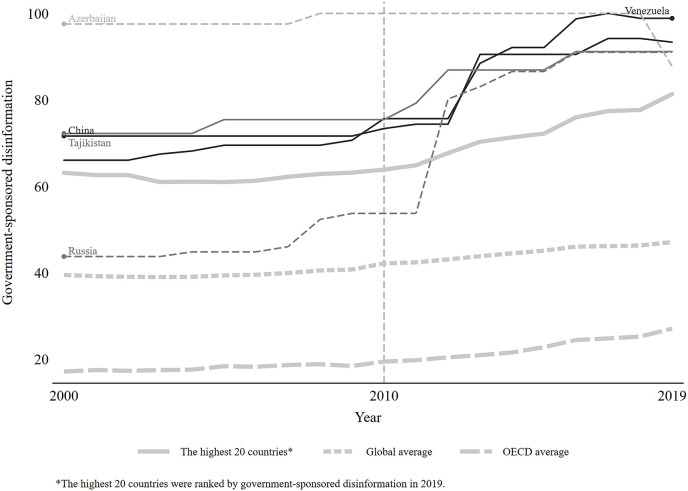
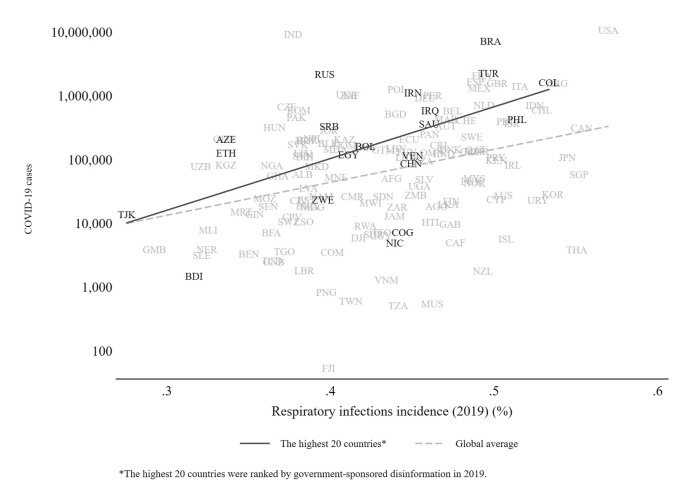
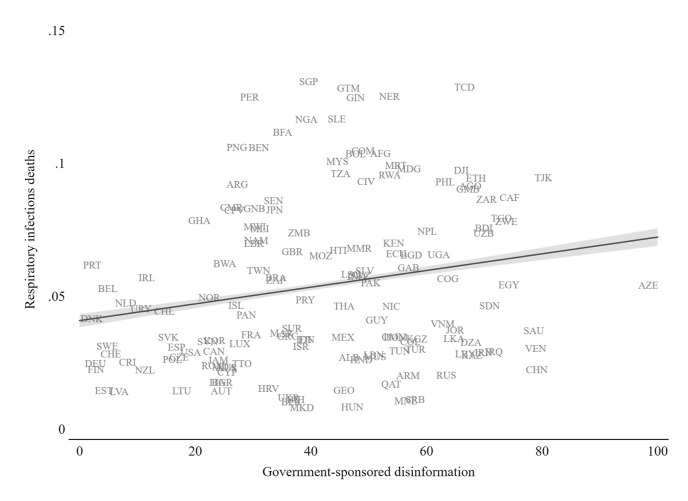
Internet misinformation and government-sponsored disinformation campaigns have been criticized for their presumed/hypothesized role in worsening the coronavirus disease 2019 (COVID-19) pandemic. We hypothesize that these government-sponsored disinformation campaigns have been positively associated with infectious disease epidemics, including COVID-19, over the last two decades. By integrating global surveys from the Digital Society Project, Global Burden of Disease, and other data sources across 149 countries for the period 2001-2019, we examined the association between government-sponsored disinformation and the spread of respiratory infections before the COVID-19 outbreak. Then, building on those results, we applied a negative binomial regression model to estimate the associations between government-sponsored disinformation and the confirmed cases and deaths related to COVID-19 during the first 300 days of the outbreak in each country and before vaccination began. After controlling for climatic, public health, socioeconomic, and political factors, we found that government-sponsored disinformation was significantly associated with the incidence and prevalence percentages of respiratory infections in susceptible populations during the period 2001-2019. The results also show that disinformation is significantly associated with the incidence rate ratio (IRR) of cases of COVID-19. The findings imply that governments may contain the damage associated with pandemics by ending their sponsorship of disinformation campaigns.
互联网错误信息和政府资助的虚假信息宣传活动因其在加剧 2019 年冠状病毒病(COVID-19)大流行方面的假定/假设作用而受到批评。我们假设这些政府资助的虚假信息宣传活动与过去二十年来包括 COVID-19 在内的传染病流行呈正相关。通过整合来自数字社会项目、全球疾病负担和其他数据源的全球调查,我们研究了 2001 年至 2019 年期间政府资助的虚假信息与呼吸道感染传播之间的关联。然后,根据这些结果,我们应用负二项回归模型来估计在爆发的头 300 天内,政府资助的虚假信息与每个国家与 COVID-19 相关的确诊病例和死亡人数之间的关联,并且在接种疫苗之前。在控制气候、公共卫生、社会经济和政治因素后,我们发现政府资助的虚假信息与易感人群中呼吸道感染的发病率和流行率百分比在 2001-2019 年期间存在显著关联。结果还表明,虚假信息与 COVID-19 病例的发病率比值(IRR)显著相关。研究结果表明,政府可以通过终止对虚假信息宣传活动的资助来遏制与大流行相关的损害。