de Carvalho Victor Diogho Heuer, Nepomuceno Thyago Celso Cavalcante, Poleto Thiago, Turet Jean Gomes, Costa Ana Paula Cabral Seixas
Eixo das Tecnologias, Campus do Sertão, Federal University of Alagoas, Delmiro Gouveia 57480-000, Brazil.
Núcleo de Tecnologia, Centro Acadêmico do Agreste, Federal University of Pernambuco, Caruaru 55014-900, Brazil.
Trop Med Infect Dis. 2022 Sep 22;7(10):256. doi: 10.3390/tropicalmed7100256.
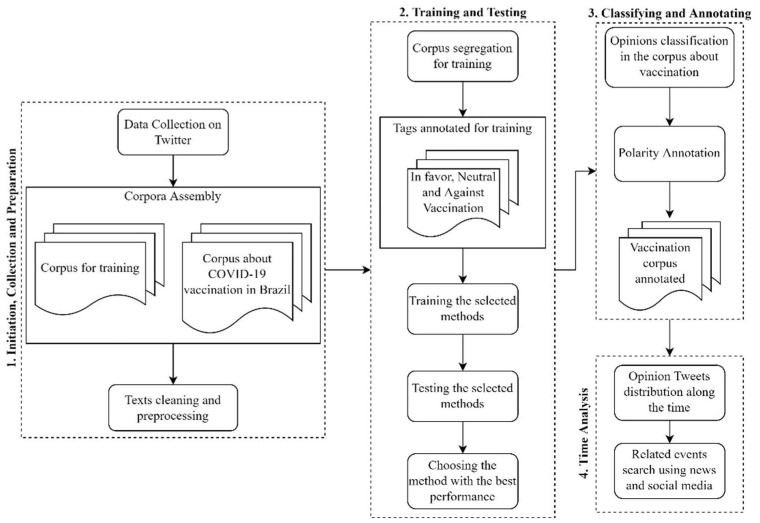
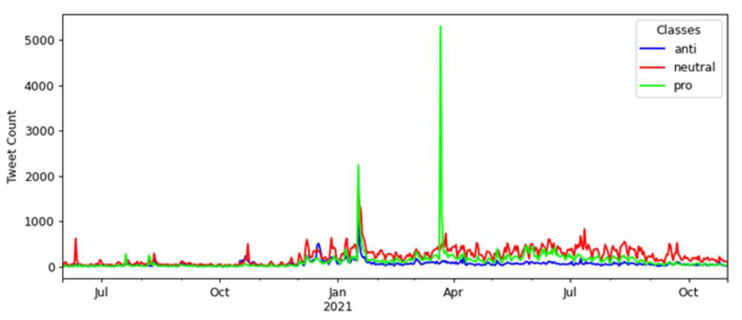
This article presents a study that applied opinion analysis about COVID-19 immunization in Brazil. An initial set of 143,615 tweets was collected containing 49,477 pro- and 44,643 anti-vaccination and 49,495 neutral posts. Supervised classifiers (multinomial naïve Bayes, logistic regression, linear support vector machines, random forests, adaptative boosting, and multilayer perceptron) were tested, and multinomial naïve Bayes, which had the best trade-off between overfitting and correctness, was selected to classify a second set containing 221,884 unclassified tweets. A timeline with the classified tweets was constructed, helping to identify dates with peaks in each polarity and search for events that may have caused the peaks, providing methodological assistance in combating sources of misinformation linked to the spread of anti-vaccination opinion.
本文介绍了一项对巴西新冠疫苗接种情况进行观点分析的研究。最初收集了143615条推文,其中包含49477条支持疫苗接种、44643条反对疫苗接种以及49495条中立的推文。对监督分类器(多项式朴素贝叶斯、逻辑回归、线性支持向量机、随机森林、自适应增强和多层感知器)进行了测试,选择了在过拟合和正确性之间具有最佳权衡的多项式朴素贝叶斯来对包含221884条未分类推文的第二组进行分类。构建了一个包含已分类推文的时间线,有助于识别每种极性出现峰值的日期,并寻找可能导致峰值的事件,为打击与反疫苗接种观点传播相关的错误信息来源提供方法上的帮助。