Tampere University, Department of Health Sciences, Faculty of Social Sciences, Tampere, Finland.
University of Turku, INVEST Research Flagship Center, Turku, Finland.
PLoS Med. 2022 Feb 9;19(2):e1003919. doi: 10.1371/journal.pmed.1003919. eCollection 2022 Feb.
Vaccination is the most effective means of preventing the spread of infectious diseases. Despite the proven benefits of vaccination, vaccine hesitancy keeps many people from getting vaccinated.
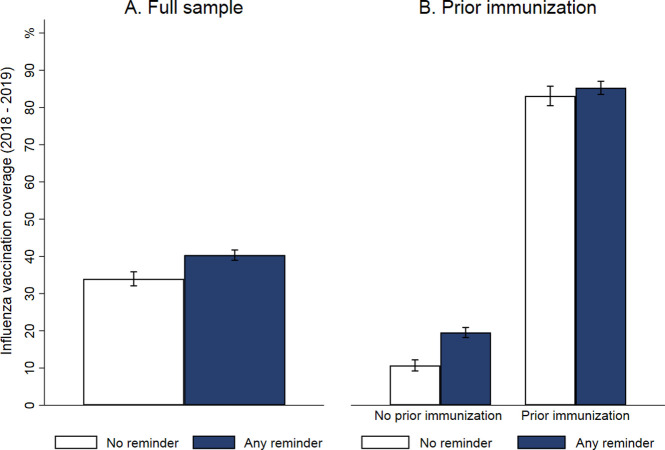
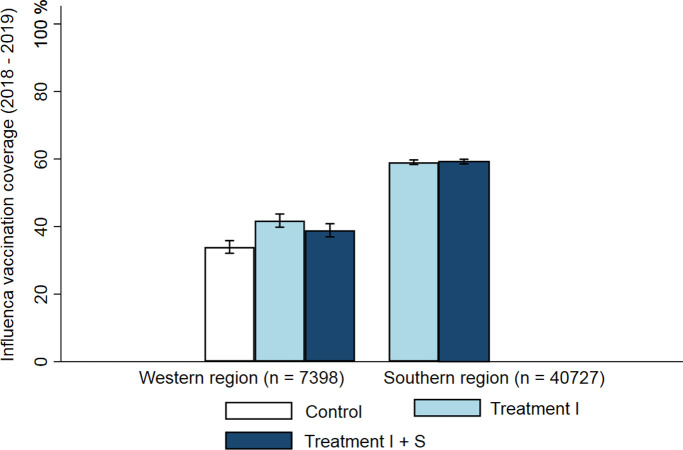
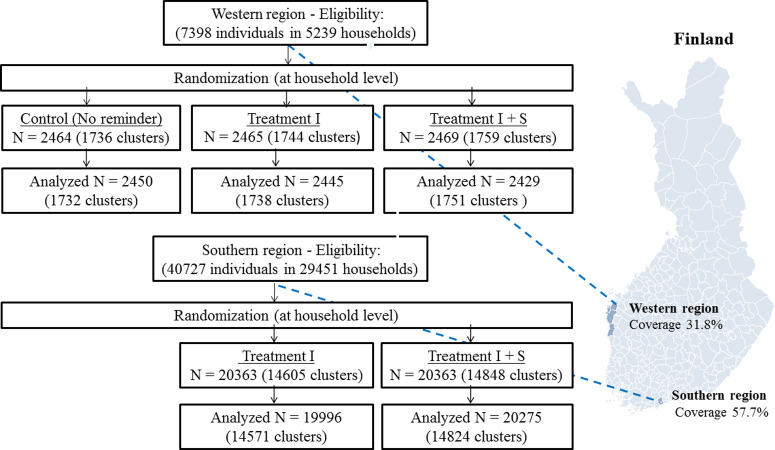
We conducted a large-scale cluster randomized controlled trial in Finland to test the effectiveness of centralized written reminders (distributed via mail) on influenza vaccination coverage. The study included the entire older adult population (aged 65 years and above) in 2 culturally and geographically distinct regions with historically low (31.8%, n = 7,398, mean age 75.5 years) and high (57.7%, n = 40,727, mean age 74.0 years) influenza vaccination coverage. The study population was randomized into 3 treatments: (i) no reminder (only in the region with low vaccination coverage); (ii) an individual-benefits reminder, informing recipients about the individual benefits of vaccination; and (iii) an individual- and social-benefits reminder, informing recipients about the additional social benefits of vaccination in the form of herd immunity. There was no control treatment group in the region with high vaccination coverage as general reminders had been sent in previous years. The primary endpoint was a record of influenza vaccination in the Finnish National Vaccination Register during a 5-month follow-up period (from October 18, 2018 to March 18, 2019). Vaccination coverage after the intervention in the region with historically low coverage was 41.8% in the individual-benefits treatment, 38.9% in the individual- and social-benefits treatment and 34.0% in the control treatment group. Vaccination coverage after the intervention in the region with historically high coverage was 59.0% in the individual-benefits treatment and 59.2% in the individual- and social-benefits treatment. The effect of receiving any type of reminder letter in comparison to control treatment group (no reminder) was 6.4 percentage points (95% CI: 3.6 to 9.1, p < 0.001). The effect of reminders was particularly large among individuals with no prior influenza vaccination (8.8 pp, 95% CI: 6.5 to 11.1, p < 0.001). There was a substantial positive effect (5.3 pp, 95% CI: 2.8 to 7.8, p < 0.001) among the most consistently unvaccinated individuals who had not received any type of vaccine during the 9 years prior to the study. There was no difference in influenza vaccination coverage between the individual-benefit reminder and the individual- and social-benefit reminder (region with low vaccination coverage: 2.9 pp, 95% CI: -0.4 to 6.1, p = 0.087, region with high vaccination coverage: 0.2 pp, 95% CI: -1.0 to 1.3, p = 0.724). Study limitations included potential contamination between the treatments due to information spillovers and the lack of control treatment group in the region with high vaccination coverage.
In this study, we found that sending reminders was an effective and scalable intervention strategy to increase vaccination coverage in an older adult population with low vaccination coverage. Communicating the social benefits of vaccinations, in addition to individual benefits, did not enhance vaccination coverage. The effectiveness of letter reminders about the benefits of vaccination to improve influenza vaccination coverage may depend on the prior vaccination history of the population.
AEA RCT registry AEARCTR-0003520 and ClinicalTrials.gov NCT03748160.
接种疫苗是预防传染病传播最有效的手段。尽管接种疫苗的好处已得到证实,但疫苗犹豫仍使许多人无法接种疫苗。
我们在芬兰进行了一项大规模的集群随机对照试验,以测试集中书面提醒(通过邮件分发)对流感疫苗接种覆盖率的影响。该研究包括两个文化和地理上有明显差异的地区的所有老年人群(65 岁及以上),这两个地区的流感疫苗接种率历史上一直很低(31.8%,n=7398,平均年龄 75.5 岁)和高(57.7%,n=40727,平均年龄 74.0 岁)。研究人群被随机分为 3 种治疗方法:(i)无提醒(仅在接种率较低的地区);(ii)个体效益提醒,告知收件人接种疫苗的个体效益;(iii)个体和社会效益提醒,以群体免疫的形式告知收件人接种疫苗的额外社会效益。在接种率较高的地区没有对照组,因为在过去几年中已经发送了一般提醒。主要终点是在 5 个月的随访期间(从 2018 年 10 月 18 日至 2019 年 3 月 18 日)在芬兰国家疫苗接种登记处记录流感疫苗接种情况。在历史上接种率较低的地区,干预后的接种率在个体效益治疗组中为 41.8%,在个体和社会效益治疗组中为 38.9%,在对照组中为 34.0%。在历史上接种率较高的地区,干预后的接种率在个体效益治疗组中为 59.0%,在个体和社会效益治疗组中为 59.2%。与对照组(无提醒)相比,收到任何类型提醒信的效果为 6.4 个百分点(95%CI:3.6 至 9.1,p<0.001)。对于没有既往流感疫苗接种史的个体,提醒效果尤其显著(8.8 个百分点,95%CI:6.5 至 11.1,p<0.001)。在研究前 9 年期间没有接种任何类型疫苗的最不常接种人群中,存在着实质性的积极影响(5.3 个百分点,95%CI:2.8 至 7.8,p<0.001)。在接种率较低的地区,个体效益提醒和个体和社会效益提醒之间的流感疫苗接种覆盖率没有差异(2.9 个百分点,95%CI:-0.4 至 6.1,p=0.087);在接种率较高的地区,差异为 0.2 个百分点(95%CI:-1.0 至 1.3,p=0.724)。研究局限性包括由于信息溢出,治疗方法之间可能存在潜在的污染,以及在接种率较高的地区缺乏对照组。
在这项研究中,我们发现,发送提醒是一种有效且可扩展的干预策略,可以提高低接种率老年人群的疫苗接种率。除了个体效益外,传达疫苗接种的社会效益并不能提高疫苗接种率。关于疫苗效益的信函提醒对改善流感疫苗接种覆盖率的有效性可能取决于人群的既往接种史。
AEA RCT 注册表 AEARCTR-0003520 和 ClinicalTrials.gov NCT03748160。