Bayerle Pauline, Kerling Arno, Kück Momme, Rolff Simone, Boeck Hedwig Theda, Sundermeier Thorben, Ensslen Ralf, Tegtbur Uwe, Lauenstein Dirk, Böthig Dietmar, Bara Christoph, Hanke Alexander, Terkamp Christoph, Haverich Axel, Stiesch Meike, de Zwaan Martina, Haufe Sven, Nachbar Lars
Institute of Sports Medicine, Hannover Medical School, Carl-Neuberg-Str. 1, 30625, Hannover, Germany.
Volkswagen AG, Wolfsburg, Germany.
BMC Sports Sci Med Rehabil. 2022 Feb 10;14(1):24. doi: 10.1186/s13102-022-00409-1.
Metabolic syndrome (MetS) is associated with an increased risk for cardiovascular events and high socioeconomic costs. Despite lifestyle interventions focusing on exercise are effective strategies to improve parameters of the above aspects, many programs fail to show sustained effects in the long-term.
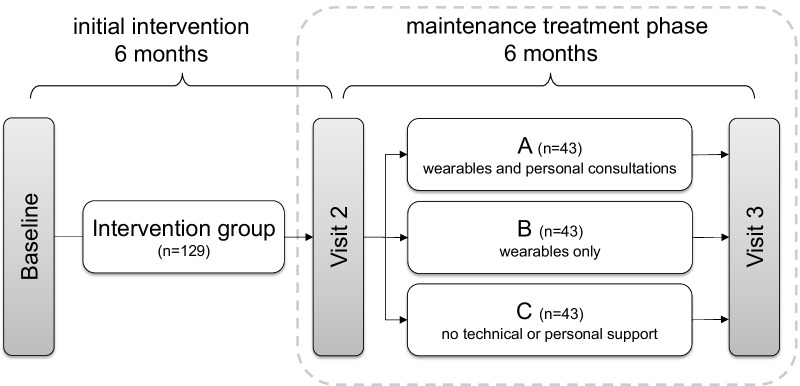
At visit 2 (V2) 129 company employees with diagnosed MetS, who previously participated in a 6-month telemonitoring-supported exercise intervention, were randomized into three subgroups for a 6-month maintenance treatment phase. A wearable activity device was provided to subgroup A and B to assess and to track physical activity. Further subgroup A attended personal consultations with individual instructions for exercise activities. Subgroup C received neither technical nor personal support. 6 months later at visit (V3), changes in exercise capacity, MetS severity, work ability, health-related quality of life and anxiety and depression were compared between the subgroups with an analysis of variance with repeated measurements.
The total physical activity (in MET*h/week) declined between visit 2 and visit 3 (subgroup A: V2: 48.0 ± 33.6, V3: 37.1 ± 23.0; subgroup B: V2: 52.6 ± 35.7, V3: 43.8 ± 40.7, subgroup C: V2: 51.5 ± 29.7, V3: 36.9 ± 22.8, for all p = 0.00) with no between-subgroup differences over time (p = 0.68). In all three subgroups the initial improvements in relative exercise capacity and MetS severity were maintained. Work ability declined significantly in subgroup C (V2: 40.3 ± 5.0, V3: 39.1 ± 5.7; p < 0.05), but remained stable in the other subgroups with no between-subgroup differences over time (p = 0.38). Health-related quality of life and anxiety and depression severity also showed no significant differences over time.
Despite the maintenance of physical activity could not be achieved, most of the health related outcomes remained stable and above baseline value, with no difference regarding the support strategy during the maintenance treatment phase. Trial registration The study was completed as a cooperation project between the Volkswagen AG and the Hannover Medical School (ClinicalTrials.gov Identifier: NCT02029131).
代谢综合征(MetS)与心血管事件风险增加及高额社会经济成本相关。尽管以运动为重点的生活方式干预是改善上述方面参数的有效策略,但许多项目在长期内未能显示出持续效果。
在第2次就诊(V2)时,129名被诊断为MetS的公司员工(他们此前参加了为期6个月的远程监测支持的运动干预)被随机分为三个亚组,进行为期6个月的维持治疗阶段。为A组和B组提供了可穿戴活动设备,以评估和跟踪身体活动。此外,A组参加了个人咨询,并接受了有关运动活动的个性化指导。C组既未获得技术支持也未获得个人支持。6个月后的第3次就诊(V3)时,通过重复测量方差分析比较了亚组之间运动能力、MetS严重程度、工作能力、健康相关生活质量以及焦虑和抑郁的变化。
在第2次就诊和第3次就诊之间,总身体活动量(以MET*小时/周计)下降(A组:V2:48.0±33.6,V3:37.1±23.0;B组:V2:52.6±35.7,V3:43.8±40.7,C组:V2:51.5±29.7,V3:36.9±22.8,所有p=0.00),且随时间推移亚组间无差异(p=0.68)。在所有三个亚组中,相对运动能力和MetS严重程度的初始改善得以维持。C组的工作能力显著下降(V2:40.3±5.0,V3:39.1±5.7;p<0.05),但在其他亚组中保持稳定,且随时间推移亚组间无差异(p=0.38)。健康相关生活质量以及焦虑和抑郁严重程度随时间也未显示出显著差异。
尽管未能实现身体活动量的维持,但大多数与健康相关的结果保持稳定且高于基线值,维持治疗阶段的支持策略之间无差异。试验注册:该研究作为大众汽车集团与汉诺威医学院的合作项目完成(ClinicalTrials.gov标识符:NCT02029131)。