Department of Epidemiology, School of Public Health, Sun Yat-Sen University, 74 Zhongshan Second Road, Guangzhou, 510080, Guangdong, China.
BMC Geriatr. 2022 Feb 12;22(1):118. doi: 10.1186/s12877-022-02796-z.
Evidence on the association between adverse childhood experiences (ACEs) and handgrip strength (HGS) in later life was limited and inconclusive. We aimed to explore the impact of ACEs on HGS among middle-aged and older Chinese adults.
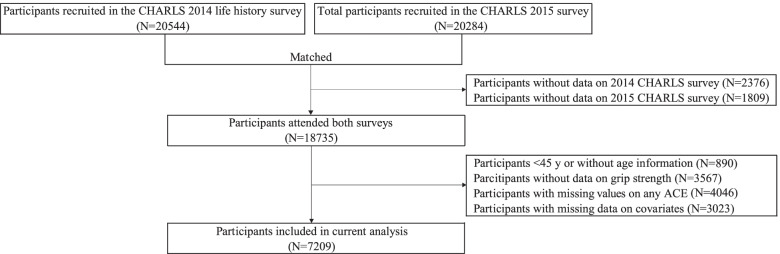
We conducted a cross-sectional study with data extracted from the China Health and Retirement Longitudinal Study (CHARLS), a nationally representative survey with respondents recruited from 450 villages/urban communities of 28 provinces. Participants aged 45 years or older were drawn from the CHARLS 2014 life history survey and the 2015 health survey. Twelve ACE indicators before the age of 17 years were collected. HGS was measured with a dynamometer and the maximum value of HGS obtained from both hands was used in the analyses. Low muscle strength (LMS) was defined according to the recommendation of European Working Group on Sarcopenia in Older People (EWGSOP). Multivariate linear and logistic regression models were constructed to evaluate the association of ACEs with continuous HGS and LMS, with adjustment for age, sex, marital status, ethnicity, area of residence, smoking and drinking status, body mass index, hypertension, dyslipidaemia, diabetes mellitus, cardiovascular disease, arthritis, hip fracture, and memory-related disease.
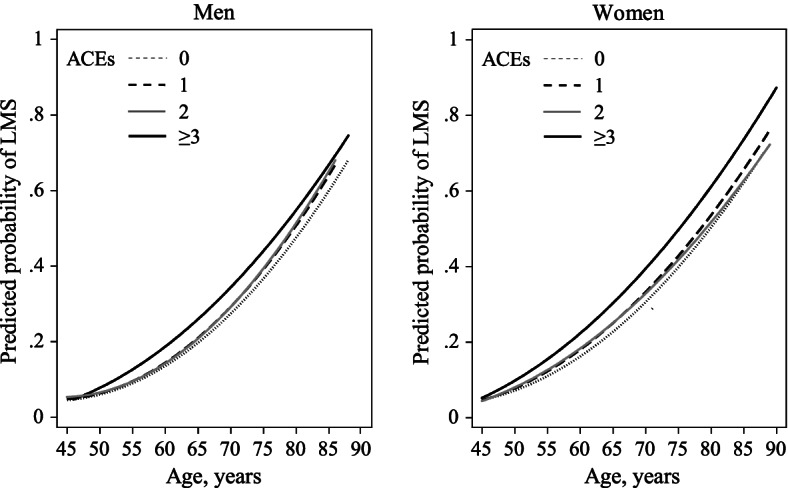
Of the 7209 eligible participants, 2258 (31.3%) had experienced three or more ACEs. Compared to individuals without ACEs, exposure to ≥ 3 ACEs was negatively associated with continuous HGS in kilogram (β = -0.93, 95% CI: -1.37, -0.49) and positively associated with the risk of LMS (OR = 1.34, 95% CI: 1.12, 1.61). Such associations were consistently found both in men and women who had experienced three or more ACEs. Significant dose-response relationship between the number of ACEs and outcomes was also observed in the overall population and different sex groups.
Exposure to ACEs was associated with lower HGS and increased risk of LMS among middle-aged and older Chinese adults, indicating the importance of intervention in individuals with experience of ACEs in order to mitigate its detrimental impact on HGS and promote healthy ageing.
关于不良童年经历(ACEs)与晚年手握力(HGS)之间关联的证据有限且尚无定论。本研究旨在探讨 ACEs 对中国中老年人群 HGS 的影响。
我们开展了一项横断面研究,数据来自中国健康与养老追踪调查(CHARLS),这是一项具有全国代表性的调查,从全国 28 个省的 450 个村/社区中招募了受访者。CHARLS 2014 年生活史调查和 2015 年健康调查招募了 45 岁及以上的参与者。收集了 17 岁前的 12 项 ACE 指标。使用测力计测量 HGS,分析时采用双手的最大 HGS 值。低肌肉力量(LMS)的定义依据欧洲老年人肌少症工作组(EWGSOP)的建议。构建多变量线性和逻辑回归模型,以评估 ACEs 与连续 HGS 和 LMS 的关联,调整因素包括年龄、性别、婚姻状况、民族、居住地区、吸烟和饮酒状况、体质指数、高血压、血脂异常、糖尿病、心血管疾病、关节炎、髋部骨折和记忆相关疾病。
在 7209 名符合条件的参与者中,2258 名(31.3%)经历了 3 种及以上 ACEs。与无 ACEs 的个体相比,暴露于≥3 种 ACEs 与连续 HGS(千克)呈负相关(β=-0.93,95%CI:-1.37,-0.49),与 LMS 风险呈正相关(OR=1.34,95%CI:1.12,1.61)。在经历 3 种及以上 ACEs 的男性和女性中均观察到了这些关联。在总体人群和不同性别组中,ACEs 数量与结局之间也存在显著的剂量-反应关系。
在中国中老年人群中,暴露于 ACEs 与较低的 HGS 和较高的 LMS 风险相关,表明在 ACEs 经历者中进行干预以减轻其对 HGS 的不利影响并促进健康老龄化非常重要。