Monash Nursing and Midwifery, Monash University, Clayton, Victoria, Australia.
J Am Med Inform Assoc. 2022 Apr 13;29(5):970-982. doi: 10.1093/jamia/ocac015.
The COVID-19 pandemic has seen a rapid adoption of telehealth consultations, potentially creating new barriers to healthcare access for racial/ethnic minorities. This systematic review explored the use of telehealth consultations for people from racial/ethnic minority populations in relation to health outcomes, access to care, implementation facilitators and barriers, and satisfaction with care.
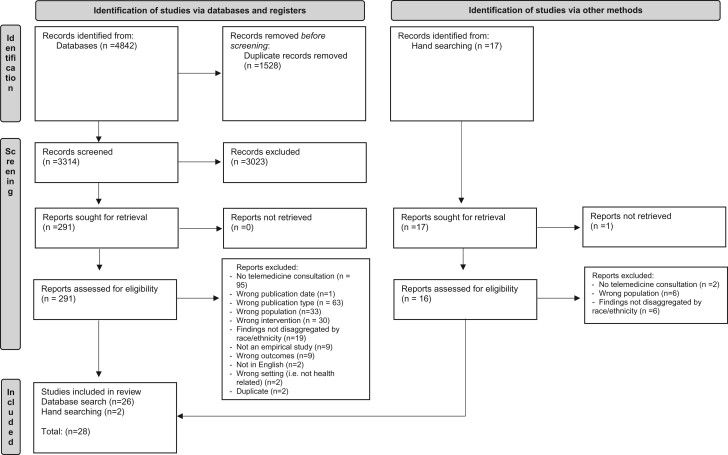
This review followed the Preferred Reporting Items for Systematic Reviews and Meta-Analysis and the Joanna Briggs Institute Manual for Evidence Synthesis. Five major databases were searched to identify relevant studies. Screening, full-text review, quality appraisal, and data extraction were all completed independently and in duplicate. A convergent integrated approach to data synthesis was applied with findings reported narratively.
A total of 28 studies met the inclusion criteria. Telehealth-delivered interventions were mostly effective for the treatment/management of physical and mental health conditions including depression, diabetes, and hypertension. In several studies, telehealth improved access to care by providing financial and time benefits to patients. Technological difficulties were the main barriers to effective telehealth consultation, although overall satisfaction with telehealth-delivered care was high.
Telehealth-delivered care for racial/ethnic minorities offers promise across a range of conditions and outcomes, particularly when delivered in the patient's preferred language. However, telehealth may be problematic for some due to cost and limited digital and health literacy.
The development and implementation of guidelines, policies, and practices in relation to telehealth consultations for racial/ethnic minorities should consider the barriers and facilitators identified in this review to ensure existing health disparities are not exacerbated.
COVID-19 大流行期间,远程医疗咨询迅速普及,这可能为少数族裔人群获得医疗服务带来新的障碍。本系统评价探讨了针对少数族裔人群使用远程医疗咨询服务与健康结果、获得医疗服务、实施促进因素和障碍以及对医疗服务的满意度之间的关系。
本研究遵循系统评价和荟萃分析的首选报告项目以及乔安娜·布里格斯研究所证据综合手册。共检索了五个主要数据库以确定相关研究。筛选、全文审查、质量评估和数据提取均由两人独立完成。采用融合综合方法对数据进行综合,结果以叙述方式报告。
共有 28 项研究符合纳入标准。远程医疗干预措施在治疗/管理身体和心理健康状况方面(包括抑郁、糖尿病和高血压)大多是有效的。在一些研究中,远程医疗通过为患者提供经济和时间上的益处来改善获得医疗服务的机会。技术困难是有效远程医疗咨询的主要障碍,但总体上患者对远程医疗服务的满意度较高。
针对少数族裔人群的远程医疗护理在一系列疾病和结果方面都有很大的应用前景,特别是在以患者首选语言提供时。然而,由于成本和有限的数字和健康素养,远程医疗对某些人来说可能存在问题。
制定和实施针对少数族裔人群的远程医疗咨询指南、政策和实践时,应考虑本评价中确定的障碍和促进因素,以确保不会加剧现有的健康差距。