Tennessee Population Health Consortium, University of Tennessee Health Science Center, Memphis, TN, United States.
Patient-Centered Outcomes Research Institute, Washington, DC, United States.
J Med Internet Res. 2021 Dec 7;23(12):e28503. doi: 10.2196/28503.
Health systems and providers across America are increasingly employing telehealth technologies to better serve medically underserved low-income, minority, and rural populations at the highest risk for health disparities. The Patient-Centered Outcomes Research Institute (PCORI) has invested US $386 million in comparative effectiveness research in telehealth, yet little is known about the key early lessons garnered from this research regarding the best practices in using telehealth to address disparities.
This paper describes preliminary lessons from the body of research using study findings and case studies drawn from PCORI seminal patient-centered outcomes research (PCOR) initiatives. The primary purpose was to identify common barriers and facilitators to implementing telehealth technologies in populations at risk for disparities.
A systematic scoping review of telehealth studies addressing disparities was performed. It was guided by the Arksey and O'Malley Scoping Review Framework and focused on PCORI's active portfolio of telehealth studies and key PCOR identified by study investigators. We drew on this broad literature using illustrative examples from early PCOR experience and published literature to assess barriers and facilitators to implementing telehealth in populations at risk for disparities, using the active implementation framework to extract data. Major themes regarding how telehealth interventions can overcome barriers to telehealth adoption and implementation were identified through this review using an iterative Delphi process to achieve consensus among the PCORI investigators participating in the study.
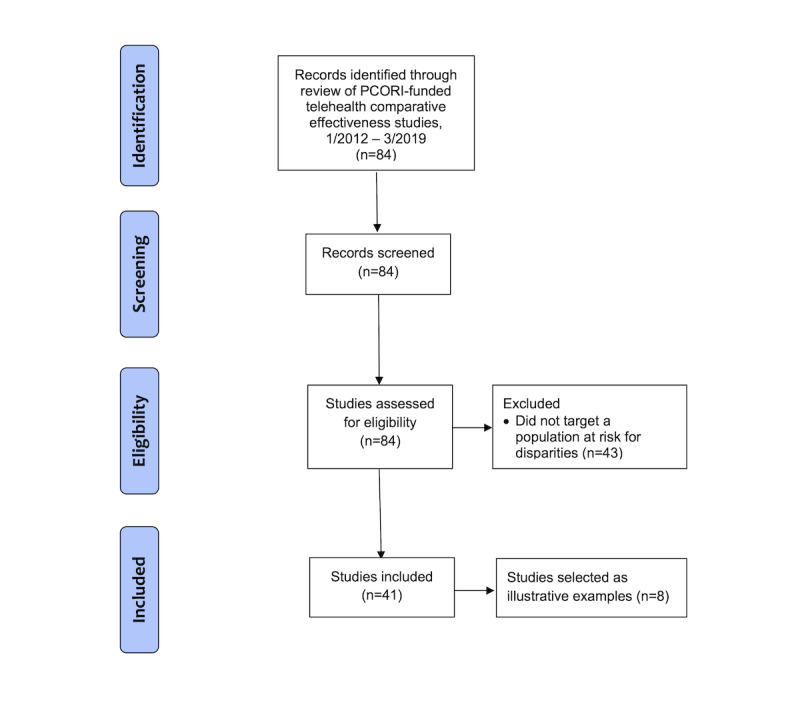
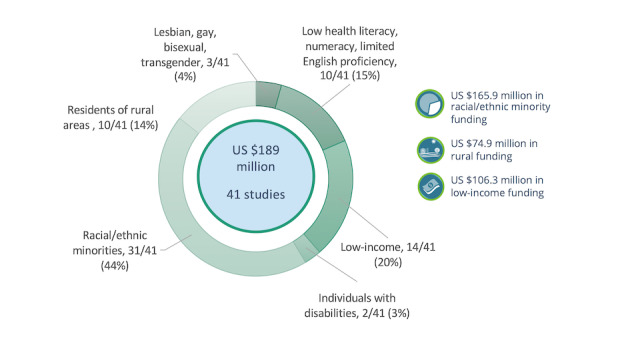
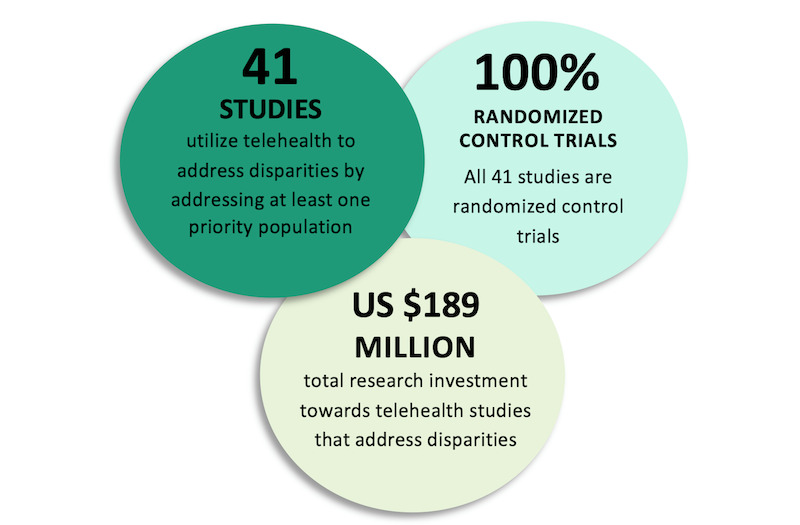
PCORI has funded 89 comparative effectiveness studies in telehealth, of which 41 assessed the use of telehealth to improve outcomes for populations at risk for health disparities. These 41 studies employed various overlapping modalities including mobile devices (29/41, 71%), web-based interventions (30/41, 73%), real-time videoconferencing (15/41, 37%), remote patient monitoring (8/41, 20%), and store-and-forward (ie, asynchronous electronic transmission) interventions (4/41, 10%). The studies targeted one or more of PCORI's priority populations, including racial and ethnic minorities (31/41, 41%), people living in rural areas, and those with low income/low socioeconomic status, low health literacy, or disabilities. Major themes identified across these studies included the importance of patient-centered design, cultural tailoring of telehealth solutions, delivering telehealth through trusted intermediaries, partnering with payers to expand telehealth reimbursement, and ensuring confidential sharing of private information.
Early PCOR evidence suggests that the most effective health system- and provider-level telehealth implementation solutions to address disparities employ patient-centered and culturally tailored telehealth solutions whose development is actively guided by the patients themselves to meet the needs of specific communities and populations. Further, this evidence shows that the best practices in telehealth implementation include delivery of telehealth through trusted intermediaries, close partnership with payers to facilitate reimbursement and sustainability, and safeguards to ensure patient-guided confidential sharing of personal health information.
美国各地的医疗系统和医疗机构越来越多地采用远程医疗技术,以更好地为医疗服务不足的低收入、少数族裔和农村地区服务,这些地区的人群面临着最大的健康差距风险。患者中心的结果研究所(PCORI)已经在远程医疗的比较有效性研究中投资了 3.86 亿美元,但对于从这项研究中获得的有关使用远程医疗来解决差异的最佳实践的关键早期经验知之甚少。
本文描述了从使用 PCORI 开创性的以患者为中心的结果研究(PCOR)计划中得出的研究结果和案例研究中提取的研究结果中获得的初步经验。主要目的是确定在面临差异风险的人群中实施远程医疗技术的常见障碍和促进因素。
对解决差异问题的远程医疗研究进行了系统的范围界定审查。它是由 Arksey 和 O'Malley 范围界定审查框架指导的,并侧重于 PCORI 远程医疗研究的活跃投资组合和由研究调查人员确定的关键 PCOR。我们利用这一广泛的文献,从早期 PCOR 经验和已发表的文献中的说明性示例中,使用主动实施框架提取数据,评估在面临差异风险的人群中实施远程医疗的障碍和促进因素。通过迭代 Delphi 过程,在参与研究的 PCORI 调查人员之间达成共识,确定了远程医疗干预措施如何克服远程医疗采用和实施障碍的主要主题。
PCORI 已在远程医疗方面资助了 89 项比较有效性研究,其中 41 项评估了远程医疗在改善面临健康差异风险的人群的结果方面的使用。这 41 项研究采用了各种重叠的模式,包括移动设备(41/41,71%)、基于网络的干预措施(41/41,73%)、实时视频会议(41/41,37%)、远程患者监测(41/41,20%)和存储和转发(即异步电子传输)干预措施(41/41,10%)。这些研究针对 PCORI 的一个或多个优先人群,包括种族和族裔少数群体(41/41,41%)、居住在农村地区的人群以及收入/社会经济地位较低、健康素养较低或有残疾的人群。这些研究确定的主要主题包括以患者为中心的设计的重要性、远程医疗解决方案的文化调整、通过可信的中介提供远程医疗服务、与支付方合作扩大远程医疗报销、以及确保私人信息的机密共享。
早期的 PCOR 证据表明,解决差异的最有效的医疗系统和提供者层面的远程医疗实施解决方案采用以患者为中心和文化调整的远程医疗解决方案,其开发由患者自己积极指导,以满足特定社区和人群的需求。此外,这一证据表明,远程医疗实施的最佳实践包括通过可信的中介提供远程医疗服务、与支付方密切合作以促进报销和可持续性、以及确保患者引导的个人健康信息机密共享的保障措施。