Liu Boxiang, Li Yanjun, Zhang Liang
Baidu Research, Sunnyvale, CA, United States.
Front Genet. 2022 Jan 27;12:785290. doi: 10.3389/fgene.2021.785290. eCollection 2021.
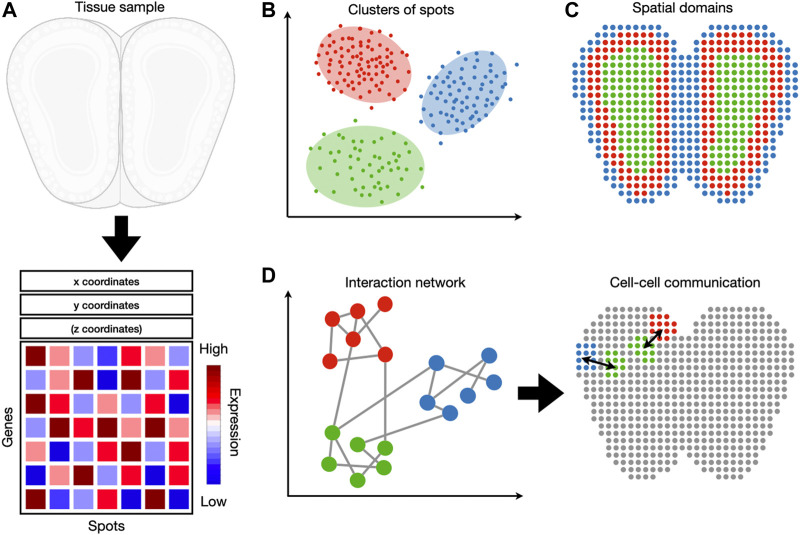
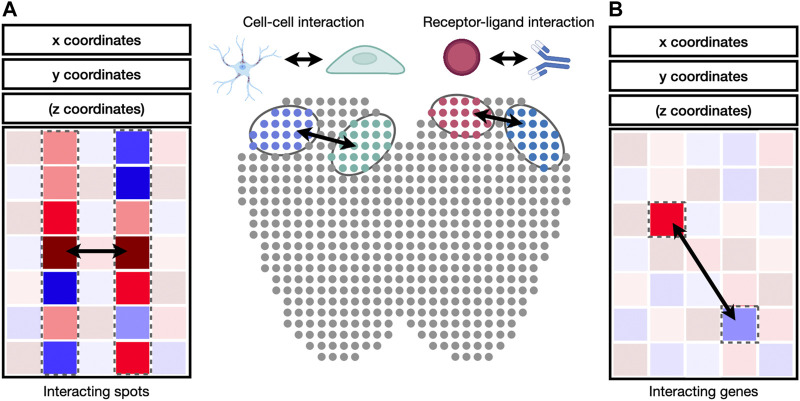
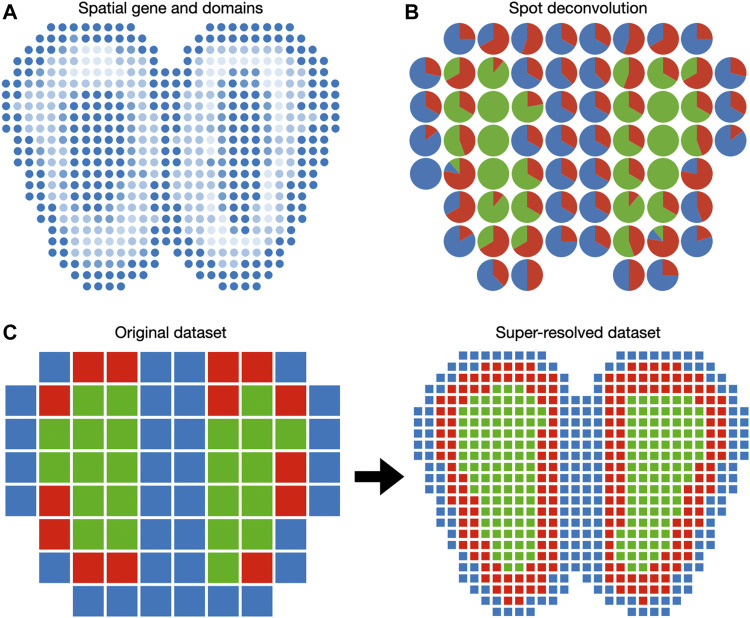
Human and animal tissues consist of heterogeneous cell types that organize and interact in highly structured manners. Bulk and single-cell sequencing technologies remove cells from their original microenvironments, resulting in a loss of spatial information. Spatial transcriptomics is a recent technological innovation that measures transcriptomic information while preserving spatial information. Spatial transcriptomic data can be generated in several ways. RNA molecules are measured by sequencing, hybridization, or spatial barcoding to recover original spatial coordinates. The inclusion of spatial information expands the range of possibilities for analysis and visualization, and spurred the development of numerous novel methods. In this review, we summarize the core concepts of spatial genomics technology and provide a comprehensive review of current analysis and visualization methods for spatial transcriptomics.
人类和动物组织由异质细胞类型组成,这些细胞以高度结构化的方式组织和相互作用。批量测序和单细胞测序技术将细胞从其原始微环境中移除,导致空间信息的丢失。空间转录组学是一项最新的技术创新,它在保留空间信息的同时测量转录组信息。空间转录组数据可以通过多种方式生成。通过测序、杂交或空间条形码对RNA分子进行测量,以恢复原始空间坐标。空间信息的纳入扩展了分析和可视化的可能性范围,并催生了许多新方法的发展。在这篇综述中,我们总结了空间基因组学技术的核心概念,并对当前空间转录组学的分析和可视化方法进行了全面综述。