Pettersen Henrik Sahlin, Belevich Ilya, Røyset Elin Synnøve, Smistad Erik, Simpson Melanie Rae, Jokitalo Eija, Reinertsen Ingerid, Bakke Ingunn, Pedersen André
Department of Pathology, St. Olavs Hospital, Trondheim University Hospital, Trondheim, Norway.
Department of Clinical and Molecular Medicine, Faculty of Medicine and Health Sciences, NTNU - Norwegian University of Science and Technology, Trondheim, Norway.
Front Med (Lausanne). 2022 Jan 27;8:816281. doi: 10.3389/fmed.2021.816281. eCollection 2021.
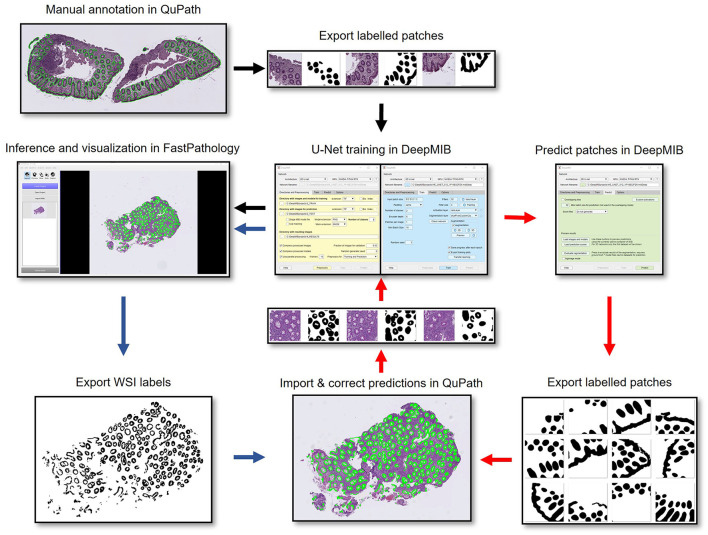
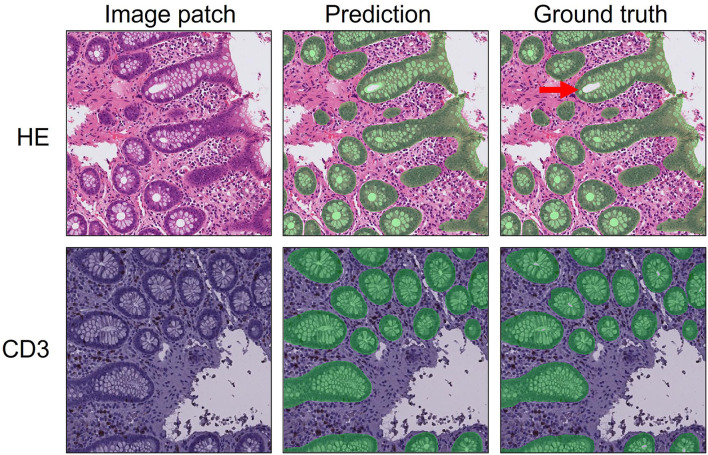
Application of deep learning on histopathological whole slide images (WSIs) holds promise of improving diagnostic efficiency and reproducibility but is largely dependent on the ability to write computer code or purchase commercial solutions. We present a code-free pipeline utilizing free-to-use, open-source software (QuPath, DeepMIB, and FastPathology) for creating and deploying deep learning-based segmentation models for computational pathology. We demonstrate the pipeline on a use case of separating epithelium from stroma in colonic mucosa. A dataset of 251 annotated WSIs, comprising 140 hematoxylin-eosin (HE)-stained and 111 CD3 immunostained colon biopsy WSIs, were developed through active learning using the pipeline. On a hold-out test set of 36 HE and 21 CD3-stained WSIs a mean intersection over union score of 95.5 and 95.3% was achieved on epithelium segmentation. We demonstrate pathologist-level segmentation accuracy and clinical acceptable runtime performance and show that pathologists without programming experience can create near state-of-the-art segmentation solutions for histopathological WSIs using only free-to-use software. The study further demonstrates the strength of open-source solutions in its ability to create generalizable, open pipelines, of which trained models and predictions can seamlessly be exported in open formats and thereby used in external solutions. All scripts, trained models, a video tutorial, and the full dataset of 251 WSIs with ~31 k epithelium annotations are made openly available at https://github.com/andreped/NoCodeSeg to accelerate research in the field.
将深度学习应用于组织病理学全切片图像(WSIs)有望提高诊断效率和可重复性,但很大程度上依赖于编写计算机代码或购买商业解决方案的能力。我们提出了一种无需代码的流程,利用免费的开源软件(QuPath、DeepMIB和FastPathology)来创建和部署基于深度学习的计算病理学分割模型。我们在结肠黏膜上皮与基质分离的用例中展示了该流程。通过使用该流程进行主动学习,开发了一个包含251个带注释的WSIs的数据集,其中包括140个苏木精-伊红(HE)染色和111个CD3免疫染色的结肠活检WSIs。在36个HE染色和21个CD3染色的WSIs的保留测试集上,上皮分割的平均交并比分数分别达到了95.5%和95.3%。我们展示了病理学家级别的分割准确性和临床可接受的运行时性能,并表明没有编程经验的病理学家仅使用免费软件就能为组织病理学WSIs创建近乎最先进的分割解决方案。该研究进一步证明了开源解决方案在创建可推广的开放流程方面的优势,其中训练好的模型和预测结果可以以开放格式无缝导出,从而用于外部解决方案。所有脚本、训练好的模型、视频教程以及包含约31k上皮注释的251个WSIs的完整数据集可在https://github.com/andreped/NoCodeSeg上公开获取,以加速该领域的研究。