Nguyen Xuan Dung, Zhao Yang, Evans Jeffrey D, Lin Jun, Purswell Joseph L
Department of Animal Science, The University of Tennessee, Knoxville, TN 37996, USA.
Poultry Research Unit, Agriculture Research Service, United States Department of Agriculture (USDA), Mississippi State, MS 39762, USA.
Animals (Basel). 2022 Jan 24;12(3):284. doi: 10.3390/ani12030284.
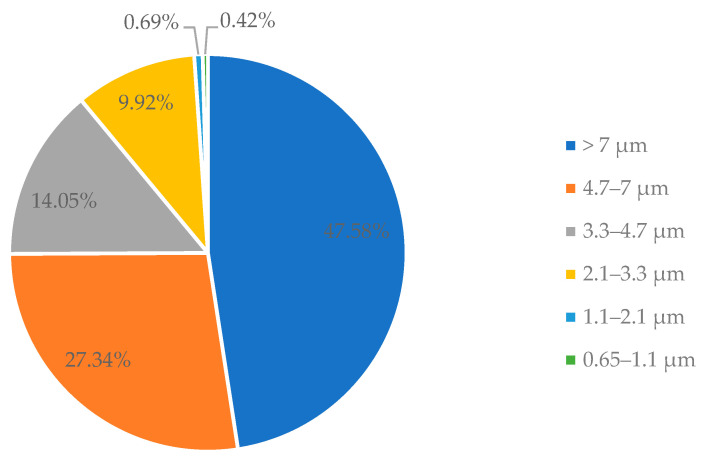
Airborne () in the poultry environment can migrate inside and outside houses through air movement. The airborne , after settling on surfaces, could be re-aerosolized or picked up by vectors (e.g., caretakers, rodents, transport trucks) for further transmission. To assess the impacts of airborne transmission among poultry farms, understanding the survivability of the bacteria is necessary. The objective of this study is to determine the survivability of airborne , settled , and in poultry litter under laboratory environmental conditions (22-28 °C with relative humidity of 54-63%). To determine the survivability of airborne , an AGI-30 bioaerosol sampler (AGI-30) was used to collect the at 0 and 20 min after the aerosolization. The half-life time of airborne was then determined by comparing the number of colony-forming units (CFUs) of the two samplings. To determine the survivability of settled , four sterile Petri dishes were placed on the chamber floor right after the aerosolization to collect settled . The Petri dishes were then divided into two groups, with each group being quantified for culturable concentrations and dust particle weight at 24-h intervals. The survivability of settled was then determined by comparing the number of viable per milligram settled dust collected in the Petri dishes in the two groups. The survivability of in the poultry litter sample (for aerosolization) was also determined. Results show that the half-life time of airborne was 5.7 ± 1.2 min. The survivability of in poultry litter and settled were much longer with the half-life time of 15.9 ± 1.3 h and 9.6 ± 1.6 h, respectively. In addition, the size distribution of airborne attached to dust particles and the size distribution of airborne dust particles were measured by using an Andersen impactor and a dust concentration monitor (DustTrak). Results show that most airborne (98.89% of total ) were carried by the dust particles with aerodynamic diameter larger than 2.1 µm. The findings of this study may help better understand the fate of transmitted through the air and settled on surfaces and evaluate the impact of airborne transmission in poultry production.
家禽环境中的空气传播性[细菌名称]可通过空气流动在禽舍内外迁移。空气传播性[细菌名称]沉降在表面后,可能会再次气溶胶化,或被媒介(如饲养员、啮齿动物、运输卡车)携带,从而进一步传播。为评估家禽养殖场之间空气传播性[细菌名称]传播的影响,了解该细菌的生存能力很有必要。本研究的目的是确定在实验室环境条件(22 - 28°C,相对湿度54 - 63%)下,空气传播性[细菌名称]、沉降后的[细菌名称]以及家禽垫料中的[细菌名称]的生存能力。为确定空气传播性[细菌名称]的生存能力,使用AGI - 30生物气溶胶采样器(AGI - 30)在雾化后0分钟和20分钟采集[细菌名称]。然后通过比较两次采样的菌落形成单位(CFU)数量来确定空气传播性[细菌名称]的半衰期。为确定沉降后[细菌名称]的生存能力,雾化后立即在试验箱底部放置四个无菌培养皿以收集沉降后的[细菌名称]。然后将培养皿分为两组,每组每隔24小时对可培养的[细菌名称]浓度和灰尘颗粒重量进行定量。然后通过比较两组培养皿中每毫克沉降灰尘收集到的活[细菌名称]数量来确定沉降后[细菌名称]的生存能力。还确定了家禽垫料样本(用于雾化)中[细菌名称]的生存能力。结果表明,空气传播性[细菌名称]的半衰期为5.7±1.2分钟。家禽垫料中和沉降后[细菌名称]的生存能力要长得多,半衰期分别为15.9±1.3小时和9.6±1.6小时。此外,使用安德森撞击器和灰尘浓度监测仪(DustTrak)测量附着在灰尘颗粒上的空气传播性[细菌名称]的大小分布以及空气传播灰尘颗粒的大小分布。结果表明,大多数空气传播性[细菌名称](占总[细菌名称]的98.89%)由空气动力学直径大于2.1 µm的灰尘颗粒携带。本研究结果可能有助于更好地了解通过空气传播并沉降在表面的[细菌名称]的归宿,并评估空气传播在禽类生产中的影响。