Cao Anlan, Ferrucci Leah M, Caan Bette J, Irwin Melinda L
Department of Chronic Disease Epidemiology, Yale School of Public Health, 60 College Street, New Haven, CT 06520-8034, USA.
Yale Cancer Center, New Haven, CT 06520-8034, USA.
Cancers (Basel). 2022 Feb 3;14(3):786. doi: 10.3390/cancers14030786.
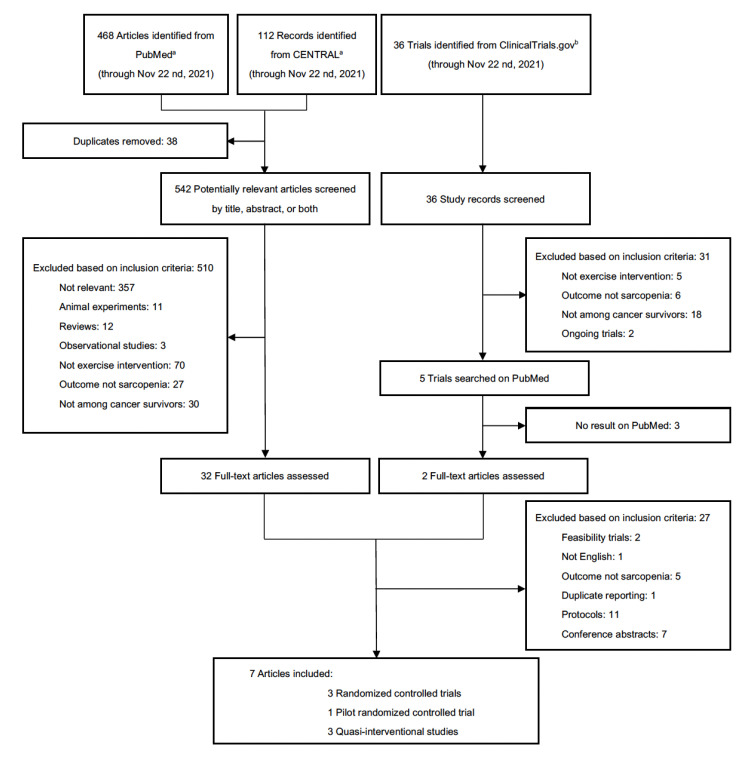
Sarcopenia is related to adverse health outcomes in cancer survivors. Previous reviews reported exercise improved muscle mass or function in cancer survivors, but thus far a systematic review examining the effect of exercise on sarcopenia in this population has not been conducted. Therefore, we systematically searched PubMed, CENTRAL (Cochrane Central Register of Controlled Trials) and ClinicalTrials.gov for publications and ongoing trials (through November 2021) that reported exercise interventions and diagnosed sarcopenia among cancer survivors. Seven exercise trials were eligible for this review. Six of seven studies showed exercise increased skeletal muscle post intervention (1.6% to 5.4% increase within intervention groups compared to baseline, ≤ 0.07; 2.1% to 12.8% greater increase for intervention than control groups, ≤ 0.02) and in the three studies that reported sarcopenia reversal, an improvement (18.2% to 42.9% decrease in sarcopenia in exercise groups, 5.2% increase to 16.7% decrease in sarcopenia in control groups, = 0.04) was observed. Existing research indicates the potential for exercise to improve health outcomes for cancer survivors through building muscle and attenuating sarcopenia. More high-quality, long-term, large randomized controlled trials examining effects of different exercise types and doses to improve sarcopenia should be conducted to further explore this important topic.
肌肉减少症与癌症幸存者的不良健康结局相关。以往的综述报告称,运动可改善癌症幸存者的肌肉质量或功能,但迄今为止,尚未对运动对该人群肌肉减少症的影响进行系统综述。因此,我们系统检索了PubMed、CENTRAL(Cochrane对照试验中央注册库)和ClinicalTrials.gov,以查找报告运动干预措施并诊断癌症幸存者肌肉减少症的已发表文献和正在进行的试验(截至2021年11月)。七项运动试验符合本综述的纳入标准。七项研究中的六项显示,运动干预后骨骼肌增加(干预组与基线相比增加1.6%至5.4%,P≤0.07;干预组比对照组增加2.1%至12.8%,P≤0.02),在三项报告肌肉减少症逆转情况的研究中,观察到有所改善(运动组肌肉减少症减少18.2%至42.9%,对照组肌肉减少症增加5.2%至减少16.7%,P = 0.04)。现有研究表明,运动有可能通过增强肌肉和减轻肌肉减少症来改善癌症幸存者的健康结局。应开展更多高质量、长期、大型随机对照试验,以研究不同运动类型和剂量对改善肌肉减少症的影响,从而进一步探索这一重要课题。