School of Psychology and Neuroscience, University of Glasgow, Glasgow G12 8QB, UK.
Sensors (Basel). 2022 Jan 31;22(3):1100. doi: 10.3390/s22031100.
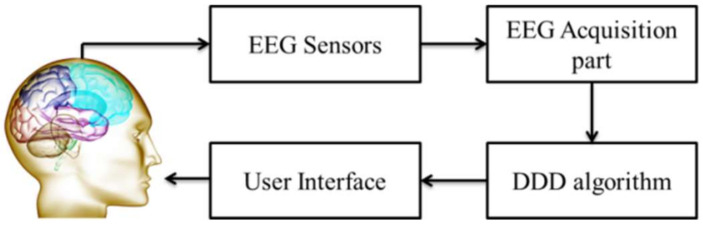
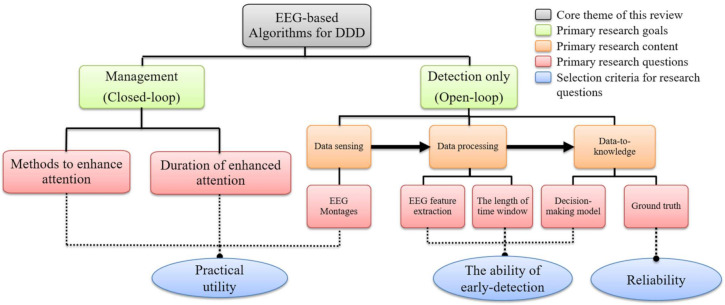
Drowsiness is not only a core challenge to safe driving in traditional driving conditions but also a serious obstacle for the wide acceptance of added services of self-driving cars (because drowsiness is, in fact, one of the most representative early-stage symptoms of self-driving carsickness). In view of the importance of detecting drivers' drowsiness, this paper reviews the algorithms of electroencephalogram (EEG)-based drivers' drowsiness detection (DDD). To facilitate the review, the EEG-based DDD approaches are organized into a tree structure taxonomy, having two main categories, namely "detection only (open-loop)" and "management (closed-loop)", both aimed at designing better DDD systems that ensure early detection, reliability and practical utility. To achieve this goal, we addressed seven questions, the answers of which helped in developing an EEG-based DDD system that is superior to the existing ones. A basic assumption in this review article is that although driver drowsiness and carsickness-induced drowsiness are caused by different factors, the brain network that regulates drowsiness is the same.
困倦不仅是传统驾驶条件下安全驾驶的核心挑战,也是自动驾驶汽车附加服务广泛接受的严重障碍(因为困倦实际上是自动驾驶晕车的最具代表性的早期症状之一)。鉴于检测驾驶员困倦的重要性,本文回顾了基于脑电图(EEG)的驾驶员困倦检测(DDD)算法。为了便于审查,基于 EEG 的 DDD 方法被组织成一个树形结构分类法,有两个主要类别,即“仅检测(开环)”和“管理(闭环)”,两者都旨在设计更好的 DDD 系统,以确保早期检测、可靠性和实际应用。为了实现这一目标,我们提出了七个问题,这些问题的答案有助于开发出优于现有系统的基于 EEG 的 DDD 系统。本文的一个基本假设是,尽管驾驶员困倦和晕车引起的困倦是由不同的因素引起的,但调节困倦的大脑网络是相同的。