Kuila Debashis, Ghosh Somdatta
Mycorrhiza & Microbiology Research Section, Department of Botany(UG & PG), Midnapore College (Autonomous), Midnapore, W. B., 721101, India.
Department of Botany and Forestry, Vidyasagar University, 721102, India.
Curr Res Microb Sci. 2022 Jan 23;3:100107. doi: 10.1016/j.crmicr.2022.100107. eCollection 2022.
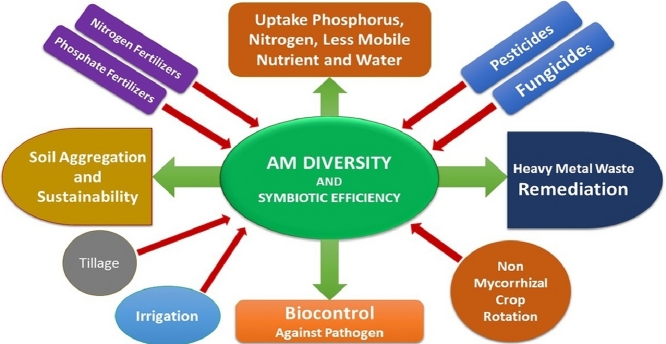
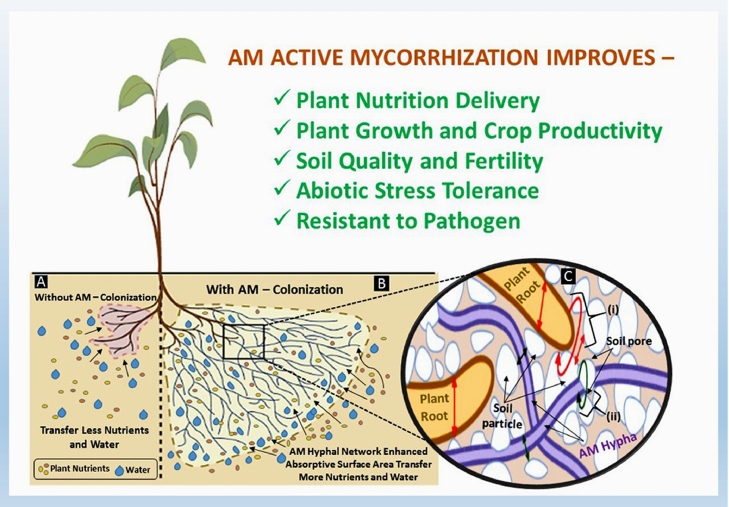
The rapid growth of human population on globe and reduction in agricultural land exerts huge pressure on crop productivity, food security and soil health; specially, in developing countries. Improper land management with excessive dependency on chemical fertilizers and agrochemicals to secure productivity tolls on human health, environment, biodiversity and sustainability. The utilization of arbuscular mycorrhizal fungi (AMF) as bio-fertilizer and in consortia with other beneficial microbes has become an increasing area of research in agriculture and life sciences. Former investigations revealed the positive influence of AM in nutrition, growth, yield of crops, soil quality increasing biological soil fertility and pathogen resistance. AMF symbionts are highly beneficial in plant abiotic stress tolerance. Along with other beneficial rhiozobacteria AM is almost substitute of chemical fertilizers in modern sustainable organic agricultural systems. But conventional agriculture in most countries is beyond to reach these benefits of AM. The issues which hinder the utilization also contradict to sustainability to some degrees. The present review highlights on the issues of hindrances in applicability of AM to the agricultural fields focusing on the mode of functions, maintaining soil and environmental sustainability; interactions with other biofertilizers and impact of various agrochemicals and agro-practices including tillage and crop rotation. The procedures to avail the full benefit of AM in agricultural field for sustainable system are discussed here.
全球人口的快速增长以及农业用地的减少对作物生产力、粮食安全和土壤健康造成了巨大压力;特别是在发展中国家。过度依赖化肥和农用化学品以确保生产力的不当土地管理对人类健康、环境、生物多样性和可持续性造成了损害。将丛枝菌根真菌(AMF)用作生物肥料以及与其他有益微生物联合使用已成为农业和生命科学领域日益受到关注的研究领域。先前的研究揭示了AM在营养、作物生长、产量、土壤质量提高生物土壤肥力和抗病性方面的积极影响。AMF共生体在植物非生物胁迫耐受性方面非常有益。与其他有益的根际细菌一起,AM几乎可以替代现代可持续有机农业系统中的化肥。但大多数国家的传统农业无法实现AM的这些益处。阻碍其利用的问题在一定程度上也与可持续性相矛盾。本综述重点关注AM在农业领域应用中的障碍问题,聚焦于其作用方式、维持土壤和环境可持续性;与其他生物肥料的相互作用以及各种农用化学品和农业实践(包括耕作和作物轮作)的影响。本文还讨论了在农业领域充分利用AM实现可持续系统的方法。