Environmental Health Institute, National Environment Agency, Singapore, Singapore.
Defence Medical and Environmental Research Institute, DSO National Laboratories, Singapore, Singapore.
Sci Rep. 2022 Feb 17;12(1):2692. doi: 10.1038/s41598-021-03954-w.
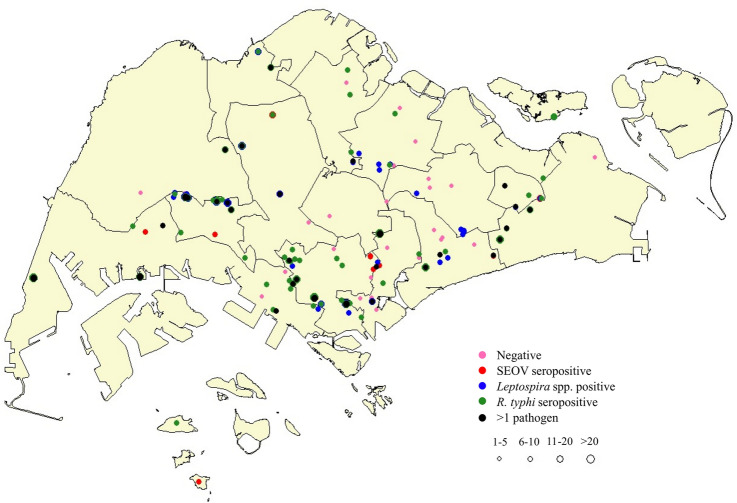
Rodents living alongside humans increases the probability of encounter and also the transmission of rodent-borne diseases. Singapore's cosmopolitan urban landscape provides a perfect setting to study the prevalence of four rodent-borne pathogens: Seoul hantavirus (SEOV), Leptospira species, Rickettsia typhi and Yersinia pestis, and identify the potential risk factors which may influence rodent density and transmission of rodent-borne diseases. A total of 1143 rodents were trapped from 10 unique landscape structures throughout Singapore. Real-time quantitative Polymerase Chain Reactions were used to detect pathogenic and intermediate Leptospira spp. and Yersinia pestis, whereas the seroprevalence of SEOV and R. typhi were analysed by Enzyme-Linked Immunosorbent Assay and Immunofluorescence Assay respectively. Multivariable logistic regression analysis was used to evaluate the association between prevalence of infection in rodent reservoirs and risk factors. Most of the rodents were caught in public residential developments (62.2%). Among the tested rodents, 42.4% were infected with Leptospira spp., while 35.5% and 32.2% were seropositive for SEOV and R. typhi respectively, whereas Yersinia pestis was not detected. Furthermore, risk factors including habitat, species, gender, and weight of rodents, influenced prevalence of infection to a varying extent. This study highlights the presence of Leptospira spp., SEOV and R. typhi in Singapore's rodent population, suggesting the need for effective rodent management and sanitation strategies to prevent further circulation and transmission to humans.
与人共同生活的啮齿动物增加了接触和传播啮齿动物传播疾病的可能性。新加坡国际化的城市景观为研究四种啮齿动物传播病原体的流行情况提供了绝佳的环境:首尔汉坦病毒(SEOV)、钩端螺旋体属、伤寒杆菌和鼠疫耶尔森菌,并确定可能影响啮齿动物密度和传播啮齿动物传播疾病的潜在风险因素。从新加坡 10 个独特的景观结构中捕获了 1143 只啮齿动物。实时定量聚合酶链反应用于检测致病性和中间型钩端螺旋体属和鼠疫耶尔森菌,而 SEOV 和 R. typhi 的血清阳性率则通过酶联免疫吸附试验和免疫荧光试验进行分析。多变量逻辑回归分析用于评估啮齿动物宿主感染率与风险因素之间的关联。大多数啮齿动物是在公共住宅区(62.2%)捕获的。在所测试的啮齿动物中,42.4%感染了钩端螺旋体属,35.5%和 32.2%分别对 SEOV 和 R. typhi 呈血清阳性,而未检测到鼠疫耶尔森菌。此外,包括栖息地、物种、性别和体重在内的风险因素在不同程度上影响了感染率。本研究强调了新加坡啮齿动物种群中存在钩端螺旋体属、SEOV 和 R. typhi,这表明需要采取有效的啮齿动物管理和卫生策略,以防止进一步传播和传染给人类。