Nobre Moura Renata, Kuboki Yeda, Baba Elisa Ryoka, Safatle-Ribeiro Adriana, Martins Bruno, de Paulo Gustavo Andrade, Tolentino Luciano Lenz, de Lima Marcelo Simas, Kulcsar Marco Aurelio, Sallum Rubens Antonio Aissar, Ribeiro Ulysses, Maluf-Filho Fauze
Department of Gastroenterology, Instituto do Cancer (ICESP), Hospital das Clinicas HCFMUSP, Faculdade de Medicina, Universidade de Sao Paulo, Sao Paulo, SP, Brazil.
Discipline of Head and Neck Surgery, Instituto do Cancer (ICESP), Hospital das Clinicas HCFMUSP, Faculdade de Medicina, Universidade de Sao Paulo, Sao Paulo, SP, Brazil.
Endosc Int Open. 2022 Feb 15;10(2):E200-E208. doi: 10.1055/a-1675-2334. eCollection 2022 Feb.
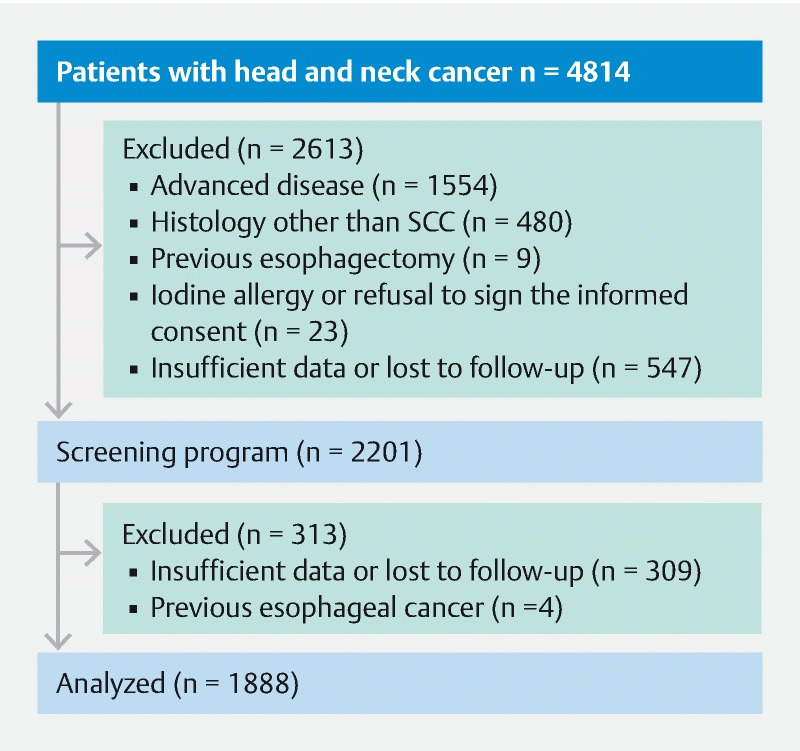
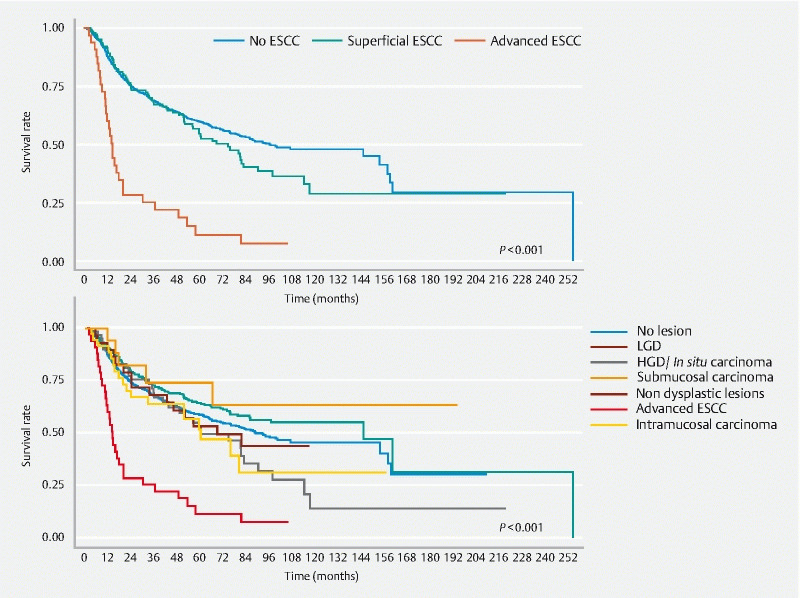
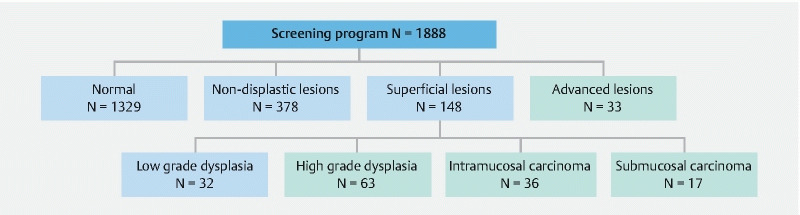
Patients with head and neck squamous cell carcinoma (HNSCC) are at risk of a second primary tumor in the gastrointestinal tract, most commonly in the esophagus. Screening these patients for esophageal carcinoma may help detect asymptomatic dysplasia and early cancer, thus allowing curative treatment and more prolonged survival, but the impact of endoscopic screening remains uncertain. Here we aimed to describe the long-term results of an esophageal SCC screening program in patients with head and neck cancer in terms of prevalence, associated risk factors, and survival. We performed an observational study of a prospectively collected database including patients with HNSCC who had undergone high-definition endoscopy with chromoscopy between 2010 and 2018 at a Brazilian tertiary academic center. The study included 1,888 patients. The esophageal SCC prevalence was 7.9 %, with the majority (77.8 %) being superficial lesions. Significant risk factors for esophageal high-grade dysplasia (HGD) and invasive cancer included tumors of the oral cavity and oropharynx and the presence of low-grade dysplasia (LGD). Overall survival (OS) was significantly shorter among patients in whom esophageal cancer was diagnosed at an advanced stage ( < .001). OS did not significantly differ between patients with HGD and early esophageal cancer versus those without esophageal cancer ( = .210) Endoscopic screening for superficial esophageal neoplasia in patients with HNSCC improves esophageal cancer detection. Screening could potentially benefit patients with primary cancer located at the oropharynx or oral cavity. In addition, the detection of esophageal LGD indicates a need for endoscopic surveillance.
头颈部鳞状细胞癌(HNSCC)患者有发生胃肠道第二原发性肿瘤的风险,最常见于食管。对这些患者进行食管癌筛查可能有助于发现无症状的发育异常和早期癌症,从而实现根治性治疗并延长生存期,但内镜筛查的影响仍不确定。在此,我们旨在从患病率、相关风险因素和生存率方面描述一项针对头颈癌患者的食管鳞状细胞癌筛查计划的长期结果。我们对一个前瞻性收集的数据库进行了观察性研究,该数据库包括2202010年至2018年期间在巴西一家三级学术中心接受高清内镜染色检查的HNSCC患者。该研究纳入了1888例患者。食管鳞状细胞癌的患病率为7.9%,其中大多数(77.8%)为浅表病变。食管高级别发育异常(HGD)和浸润性癌的显著风险因素包括口腔和口咽肿瘤以及低级别发育异常(LGD)的存在。在晚期诊断出食管癌的患者中,总生存期(OS)显著缩短(<0.001)。HGD和早期食管癌患者与无食管癌患者的OS无显著差异(=0.210)。对HNSCC患者进行食管浅表肿瘤的内镜筛查可提高食管癌的检出率。筛查可能对原发癌位于口咽或口腔的患者有益。此外,食管LGD的检测表明需要进行内镜监测。