Santos-Beneit Fernando, Ceniceros Ana, Nikolaou Athanasios, Salas José A, Gutierrez-Merino Jorge
Department of Chemical Engineering and Environmental Technology, School of Industrial Engineering, University of Valladolid, Valladolid, Spain.
Departamento de Biología Funcional, Universidad de Oviedo, Oviedo, Spain.
Front Microbiol. 2022 Feb 3;13:742168. doi: 10.3389/fmicb.2022.742168. eCollection 2022.
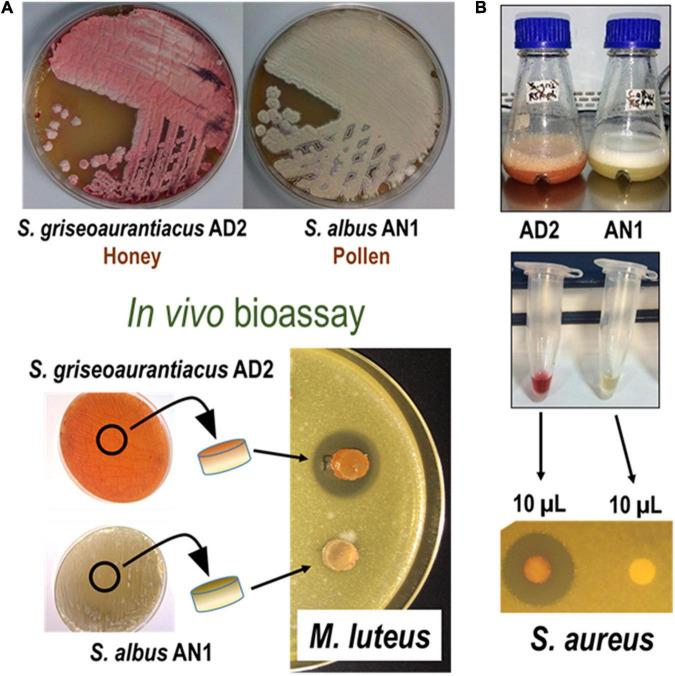
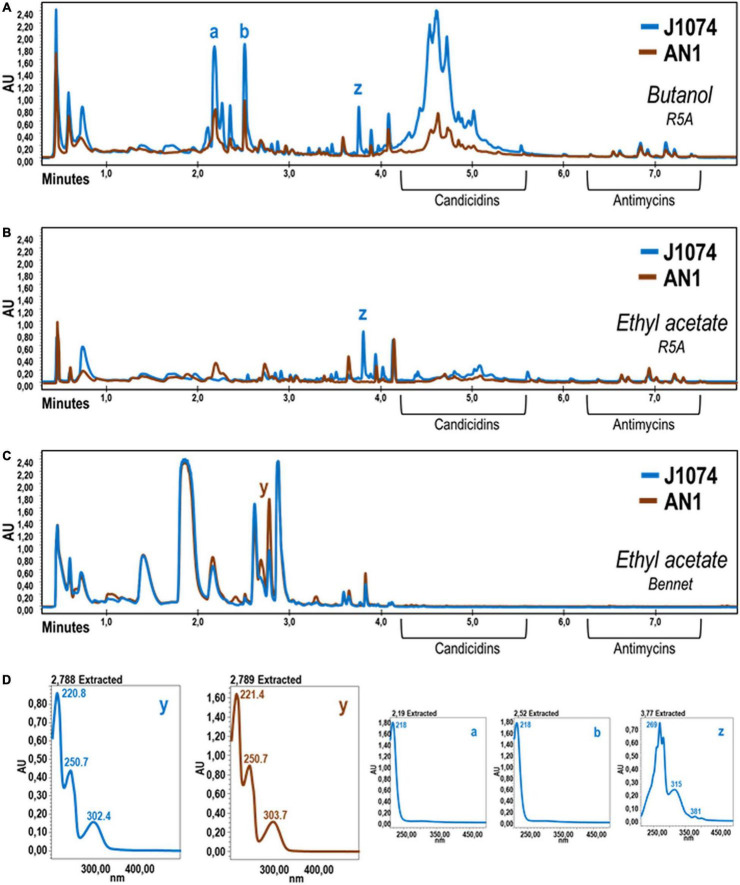
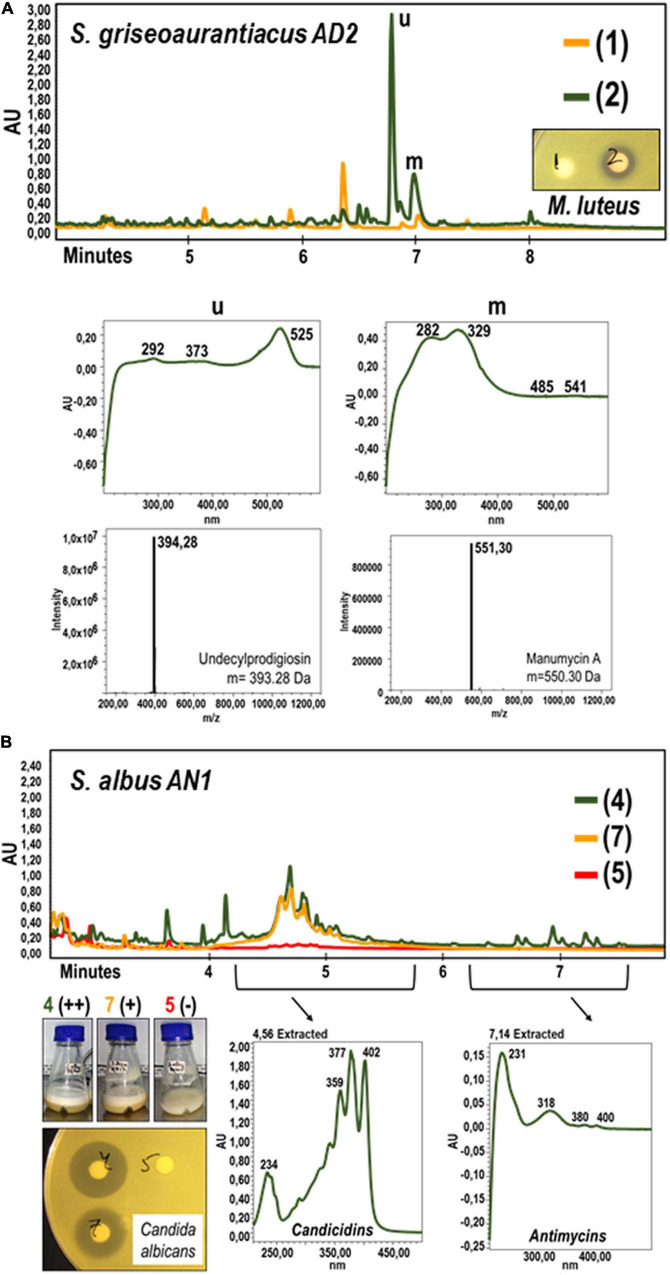
The World Health Organization warns that the alarming increase in antibiotic resistant bacteria will lead to 2.7 million deaths annually due to the lack of effective antibiotic therapies. Clearly, there is an urgent need for short-term alternatives that help to alleviate these alarming figures. In this respect, the scientific community is exploring neglected ecological niches from which the prototypical antibiotic-producing bacteria Streptomycetes are expected to be present. Recent studies have reported that honeybees and their products carry species that possess strong antibacterial activity. In this study, we have investigated the antibiotic profile of two Streptomycetes strains that were isolated from beehives. One of the isolates is the strain AN1, which derives from pollen, and shows potent antimicrobial activity against . The other isolate is the strain AD2, which was isolated from honey, and displays a broad range of antimicrobial activity against different Gram-positive bacteria, including pathogens such as and . Cultures of AD2 have the capacity to produce the antibacterial compounds undecylprodigiosin and manumycin, while those of AN1 accumulate antifungal compounds such as candicidins and antimycins. Furthermore, genome and dereplication analyses suggest that the number of putative bioactive metabolites produced by AD2 and AN1 is considerably high, including compounds with anti-microbial and anti-cancer properties. Our results postulate that beehives are a promising source for the discovery of novel bioactive compounds that might be of interest to the agri-food sector and healthcare pharmaceuticals.
世界卫生组织警告称,由于缺乏有效的抗生素治疗方法,抗生素耐药细菌数量的惊人增长将导致每年270万人死亡。显然,迫切需要短期替代方案来缓解这些惊人的数据。在这方面,科学界正在探索一些被忽视的生态位,预计其中存在典型的抗生素产生菌链霉菌。最近的研究报告称,蜜蜂及其产品携带具有强大抗菌活性的物种。在本研究中,我们调查了从蜂箱中分离出的两种链霉菌菌株的抗生素谱。其中一种分离株是源自花粉的AN1菌株,它对……显示出强大的抗菌活性。另一种分离株是从蜂蜜中分离出的AD2菌株,它对不同的革兰氏阳性菌,包括如……和……等病原体,表现出广泛的抗菌活性。AD2菌株的培养物能够产生抗菌化合物undecylprodigiosin和manumycin,而AN1菌株的培养物则积累抗真菌化合物,如杀假丝菌素和抗霉素。此外,基因组和去重复分析表明,AD2和AN1产生的推定生物活性代谢物数量相当多,包括具有抗菌和抗癌特性的化合物。我们的研究结果表明,蜂箱是发现新型生物活性化合物的一个有前景的来源,这些化合物可能对农业食品部门和医疗保健制药行业有意义。