From the Department of Orthopaedics and Rehabilitation, Yale School of Medicine, New Haven, CT (Dr. Ottesen, Shultz, Dr. Munger, Sibindi, Yurter, Dr. Varthi, and Dr. Grauer), and the Harvard Combined Orthopedic Residency Program, Harvard Medical School, Boston, MA (Dr. Ottesen).
J Am Acad Orthop Surg Glob Res Rev. 2022 Feb 22;6(2):e22.00009. doi: 10.5435/JAAOSGlobal-D-22-00009.
Previous studies about osteosarcoma patient characteristics, management, and outcomes have limited patient numbers, combine varied tumor types, and/or are older studies.
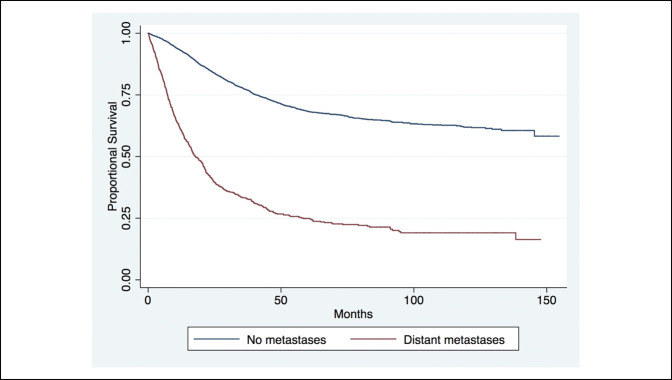
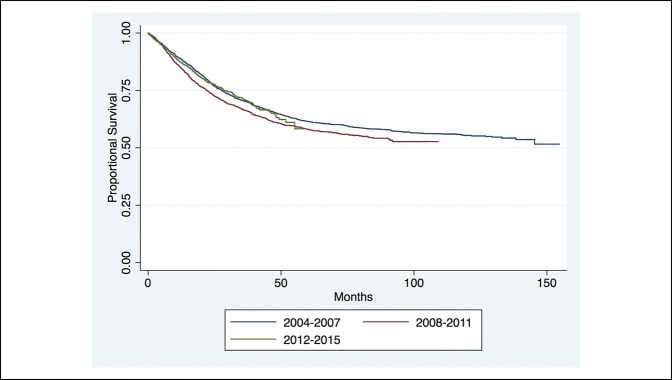
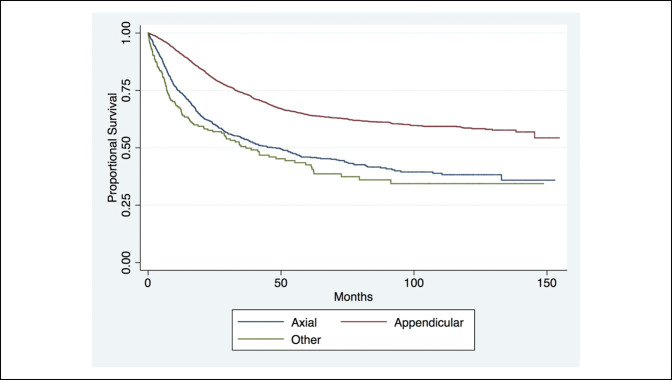
Patients with osteosarcoma from the 2004 to 2015 National Cancer Database data sets were separated into axial, appendicular, and other. Demographic and treatment data as well as 1-, 5-, and 10-year survival were determined for each group. A multivariate Cox analysis of patient variables with the likelihood of death was performed, and the Kaplan Meier survival curves were generated.
Four thousand four hundred thirty patients with osteosarcoma (3,435 appendicular, 810 axial, and 185 other) showed survival at 1-year, 5-year, and 10-year and was highest among the appendicular cohort (91.17%, 64.43%, and 58.58%, respectively). No change in survival was seen over the periods studied. The likelihood of death was greater with increasing age category, distant metastases, and treatment with radiation alone but less with appendicular primary site, treatment with surgery alone, or surgery plus chemotherapy.
Despite advances in tumor management, surgical excision remains the best predictor of survival for osteosarcomas. No difference was observed in patient survival from 2004 to 2015 and, as would be expected, distant metastases were a poor prognostic sign, as was increasing age, male sex, and axial location.
以前关于骨肉瘤患者特征、治疗和预后的研究,患者数量有限,肿瘤类型多样,或研究较陈旧。
从 2004 年至 2015 年国家癌症数据库的数据集中,将患有骨肉瘤的患者分为轴性、附肢性和其他类型。对每个组别的人口统计学和治疗数据以及 1 年、5 年和 10 年的生存率进行了确定。对具有死亡可能性的患者变量进行了多变量 Cox 分析,并生成了 Kaplan-Meier 生存曲线。
4430 例骨肉瘤患者(3435 例附肢性,810 例轴性,185 例其他)的 1 年、5 年和 10 年生存率最高,附肢性肿瘤患者的生存率最高(分别为 91.17%、64.43%和 58.58%)。在所研究的时间段内,生存率没有变化。随着年龄、远处转移和单纯放疗的增加,死亡的可能性增加,但随着附肢性原发性肿瘤、单纯手术治疗或手术加化疗的增加,死亡的可能性降低。
尽管肿瘤治疗取得了进展,但外科切除仍然是骨肉瘤生存的最佳预测因素。2004 年至 2015 年期间,患者的生存率没有差异,而且正如预期的那样,远处转移是一个不良预后的标志,年龄、性别、轴性位置也是不良预后的标志。