Department of Biomedical Engineering, National Taiwan University, Taipei 10617, Taiwan.
Department of Neurology, Hualien Tzu Chi Hospital, Buddhist Tzu Chi Medical Foundation, Hualien 97002, Taiwan.
Biosensors (Basel). 2022 Jan 27;12(2):74. doi: 10.3390/bios12020074.
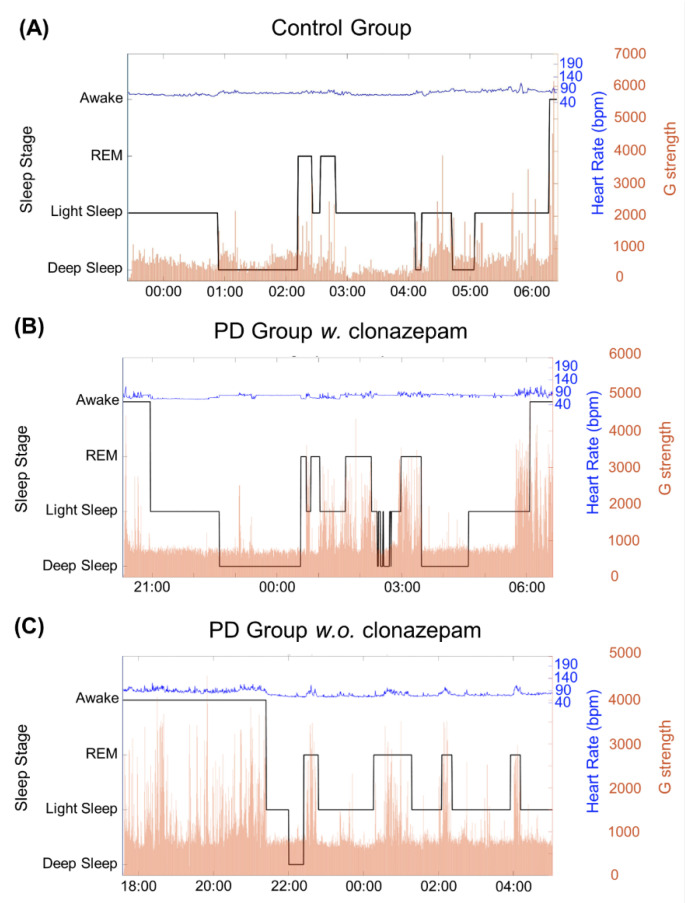
Rapid eye movement (REM) sleep behavior disorder (RBD) is associated with Parkinson's disease (PD). In this study, a smartwatch-based sensor is utilized as a convenient tool to detect the abnormal RBD phenomenon in PD patients. Instead, a questionnaire with sleep quality assessment and sleep physiological indices, such as sleep stage, activity level, and heart rate, were measured in the smartwatch sensors. Therefore, this device can record comprehensive sleep physiological data, offering several advantages such as ubiquity, long-term monitoring, and wearable convenience. In addition, it can provide the clinical doctor with sufficient information on the patient's sleeping patterns with individualized treatment. In this study, a three-stage sleep staging method (i.e., comprising sleep/awake detection, sleep-stage detection, and REM-stage detection) based on an accelerometer and heart-rate data is implemented using machine learning (ML) techniques. The ML-based algorithms used here for sleep/awake detection, sleep-stage detection, and REM-stage detection were a Cole-Kripke algorithm, a stepwise clustering algorithm, and a k-means clustering algorithm with predefined criteria, respectively. The sleep staging method was validated in a clinical trial. The results showed a statistically significant difference in the percentage of abnormal REM between the control group (1.6 ± 1.3; = 18) and the PD group (3.8 ± 5.0; = 20) ( = 0.04). The percentage of deep sleep stage in our results presented a significant difference between the control group (38.1 ± 24.3; = 18) and PD group (22.0 ± 15.0, = 20) ( = 0.011) as well. Further, our results suggested that the smartwatch-based sensor was able to detect the difference of an abnormal REM percentage in the control group (1.6 ± 1.3; = 18), PD patient with clonazepam (2.0 ± 1.7; = 10), and without clonazepam (5.7 ± 7.1; = 10) ( = 0.007). Our results confirmed the effectiveness of our sensor in investigating the sleep stage in PD patients. The sensor also successfully determined the effect of clonazepam on reducing abnormal REM in PD patients. In conclusion, our smartwatch sensor is a convenient and effective tool for sleep quantification analysis in PD patients.
快速眼动(REM)睡眠行为障碍(RBD)与帕金森病(PD)有关。在这项研究中,我们利用基于智能手表的传感器作为一种方便的工具来检测 PD 患者的异常 RBD 现象。相反,我们使用带有睡眠质量评估和睡眠生理指标(如睡眠阶段、活动水平和心率)的问卷在智能手表传感器中进行测量。因此,该设备可以记录全面的睡眠生理数据,具有普遍性、长期监测和佩戴方便等优点。此外,它可以为临床医生提供有关患者个体化治疗睡眠模式的充足信息。在这项研究中,我们使用基于机器学习(ML)技术的加速度计和心率数据的三阶段睡眠分期方法(包括睡眠/觉醒检测、睡眠阶段检测和 REM 阶段检测)来实现。这里用于睡眠/觉醒检测、睡眠阶段检测和 REM 阶段检测的基于 ML 的算法分别是 Cole-Kripke 算法、逐步聚类算法和带有预定义标准的 k-均值聚类算法。睡眠分期方法在临床试验中得到了验证。结果表明,对照组(1.6 ± 1.3; = 18)和 PD 组(3.8 ± 5.0; = 20)之间 REM 异常的百分比存在统计学显著差异( = 0.04)。我们的结果还表明,在对照组(38.1 ± 24.3; = 18)和 PD 组(22.0 ± 15.0, = 20)之间,深度睡眠阶段的百分比存在显著差异( = 0.011)。此外,我们的结果表明,基于智能手表的传感器能够检测到对照组(1.6 ± 1.3; = 18)、服用氯硝西泮的 PD 患者(2.0 ± 1.7; = 10)和未服用氯硝西泮的 PD 患者(5.7 ± 7.1; = 10)之间 REM 异常百分比的差异( = 0.007)。我们的结果证实了我们的传感器在研究 PD 患者睡眠阶段方面的有效性。该传感器还成功确定了氯硝西泮对降低 PD 患者异常 REM 的作用。总之,我们的智能手表传感器是一种方便有效的 PD 患者睡眠量化分析工具。