Neuroscience Research Unit, School of Life Sciences, University of Technology Sydney, Sydney, NSW 2007, Australia.
School of Life Sciences, University of Technology Sydney, Sydney, NSW 2007, Australia.
Int J Environ Res Public Health. 2022 Feb 15;19(4):2189. doi: 10.3390/ijerph19042189.
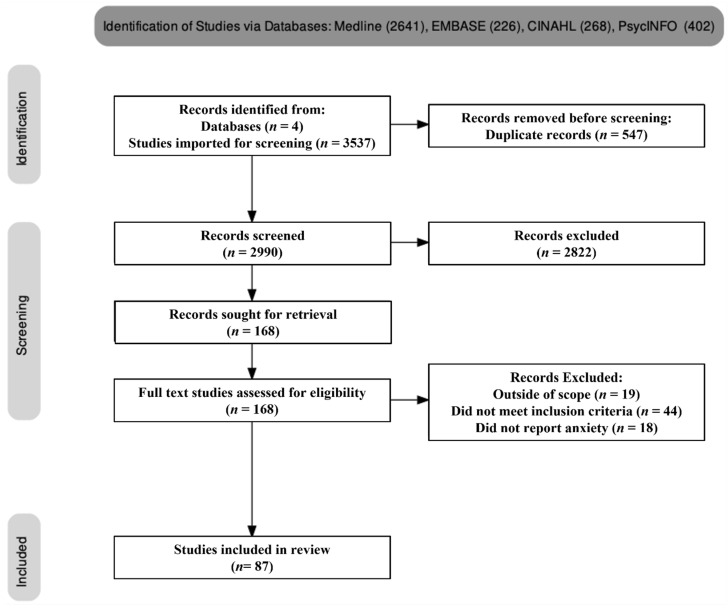
The COVID-19 pandemic has incited a rise in anxiety, with uncertainty regarding the specific impacts and risk factors across multiple populations. A qualitative systematic review was conducted to investigate the prevalence and associations of anxiety in different sample populations in relation to the COVID-19 pandemic. Four databases were utilised in the search (Medline, EMBASE, CINAHL, and PsycINFO). The review period commenced in April 2021 and was finalised on 5 July 2021. A total of 3537 studies were identified of which 87 were included in the review (sample size: 755,180). Healthcare workers had the highest prevalence of anxiety (36%), followed by university students (34.7%), the general population (34%), teachers (27.2%), parents (23.3%), pregnant women (19.5%), and police (8.79%). Risk factors such as being female, having pre-existing mental conditions, lower socioeconomic status, increased exposure to infection, and being younger all contributed to worsened anxiety. The review included studies published before July 2021; due to the ongoing nature of the COVID-19 pandemic, this may have excluded relevant papers. Restriction to only English papers and a sample size > 1000 may have also limited the range of papers included. These findings identify groups who are most vulnerable to developing anxiety in a pandemic and what specific risk factors are most common across multiple populations.
COVID-19 大流行引发了焦虑的增加,对于不同人群的具体影响和风险因素存在不确定性。进行了一项定性系统评价,以调查 COVID-19 大流行期间不同样本人群中焦虑的患病率和相关性。在搜索中使用了四个数据库(Medline、EMBASE、CINAHL 和 PsycINFO)。审查期始于 2021 年 4 月,于 2021 年 7 月 5 日结束。共确定了 3537 项研究,其中 87 项研究纳入了综述(样本量:755180)。医护人员的焦虑患病率最高(36%),其次是大学生(34.7%)、一般人群(34%)、教师(27.2%)、家长(23.3%)、孕妇(19.5%)和警察(8.79%)。一些风险因素,如女性、有先前存在的精神疾病、较低的社会经济地位、增加感染暴露和年龄较小,都导致了焦虑的恶化。综述包括 2021 年 7 月之前发表的研究;由于 COVID-19 大流行仍在继续,这可能排除了相关论文。仅限制英文论文和样本量>1000 也可能限制了纳入论文的范围。这些发现确定了在大流行中最容易出现焦虑的人群,以及在多个人群中最常见的特定风险因素。