Uhteg Katharine, Amadi Adannaya, Forman Michael, Mostafa Heba H
Johns Hopkins Hospital Medical Microbiology Laboratory, Baltimore, Maryland, USA.
Johns Hopkins School of Medicine, Division of Medical Microbiology, Department of Pathology, Johns Hopkins University School of Medicine, Baltimore, Maryland, USA.
Open Forum Infect Dis. 2021 Dec 8;9(3):ofab618. doi: 10.1093/ofid/ofab618. eCollection 2022 Mar.
Our understanding of the cocirculation of infrequently targeted respiratory pathogens and their contribution to symptoms during the coronavirus disease 2019 (COVID-19) pandemic is currently limited. This research aims at (1) understanding the epidemiology of respiratory pathogens since the start of the pandemic, (2) assessing the contribution of non-severe acute respiratory syndrome coronavirus 2 (SARS-CoV-2)/influenza/respiratory syncytial virus (RSV) respiratory pathogens to symptoms, and (3) evaluating coinfection rates in SARS-CoV-2-positive patients, both vaccinated and unvaccinated.
Retrospective analysis of respiratory pathogens identified by the Johns Hopkins Diagnostic Laboratory between December 2019 and October 2021 was performed. In addition, we assessed the contribution of respiratory pathogens other than SARS-CoV-2 to symptomatic disease by retesting 2 cohorts of specimens that were (1) collected from symptomatic patients and (2) received limited respiratory pathogen testing. The first cohort was patients who tested negative by the standard-of-care SARS-CoV-2/influenza/RSV testing. The second was a cohort of SARS-CoV-2-positive, symptomatic, fully COVID-19 immunized and unimmunized patients.
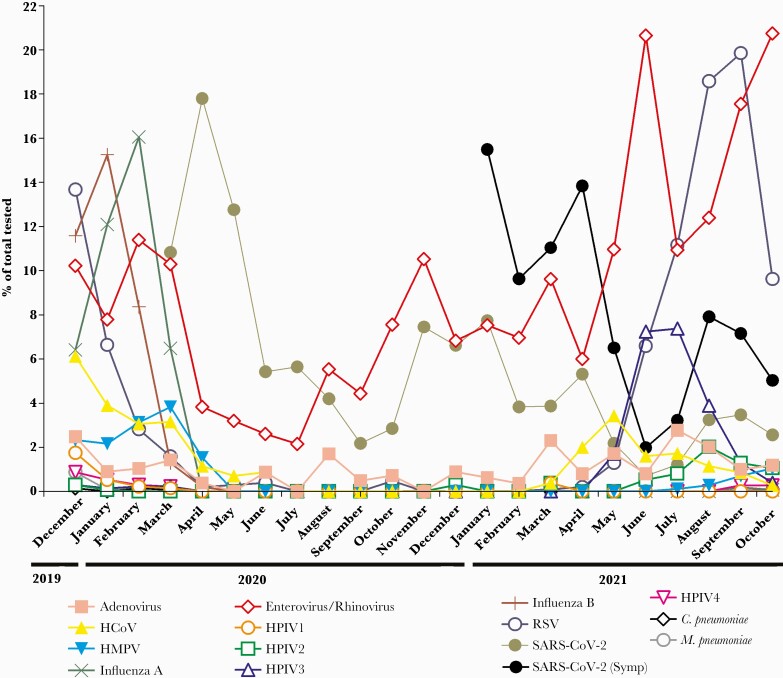
Between December 2019 and October 2021, a total of 11 806, 62 829, and 579 666 specimens were tested for an extended respiratory panel, influenza/RSV with or without SARS-CoV-2 panel, or SARS-CoV-2, respectively. Positivity rates of different targets differed between different months and were impacted by the COVID-19 pandemic. The SARS-CoV-2-negative cohort had 8.5% positivity for other respiratory pathogens that included primarily enterovirus/rhinovirus (5.8%). In the SARS-CoV-2-positive cohort, no other respiratory pathogens were detected.
The COVID-19 pandemic impacted the circulation of certain respiratory pathogens. Other respiratory viral pathogens were associated with symptomatic infections; however, coinfections with SARS-CoV-2 were highly uncommon.
我们目前对2019冠状病毒病(COVID-19)大流行期间较少被检测的呼吸道病原体的共同传播情况及其对症状的影响了解有限。本研究旨在:(1)了解自疫情开始以来呼吸道病原体的流行病学情况;(2)评估非严重急性呼吸综合征冠状病毒2(SARS-CoV-2)/流感/呼吸道合胞病毒(RSV)等呼吸道病原体对症状的影响;(3)评估接种和未接种疫苗的SARS-CoV-2阳性患者的合并感染率。
对约翰霍普金斯诊断实验室在2019年12月至2021年10月期间鉴定的呼吸道病原体进行回顾性分析。此外,我们通过对两组标本进行重新检测,评估了除SARS-CoV-2之外的呼吸道病原体对有症状疾病的影响,这两组标本分别是:(1)从有症状患者中采集的;(2)接受有限呼吸道病原体检测的。第一组是在标准护理SARS-CoV-2/流感/RSV检测中呈阴性的患者。第二组是SARS-CoV-2阳性、有症状、已完全接种和未接种COVID-19疫苗的患者。
在2019年12月至2021年10月期间,分别对11806份、62829份和579666份标本进行了扩展呼吸道病原体检测、含或不含SARS-CoV-2的流感/RSV检测以及SARS-CoV-2检测。不同目标的阳性率在不同月份有所不同,并受到COVID-19大流行的影响。SARS-CoV-2阴性组中,其他呼吸道病原体的阳性率为8.5%,主要包括肠道病毒/鼻病毒(5.8%)。在SARS-CoV-2阳性组中,未检测到其他呼吸道病原体。
COVID-19大流行影响了某些呼吸道病原体的传播。其他呼吸道病毒病原体与有症状感染有关;然而,与SARS-CoV-2的合并感染非常罕见。