Geriatric Unit, Department of Internal Medicine and Geriatrics, University of Palermo, via del Vespro, 141, 90127, Palermo, Italy.
Research and Development Unit, Parc Sanitari Sant Joan de Déu, CIBERSAM, Dr. Antoni Pujadas, 42, 08830, Sant Boi de Llobregat, Barcelona, Spain.
Eur Geriatr Med. 2022 Jun;13(3):633-639. doi: 10.1007/s41999-022-00627-3. Epub 2022 Feb 25.
Mixed findings exist for sarcopenia/quality of life (QoL) relationship. Moreover, the majority of studies in this area have utilized a cross-sectional design or specific clinical populations. Therefore, the aim of the present study was to examine the association between sarcopenia at baseline and QoL at 10 years follow-up in a large representative sample of older English adults.
Sarcopenia was diagnosed as having low handgrip strength and low skeletal muscle mass index. QoL was measured using the CASP (control, autonomy, self-realisation and pleasure)-19, with higher values reflecting higher QoL. Multivariable logistic regression analysis was conducted to assess prospective associations between sarcopenia at baseline and poor QoL at follow-up; generalized linear model with repeated measures was used for reporting mean changes during follow-up between sarcopenia and not.
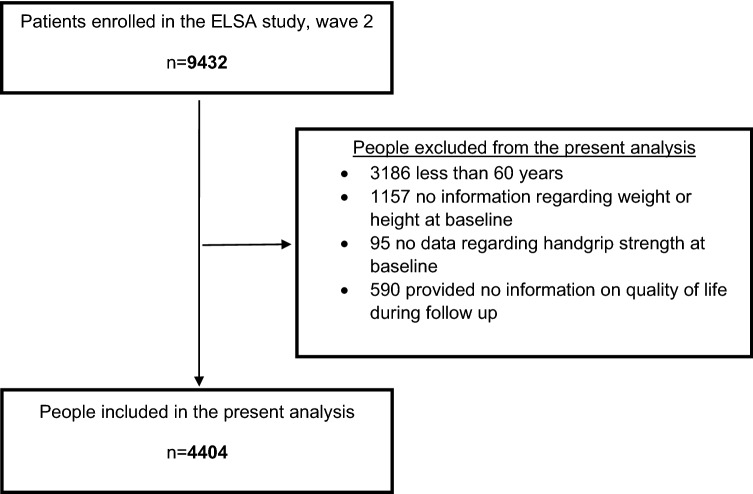
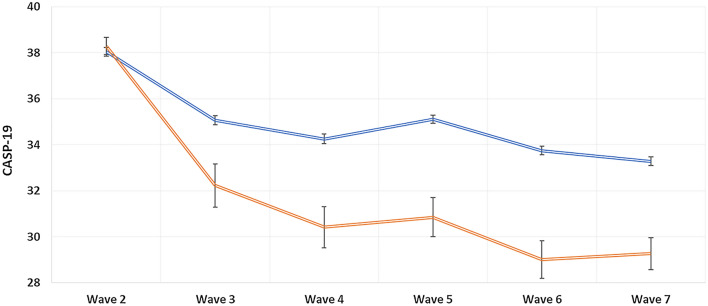
Among 4044 older participants initially included at baseline (mean age: 70.7 years; 55.1% females), 376 had sarcopenia. In the multivariable analysis, after adjusting for several potential confounders, sarcopenia at baseline was associated with a higher incidence of poor QoL (odds ratio, OR = 5.82; 95% confidence interval, CI 3.45-9.82). After matching for QoL values at baseline and adjusting for potential confounders, people with sarcopenia reported significantly lower values in CASP-19 (mean difference = - 3.94; 95% CI - 4.77 to - 3.10).
In this large representative sample of older English adults, it was observed that sarcopenia at baseline was associated with worse scores of QoL at follow-up compared to those without sarcopenia at baseline. It may be prudent to target those with sarcopenia to improve QoL.
关于肌肉减少症/生活质量(QoL)的关系,存在混合的研究结果。此外,该领域的大多数研究都采用了横断面设计或特定的临床人群。因此,本研究的目的是在一个具有代表性的英国老年人大型样本中,检查基线时的肌肉减少症与 10 年随访时的 QoL 之间的关联。
肌肉减少症的诊断标准为握力低和骨骼肌质量指数低。使用 CASP(控制、自主、自我实现和愉悦)-19 来衡量生活质量,分数越高表示生活质量越高。采用多变量逻辑回归分析来评估基线时的肌肉减少症与随访时的生活质量较差之间的前瞻性关联;采用重复测量的广义线性模型来报告随访期间肌肉减少症和非肌肉减少症之间的平均变化。
在最初纳入的 4044 名年龄较大的参与者中(平均年龄 70.7 岁,55.1%为女性),有 376 人患有肌肉减少症。在多变量分析中,在调整了几个潜在的混杂因素后,基线时的肌肉减少症与较差的 QoL 发生率较高相关(优势比,OR=5.82;95%置信区间,CI 3.45-9.82)。在对基线 QoL 值进行匹配并调整潜在混杂因素后,患有肌肉减少症的人在 CASP-19 中的得分明显较低(平均差异=-3.94;95%置信区间-4.77 至-3.10)。
在这个具有代表性的英国老年人大型样本中,观察到与基线时无肌肉减少症相比,基线时的肌肉减少症与随访时的 QoL 评分较差相关。针对那些患有肌肉减少症的人以提高 QoL 可能是明智的。