Jiang Jue, Veeraraghavan Harini
IEEE Trans Med Imaging. 2022 Feb 25;PP. doi: 10.1109/TMI.2022.3154934.
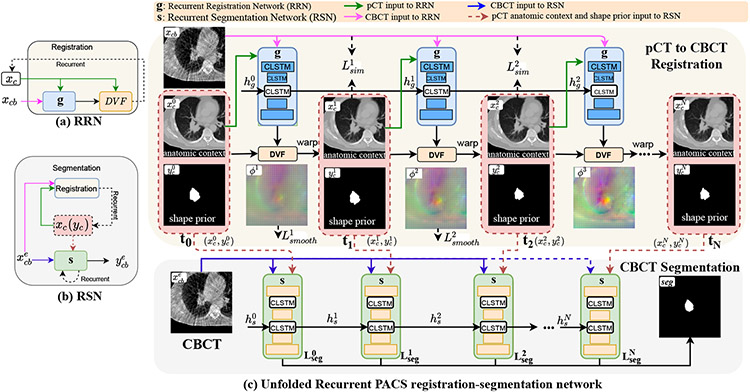
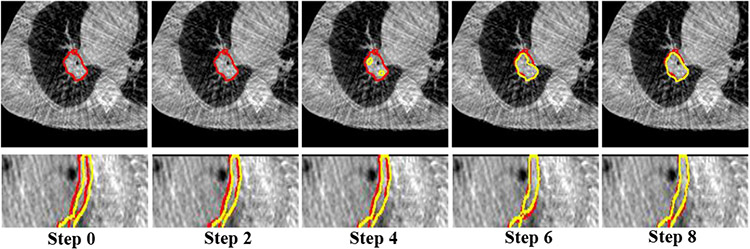
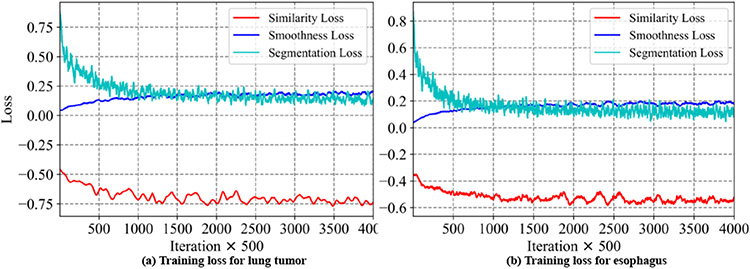
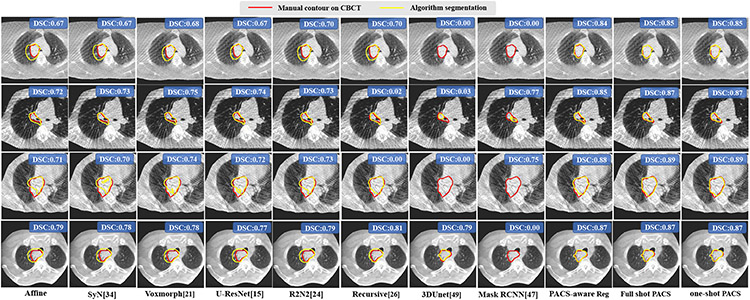
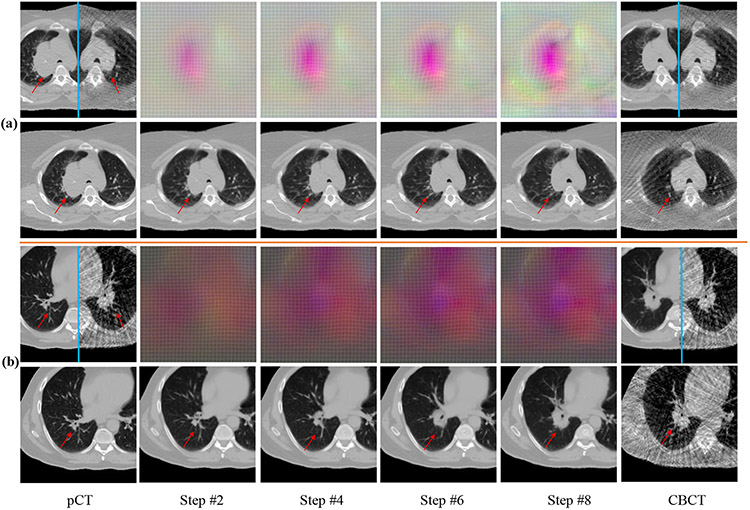
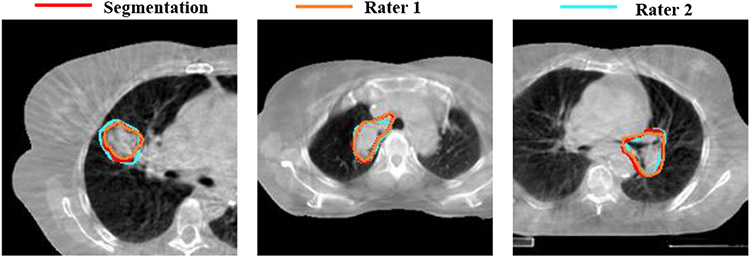
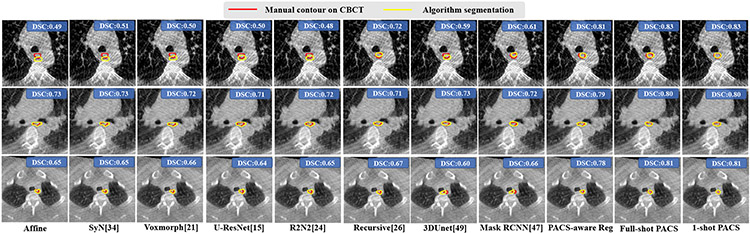
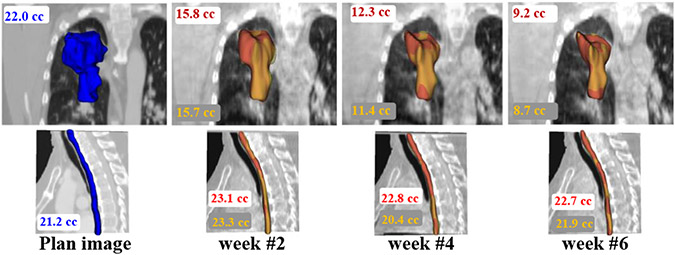
Image-guided adaptive lung radiotherapy requires accurate tumor and organs segmentation from during treatment cone-beam CT (CBCT) images. Thoracic CBCTs are hard to segment because of low soft-tissue contrast, imaging artifacts, respiratory motion, and large treatment induced intra-thoracic anatomic changes. Hence, we developed a novel Patient-specific Anatomic Context and Shape prior or PACS-aware 3D recurrent registration-segmentation network for longitudinal thoracic CBCT segmentation. Segmentation and registration networks were concurrently trained in an end-to-end framework and implemented with convolutional long-short term memory models. The registration network was trained in an unsupervised manner using pairs of planning CT (pCT) and CBCT images and produced a progressively deformed sequence of images. The segmentation network was optimized in a one-shot setting by combining progressively deformed pCT (anatomic context) and pCT delineations (shape context) with CBCT images. Our method, one-shot PACS was significantly more accurate (p <0.001) for tumor (DSC of 0.83 ± 0.08, surface DSC [sDSC] of 0.97 ± 0.06, and Hausdorff distance at 95th percentile [HD95] of 3.97±3.02mm) and the esophagus (DSC of 0.78 ± 0.13, sDSC of 0.90±0.14, HD95 of 3.22±2.02) segmentation than multiple methods. Ablation tests and comparative experiments were also done.
图像引导的自适应肺部放疗需要在治疗期间从锥束CT(CBCT)图像中准确分割肿瘤和器官。由于软组织对比度低、成像伪影、呼吸运动以及治疗引起的胸腔内解剖结构的巨大变化,胸部CBCT很难进行分割。因此,我们开发了一种新颖的针对特定患者的解剖背景和形状先验或PACS感知的3D循环配准分割网络,用于纵向胸部CBCT分割。分割和配准网络在端到端框架中同时进行训练,并使用卷积长短时记忆模型实现。配准网络使用计划CT(pCT)和CBCT图像对以无监督方式进行训练,并生成图像的逐步变形序列。分割网络通过将逐步变形的pCT(解剖背景)和pCT轮廓(形状背景)与CBCT图像相结合,在一次性设置中进行优化。我们的方法,一次性PACS,在肿瘤(DSC为0.83±0.08,表面DSC [sDSC]为0.97±0.06,第95百分位数的豪斯多夫距离[HD95]为3.97±3.02mm)和食管(DSC为0.78±0.13,sDSC为0.90±0.14,HD95为3.22±2.02)分割方面比多种方法显著更准确(p <0.001)。还进行了消融测试和对比实验。