Manfredi Roberto, Bianco Francesco, Bucciarelli Valentina, Ciliberti Giuseppe, Guerra Federico, Schicchi Nicolò, Tavio Marcello, Berton Emanuela, Surace Francesca Chiara, Colaneri Massimo, Gallina Sabina, Pozzi Marco
Cardiology and Arrhythmology Clinic, University Hospital "Umberto I-Lancisi-Salesi", Marche Polytechnic University, 60123 Ancona, Italy.
Department of Pediatric and Congenital Cardiology and Cardiac Surgery-Azienda Ospedaliero, Universitaria "Ospedali Riuniti" di Ancona, 60123 Ancona, Italy.
Vaccines (Basel). 2022 Jan 22;10(2):169. doi: 10.3390/vaccines10020169.
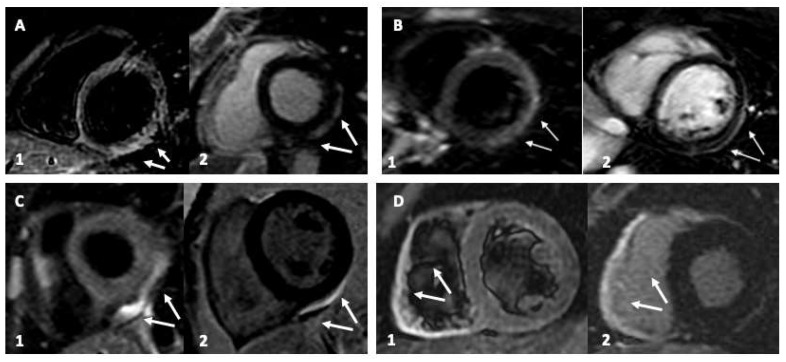
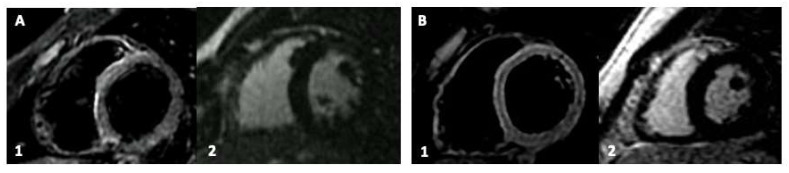
Messenger RNA (mRNA) coronavirus disease of 2019 (COVID-19) vaccines have been recently associated with acute myocarditis, predominantly in healthy young males. Out of 231,989 vaccines administrated in our region (Marche, Italy), we report a case series of six healthy patients (four males and two females, 16.5 years old (Q1, Q3: 15, 18)) that experienced mRNA-COVID-19-vaccines side effects. All patients were hospitalized due to fever and troponins elevation following the second dose of an mRNA-based COVID-19 vaccine. Cardiovascular magnetic resonance (CMR) was performed 72-96 h after vaccination. All patients were treated with colchicine and ibuprofen. Myocarditis was prevalent in males. It was characterized by myocardial edema and late gadolinium enhancement (LGE) in the lateral wall of the left ventricle (LV). One patient showed sole right ventricular involvement, while the females presented with myopericarditis (myocarditis + pericardial effusion). All patients in our series had preserved LV ejection fraction and remained clinically stable during a relatively short inpatient hospital stay. One case presented with atrial tachycardia. At the follow-up, no significant CMR findings were documented after a three-month medical treatment. According to other recently published case series, our report suggests a possible association between acute myocarditis and myopericarditis with mRNA COVID-19 vaccination in healthy young adults and pediatric patients. Not only males are involved, while some arrhythmic manifestations are possible, such as atrial tachycardia. Conversely, we here highlight the benign nature of such complications and the absence of CMR findings after a three-month medical treatment with colchicine and ibuprofen.
信使核糖核酸(mRNA)新型冠状病毒肺炎(COVID-19)疫苗最近与急性心肌炎有关,主要发生在健康的年轻男性中。在我们所在地区(意大利马尔凯)接种的231,989剂疫苗中,我们报告了一组6例健康患者(4例男性和2例女性,年龄16.5岁(四分位距:15, 18岁))出现了mRNA COVID-19疫苗副作用的病例系列。所有患者在接种第二剂基于mRNA的COVID-19疫苗后因发热和肌钙蛋白升高而住院。在接种疫苗72 - 96小时后进行了心血管磁共振(CMR)检查。所有患者均接受了秋水仙碱和布洛芬治疗。心肌炎在男性中更为常见。其特征为左心室(LV)侧壁心肌水肿和延迟钆增强(LGE)。1例患者仅右心室受累,而女性表现为心肌心包炎(心肌炎 + 心包积液)。我们系列中的所有患者左心室射血分数均保留,且在相对较短的住院期间临床保持稳定。1例患者出现房性心动过速。在随访中,经过三个月的药物治疗后,CMR未记录到明显异常。根据其他最近发表的病例系列,我们的报告表明,在健康的年轻人和儿童患者中,急性心肌炎和心肌心包炎可能与mRNA COVID-19疫苗接种有关。不仅男性会受累,还可能出现一些心律失常表现,如房性心动过速。相反,我们在此强调此类并发症的良性性质,以及在使用秋水仙碱和布洛芬进行三个月药物治疗后CMR未出现异常结果。