School of Marxism, Xinjiang University, Urumqi, China.
Department of Public Instruction, Shandong College of Traditional Chinese Medicine, Yantai, China.
Front Public Health. 2022 Feb 11;10:835210. doi: 10.3389/fpubh.2022.835210. eCollection 2022.
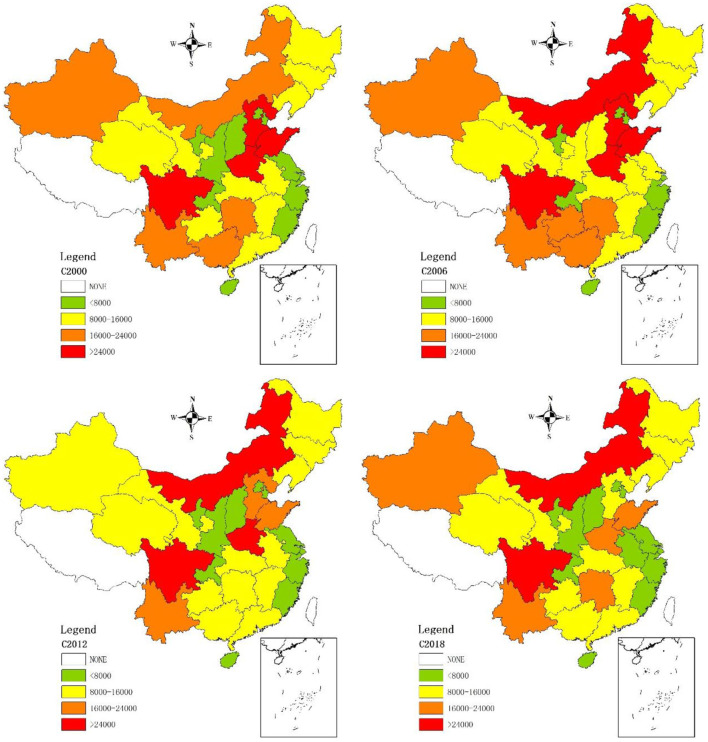
Carbon emissions of animal husbandry have been gaining increasing attention due to their high share in global carbon emissions. In this regard, it is essential to assess the regional differences, dynamic evolution patterns, convergence characteristics, and the impact of livestock structure on carbon emissions of animal husbandry. Using data from 30 provincial administrative regions from 2000 to 2018 in China, this study employs the Thiel index method, kernel density analysis, and convergence analysis to quantify the impact of livestock structure on carbon emissions of animal husbandry. The statistical results reveal that carbon emissions of animal husbandry exhibit a rising and declining trend. Specifically, the carbon emissions of animal husbandry are highest in agricultural areas (with a declining trend), followed by agro-pastoral areas (with a declining trend), and the pastoral areas (with a rising trend). It is further revealed that there are no δ convergence and β convergence of carbon emissions of animal husbandry. Finally, essential and useful policy recommendations are put forward to inhibit carbon emissions of animal husbandry.
畜牧业碳排放因其在全球碳排放中占比较高而受到越来越多的关注。在这方面,评估畜牧业碳排放的区域差异、动态演变模式、收敛特征以及畜牧业结构对其的影响至关重要。本研究利用中国 2000 年至 2018 年 30 个省级行政区的数据,采用泰尔指数法、核密度分析和收敛分析方法,量化了畜牧业结构对畜牧业碳排放的影响。统计结果表明,畜牧业碳排放呈上升和下降趋势。具体来说,农业区的畜牧业碳排放最高(呈下降趋势),其次是农牧交错区(呈下降趋势),最后是牧区(呈上升趋势)。进一步表明,畜牧业碳排放不存在 δ 收敛和 β 收敛。最后,提出了一些有必要且有用的政策建议,以抑制畜牧业碳排放。