Gokce Cemile, Gurcan Cansu, Delogu Lucia Gemma, Yilmazer Acelya
Department of Biomedical Engineering, Ankara University, Ankara, Turkey.
Stem Cell Institute, Ankara University, Ankara, Turkey.
Front Cardiovasc Med. 2022 Feb 11;9:802551. doi: 10.3389/fcvm.2022.802551. eCollection 2022.
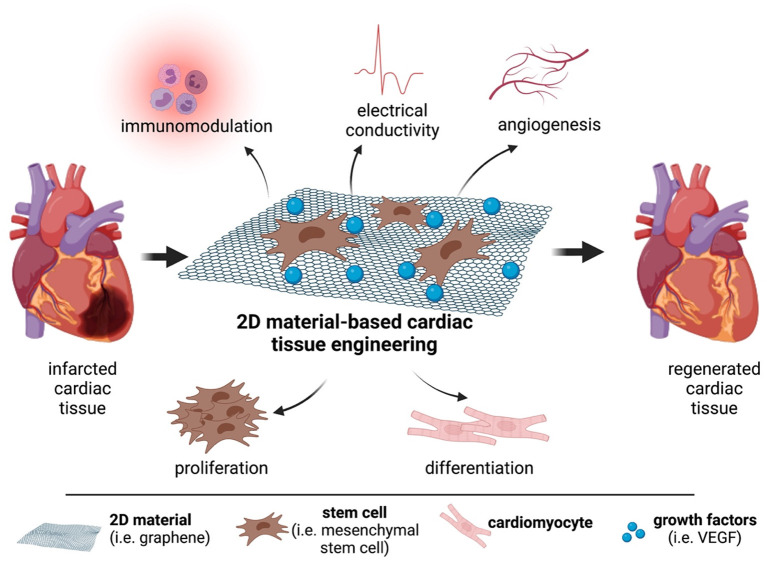
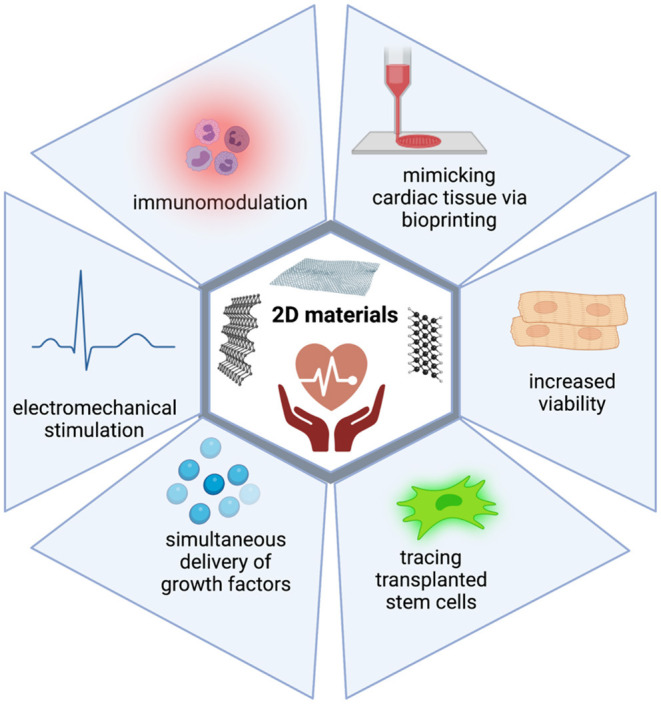
Cardiovascular diseases (CVDs) have a massive impact on human health. Due to the limited regeneration capacity of adult heart tissue, CVDs are the leading cause of death and disability worldwide. Even though there are surgical and pharmacological treatments for CVDs, regenerative strategies are the most promising approaches and have the potential to benefit millions of people. As in any other tissue engineering approach, the repair and regeneration of damaged cardiac tissues generally involve scaffolds made up of biodegradable and biocompatible materials, cellular components such as stem cells, and growth factors. This review provides an overview of biomaterial-based tissue engineering approaches for CVDs with a specific focus on the potential of 2D materials. It is essential to consider both physicochemical and immunomodulatory properties for evaluating the applicability of 2D materials in cardiac tissue repair and regeneration. As new members of the 2D materials will be explored, they will quickly become part of cardiac tissue engineering technologies.
心血管疾病(CVDs)对人类健康有着巨大影响。由于成体心脏组织的再生能力有限,心血管疾病是全球范围内死亡和残疾的主要原因。尽管有针对心血管疾病的手术和药物治疗方法,但再生策略是最具前景的方法,有可能使数百万人受益。与任何其他组织工程方法一样,受损心脏组织的修复和再生通常涉及由可生物降解和生物相容性材料制成的支架、细胞成分(如干细胞)以及生长因子。本综述概述了基于生物材料的心血管疾病组织工程方法,特别关注二维材料的潜力。在评估二维材料在心脏组织修复和再生中的适用性时,必须考虑其物理化学和免疫调节特性。随着二维材料新成员的不断探索,它们将迅速成为心脏组织工程技术的一部分。