Department of Clinical Pathology, Clinical Microbiology Unit, Faculty of Medicine, Mansoura University, Egypt.
Department of Pathology, Faculty of Medicine, Mansoura University, Egypt.
Asian Pac J Cancer Prev. 2022 Feb 1;23(2):641-650. doi: 10.31557/APJCP.2022.23.2.641.
Epstein-Barr virus (EBV) has been implicated in the development of breast cancer (BC) since 1995. It is classified into A/B genotypes, C/D subtypes, and F/f variants according to variations in its genome.
To determine the distribution difference of EBV types between BC patients and healthy controls in Egypt and to detect the association between different EBV types and BC characteristics.
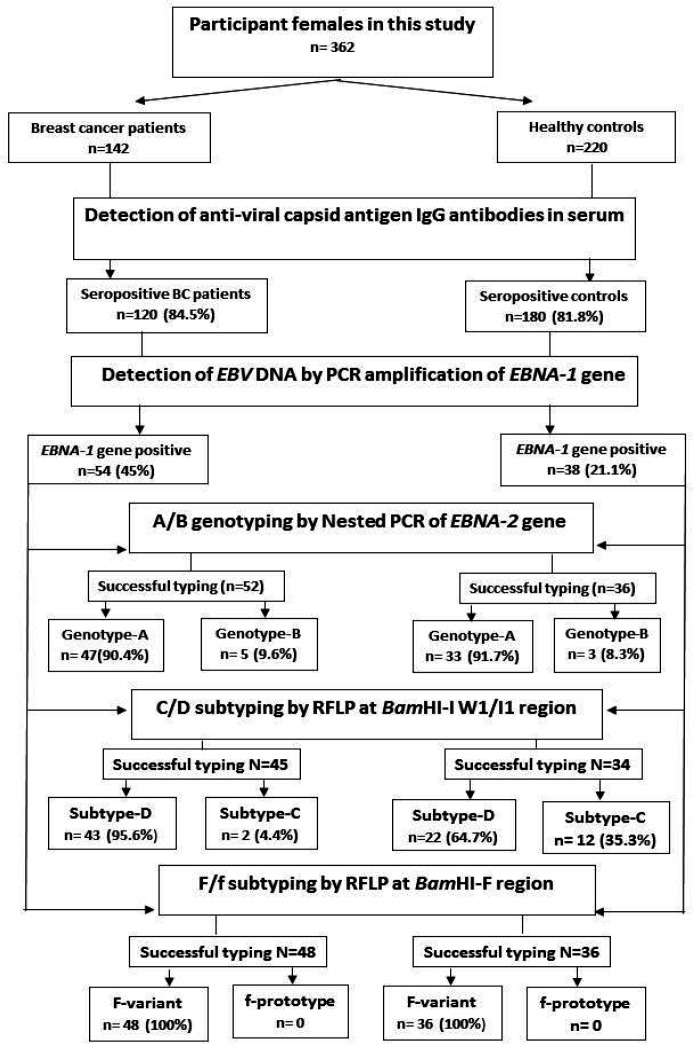
Three hundred and sixty-two participants (142 BC patients and 220 controls) were enrolled in this study. All participants were screened for EBV infection by determination of viral-capsid-IgG antibodies in their sera. EBNA-1 gene was detected by PCR in tumor biopsies of seropositive patients and in peripheral blood mononuclear cells of controls. A/B genotyping of EBV was performed by nested-PCR targeting the EBNA-2 gene. C/D subtypes and F/f variants were identified by Restriction fragment length polymorphism at BamHI-I W1/I1 and BamHI-F regions of EBV genome, respectively.
Among 362 participants, 300(82.9%) were EBV-seropositive, including 120/142(84.5%) of the BC patients and 180/220(81.8 %) of the controls. EBNA-1 gene was positive in 54(45%) of seropositive BC patients and in 38(21.1%) of seropositive controls. There was a significant association of EBNA-1 gene with breast cancer (OR=3.05, 95%CI=1.84-5.07). Moreover, EBNA-1 gene positivity was significantly associated with the more aggressive tumors. Genotype-A and prototype-F were predominant among patients (90.4%, 100%, respectively) as well as among controls (91.7%, 100%, respectively) with no statistical significant association with BC risk. However, subtype-D was significantly more frequent in patients (95.6%) than in controls (64.7%) and was significantly associated with a higher BC risk as compared to subtype-C (OR=11.7, 95%CI=2.4-57.08). Subtype-D was significantly associated with higher grades tumors (100% among grade III), with progesteron receptor-negative tumors and with HER2-positive tumors (100% for each). The combined genotypes that significantly associated with BC risk were ADF (OR=4.9) and BDF (OR=5.5).
Subtype-D of EBV could be the only EBV type implicated in BC development among Egyptian females and associated more with poor prognosis.
自 1995 年以来,爱泼斯坦-巴尔病毒(EBV)已被认为与乳腺癌(BC)的发展有关。根据其基因组的变异,它可分为 A/B 基因型、C/D 亚型和 F/f 变体。
确定 EBV 类型在埃及 BC 患者和健康对照者中的分布差异,并检测不同 EBV 类型与 BC 特征之间的关联。
本研究纳入了 362 名参与者(142 名 BC 患者和 220 名对照者)。所有参与者均通过检测血清中病毒衣壳 IgG 抗体来筛查 EBV 感染。对 EBV 阳性患者的肿瘤活检和对照者的外周血单个核细胞进行 EBNA-1 基因的 PCR 检测。通过针对 EBV 基因组中 EBNA-2 基因的巢式 PCR 进行 EBV 的 A/B 基因分型。通过限制性片段长度多态性在 BamHI-I W1/I1 和 BamHI-F 区域分别鉴定 C/D 亚型和 F/f 变体。
在 362 名参与者中,300 名(82.9%)为 EBV 血清阳性,包括 120/142 名(84.5%)BC 患者和 180/220 名(81.8%)对照者。在 EBV 阳性的 BC 患者中,有 54 名(45%)和 EBV 阳性的对照者中,有 38 名(21.1%)EBNA-1 基因阳性。EBNA-1 基因与乳腺癌显著相关(OR=3.05,95%CI=1.84-5.07)。此外,EBNA-1 基因阳性与侵袭性更强的肿瘤显著相关。在患者中,A 型和原型 F 型(分别为 90.4%,100%)以及对照者(分别为 91.7%,100%)中均占主导地位,与 BC 风险无统计学显著相关性。然而,D 亚型在患者中(95.6%)显著高于对照组(64.7%),与 C 亚型相比,D 亚型与更高的 BC 风险显著相关(OR=11.7,95%CI=2.4-57.08)。D 亚型与更高的肿瘤分级(100%为 3 级)、孕激素受体阴性肿瘤和 HER2 阳性肿瘤显著相关(各为 100%)。与 BC 风险显著相关的组合基因型为 ADF(OR=4.9)和 BDF(OR=5.5)。
埃及女性中,D 型 EBV 可能是唯一与 BC 发展相关的 EBV 类型,与不良预后的关系更密切。